
DbcultAccessing Vault...
Director's Spotlight
Senior Film Conservator
Director's Spotlight: United States
A Deep Dive into the 1916 Vision of Ralph Ince
Peeling back the layers of Ralph Ince's The Ninety and Nine exposes the collaborative alchemy between Ralph Ince and the 1916 creative team. Anchored by a narrative that is both personal and universal, it reinforces the idea that cinema is a medium of infinite possibilities.
In The Ninety and Nine, Ralph Ince pushes the boundaries of conventional narrative. The film's unique approach to its subject matter has sparked endless debates and interpretations among cinephiles and critics alike.
The visual language of The Ninety and Nine is defined by its use of shadows and framing, a hallmark of Ralph Ince's style. By utilizing a 1916-era palette, the film creates an immersive experience that perfectly complements its cult themes.
| Cinematography | Noir-Inspired |
| Soundtrack | Diegetic |
| Editing | Rhythmic |
| Art Direction | Naturalist |
Visualizing the convergence of Ralph Ince's style and the core cult narrative.
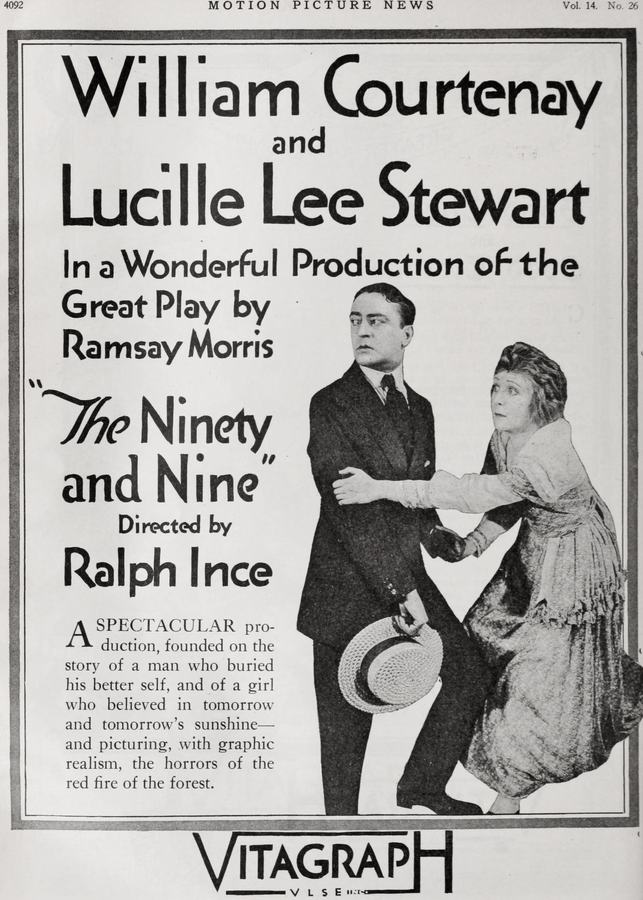
Ruth Blake lives with her father and mother in Marlow, a small town in the west. To this town comes Tom Silverton from the city. He is always intoxicated, and Ruth sets to work to reform Tom. To Marlow comes Kate Van Dyke, a city girl, and her fiancé. They stop at the Blake home. When Tom seen Kate there is mutual recognition, but when questioned both deny they have ever met one another before. Tom starts to drink heavily again, and Ruth drags him out of the tavern one day and sends him home. Her father, infuriated, forbids her to ever see the man again. There is a big barn dance, and all go, except Ruth, who refuses to go because Tom has not been invited. Blake warns his daughter again if he ever sees Silverton in his house he will kill him. Tom comes to bid Ruth goodbye for he is going away. She makes a final plea with him to reform, and he promises to make one more effort. Spying on the two is Buddy Bryson, a half-witted boy in love with Ruth. He hurries to the barn dance and tells Abner that Tom is in the house. Abner comes back. Ruth, afraid of her father's wrath, persuades Tom to escape via her bedroom window. Abner comes and she denies he has been there. He learns the truth and orders her from his home. Tom goes to the next town, Cleves, and he is there but a short time when he hears that Ruth is stopping with her aunt there. To her he goes. He breaks down and reveals the mystery that has surrounded him. In New York he was in love with a beautiful girl, Kate Van Dyke. Her weak brother committed a murder, and she begets him to flee and take the blame, for if he did so she would join him later and marry him. He fled, but instead of joining him she becomes engaged to another. He sought consolation in drink. But he is free now for her brother died in a foreign country, and before he died he confessed his guilt. In Marion the people are suffering the most intense heat of the summer. A forest fire breaks out and the entire town is threatened. They summon help, but none can be secured. Ruth and Tom learn of the predicament of Marion. They have been told there are freight cars there and all they need is an engine. Tom and Ruth secure an engine, and Tom drives through the raging forest fire and saves the population before the town is wiped out.
Decades after its release, The Ninety and Nine remains a vital piece of the cinematic puzzle. Its influence can be seen in countless modern works, solidifying Ralph Ince's status as a master of the craft in United States and beyond.