
DbcultAccessing Vault...
Director's Spotlight
Senior Film Conservator
Director's Spotlight: United States
A Deep Dive into the 1917 Vision of Richard Ridgely
Deciphering the layers of The Great Bradley Mystery (1917) reveals a monumental shift in cult filmmaking spearheaded by Richard Ridgely. With its avant-garde structure and atmospheric tension, offering layers of thematic complexity that demand repeated viewing.
In The Great Bradley Mystery, Richard Ridgely pushes the boundaries of conventional narrative. The film's unique approach to its subject matter has sparked endless debates and interpretations among cinephiles and critics alike.
The visual language of The Great Bradley Mystery is defined by its use of shadows and framing, a hallmark of Richard Ridgely's style. By utilizing a 1917-era palette, the film creates an immersive experience that perfectly complements its cult themes.
| Cinematography | Noir-Inspired |
| Soundtrack | Minimalist |
| Editing | Slow-Burn |
| Art Direction | Brutalist |
Visualizing the convergence of Richard Ridgely's style and the core cult narrative.
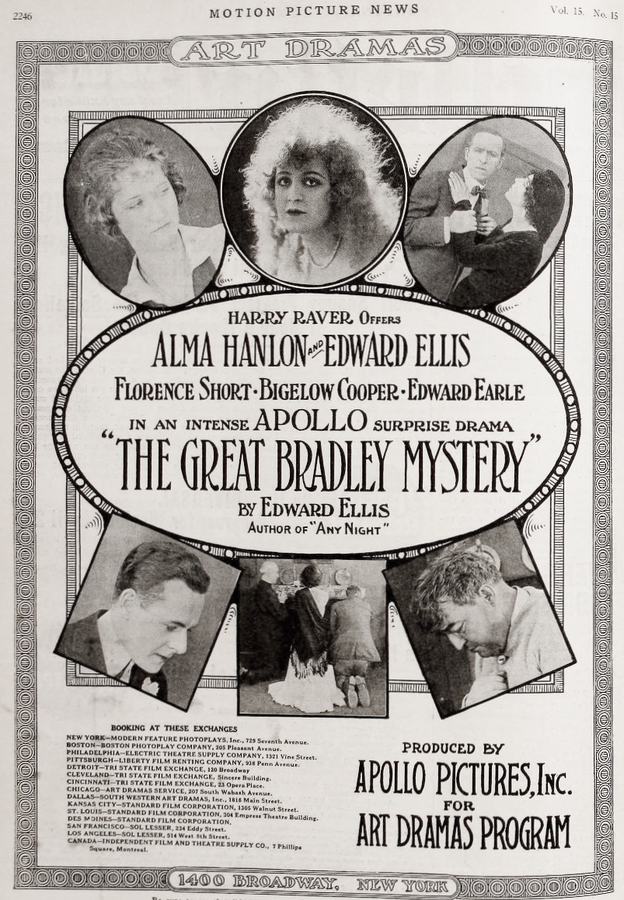
Two business partners, Bradley and Collier, are in love with Mary. Bradley gives Collier to understand that he is engaged to her, and it is this only that prevents Collier declaring his love. Lola, a young Italian girl whom Bradley has betrayed, comes to the office to beg him to marry her. Mary hears the girl's plea, and comes into the office. Here she sees Collier talking to the girl. He has come, not knowing the situation, and Bradley has slipped out another door. Mary believes that Collier is the guilty man, and refuses to speak to him. Bradley encourages her in this idea and begs her to marry him. Collier, heartbroken, has left for the west, in order to recover his lost spirits. Bradley has a fake telegram sent to him announcing Collier's death, for he knows that he has no chance with Mary as long as his rival is alive. After some time Mary marries him. But almost immediately afterward she meets Lola, who is dying in a hospital. Lola begs her to care for Bradley's child, and she learns too late that her husband deceived her. She returns and denounces him. He, knowing that the scandal is sure to get out, orders her to prepare for a trip to Europe. He sells his, as well as Collier's, share in the company. Lola's father, crazed by his daughter's death, comes to Bradley's office and sneaks in through the basement window. The next day Bradley is found dead. Tony is arrested. Collier returns and meets Mary. Together they go to the police and ask for the release of Tony. Collier tells of his arrival the night before and his knowledge of the sale of the company. He went to confront Bradley, and they struggled. Bradley drew a revolver, which went off in his hand, killing him. Collier had tried to make the case look like suicide, until he learned that Tony was being held. The police assure Collier that his innocence will be easily established, and he and Mary face the future with the knowledge that a long-deferred happiness will be theirs.
Decades after its release, The Great Bradley Mystery remains a vital piece of the cinematic puzzle. Its influence can be seen in countless modern works, solidifying Richard Ridgely's status as a master of the craft in United States and beyond.