
DbcultAccessing Vault...
Director's Spotlight
Senior Film Conservator
Director's Spotlight: United States
A Deep Dive into the 1926 Vision of Robert De Lacey
The Drama DNA of Out of the West is a reflection of United States's the subversive storytelling techniques employed by Robert De Lacey in 1926. Breaking the traditional rules of Drama engagement, it leaves an indelible mark on the soul of the viewer.
In Out of the West, Robert De Lacey pushes the boundaries of conventional narrative. The film's unique approach to its subject matter has sparked endless debates and interpretations among cinephiles and critics alike.
To fully appreciate Out of the West, one must consider the cinematic climate of 1926. During this period, United States was undergoing significant artistic shifts, and Robert De Lacey was at the forefront of this Drama movement, often challenging established norms.
| Cinematography | High-Contrast |
| Soundtrack | Experimental |
| Editing | Elliptical |
| Art Direction | Expressionist |
Visualizing the convergence of Robert De Lacey's style and the core Drama narrative.
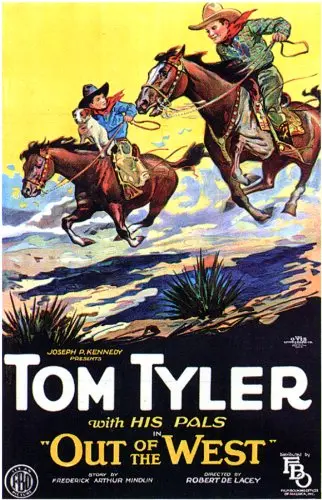
John O'Connor and Jim Rollins, rival ranchmen, each has a baseball team, though Rollins' usually wins because O'Connor's foreman and pitcher, Bide Goodrich, is paid by Rollins to throw the game. When Tom Hanley and his grandmother settle on O'Connor's ranch, the boss discovers that he is a good pitcher; and Rollins, who has bet heavily on the Fourth of July game, plots to eliminate Tom. While riding with O'Connor's daughter, Bernice, Tom is roped and captured but overcomes his attacker; he makes friends with Frankie, the O'Connor mascot, and his pup, Sitting Bull. On the night of a dance Tom is kidnapped and taken to a cave, but through Frankie's vigilance he is freed and races to the game in time to win it with a home run. Goodrich kidnaps Bernice from the ranch, but Tom pursues and overcomes the kidnapper; later, he refuses an offer to play in big league and is happily united with Bernice.
Decades after its release, Out of the West remains a vital piece of the cinematic puzzle. Its influence can be seen in countless modern works, solidifying Robert De Lacey's status as a master of the craft in United States and beyond.