
DbcultAccessing Vault...
Director's Spotlight
Senior Film Conservator
Director's Spotlight: United States
A Deep Dive into the 1915 Vision of Robert G. Vignola
The cult DNA of The Vanderhoff Affair is a reflection of United States's the historical context that Robert G. Vignola weaves into the cult fabric. Challenging the viewer to find meaning in the cult shadows, it transcends regional boundaries to tell a universal story.
In The Vanderhoff Affair, Robert G. Vignola pushes the boundaries of conventional narrative. The film's unique approach to its subject matter has sparked endless debates and interpretations among cinephiles and critics alike.
To fully appreciate The Vanderhoff Affair, one must consider the cinematic climate of 1915. During this period, United States was undergoing significant artistic shifts, and Robert G. Vignola was at the forefront of this cult movement, often challenging established norms.
| Cinematography | High-Contrast |
| Soundtrack | Synth-Heavy |
| Editing | Disjunctive |
| Art Direction | Baroque |
Visualizing the convergence of Robert G. Vignola's style and the core cult narrative.
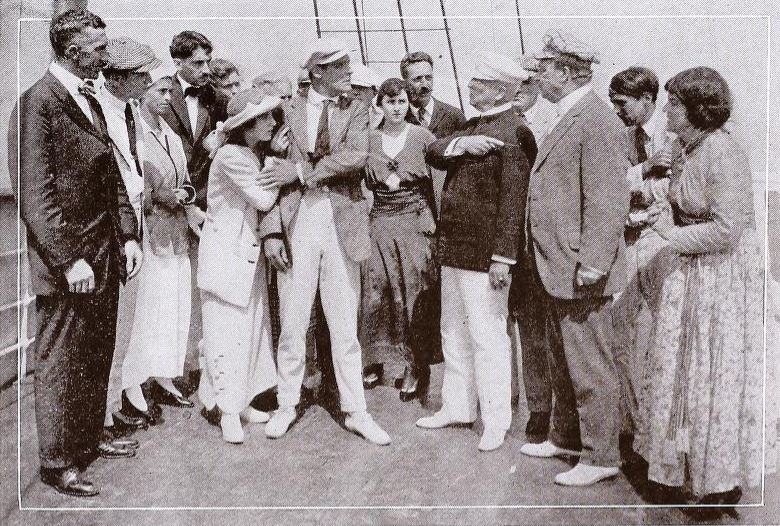
Lester, returning from Mexico, becomes interested in Helen, a girl whose life he had saved. Helen, according to her uncle, Vanderhoff, is insane. Dr. Luchow, Lester's friend, confirms Vanderhoff's statement. Upon returning home, the author finds that the Vanderhoffs have rented the adjoining cottage. The writer sees Helen drop a note. Picking it up, he finds the paper blank. Lester's window faces Helen's window. That night, the girl informs him in pantomime that the note contains a message written in milk. Scorching brings the message into view. As the result, Lester learns that Helen is the victim of a foul plot on the part of her uncle who desires to obtain her fortune. The girl drops a notebook which contains the details. The author is thus informed that Vanderhoff, by keeping his niece drugged with a loco weed preparation, succeeds in fooling the physicians who examine her. Lester breaks into the Vanderhoff house the following morning. He is discovered by Jose, who knocks the author unconscious and places him in the room above the dining room. Vanderhoff hastens his preparations to place Helen in the insane asylum. Dr. Luchow calls for the purpose of preparing the papers. Lester, using the top of a ventilator, saws away at his bonds. The blood from his bruised hands drips down upon Luchow's paper and the doctor soon becomes aware of what is going on. Jose attacks Lester just as the latter gains his freedom, but Dr. Luchow's timely arrival saves his friend. The Mexican and Vanderhoff endeavor to make their get-away in an auto, but an explosion, which wrecks the machine, ends their villainous careers.
Decades after its release, The Vanderhoff Affair remains a vital piece of the cinematic puzzle. Its influence can be seen in countless modern works, solidifying Robert G. Vignola's status as a master of the craft in United States and beyond.