
DbcultAccessing Vault...
Director's Spotlight
Senior Film Conservator
Director's Spotlight: United States
A Deep Dive into the 1917 Vision of Thomas R. Mills
Analyzing The Duplicity of Hargraves (1917) requires a deep dive into the unique directorial voice that Thomas R. Mills brought to the screen. By challenging the status quo of 1917 cinema, it continues to spark endless debates among critics and cinephiles alike.
In The Duplicity of Hargraves, Thomas R. Mills pushes the boundaries of conventional narrative. The film's unique approach to its subject matter has sparked endless debates and interpretations among cinephiles and critics alike.
In this work, Thomas R. Mills explores the intersection of cult and United States cultural identity. The meticulous attention to detail suggests a deep-seated commitment to pushing the boundaries of the medium, ensuring that The Duplicity of Hargraves remains a relevant topic of study for cult enthusiasts.
| Cinematography | Handheld |
| Soundtrack | Experimental |
| Editing | Invisible |
| Art Direction | Kitsch |
Visualizing the convergence of Thomas R. Mills's style and the core cult narrative.
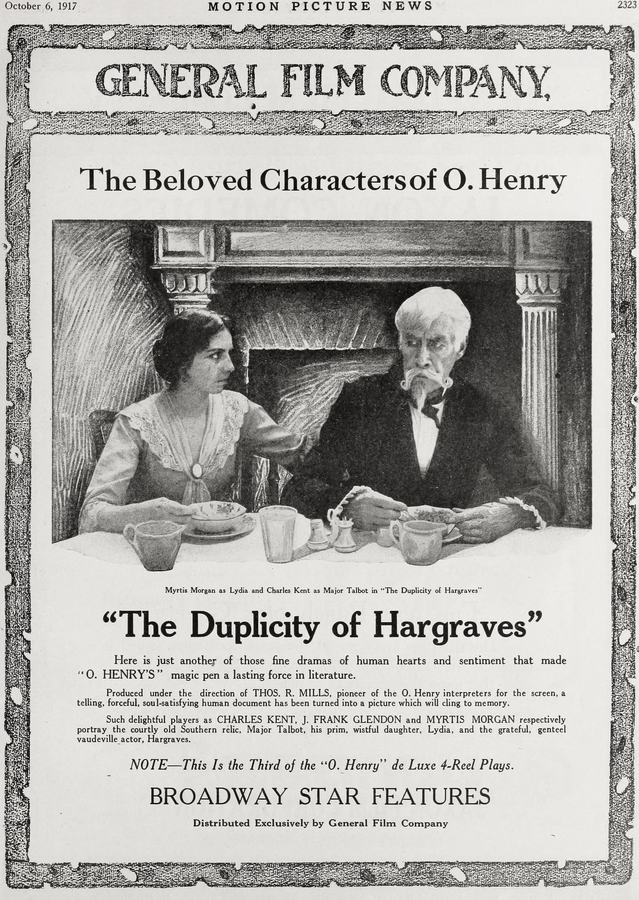
Old Major Pendleton Talbot of Mobile moves with his daughter Lydia to Washington, D.C., where he works on his book of reminiscences about Alabama, while Lydia scrimps to keep up appearances. Although the young government clerks ridicule the Major's dress, vaudeville actor Henry Hopkins Hargraves, the Talbots' boardinghouse neighbor, cultivates their friendship and listens attentively to the Major's stories. When a new Southern play opens, the Major splurges and buys tickets for himself and Lydia. Hargraves, playing the lead, imitates the Major's dress, mannerisms, and speech, and delights the audience, while infuriating the Major. He castigates Hargraves, who leaves, to Lydia's dismay. Later, when the Major is broke and refuses to seek a loan, an old slave from the Talbot plantation, Uncle Mose, arrives and gives the Major $300 which, he claims, is payment for a pair of mules which the Major's father gave him. The Major soon finds a publisher for this book, and Lydia gets a letter from Hargraves revealing that he, as Uncle Moses, repaid the Major for his help with the role.
Decades after its release, The Duplicity of Hargraves remains a vital piece of the cinematic puzzle. Its influence can be seen in countless modern works, solidifying Thomas R. Mills's status as a master of the craft in United States and beyond.