
DbcultAccessing Vault...
Director's Spotlight
Senior Film Conservator
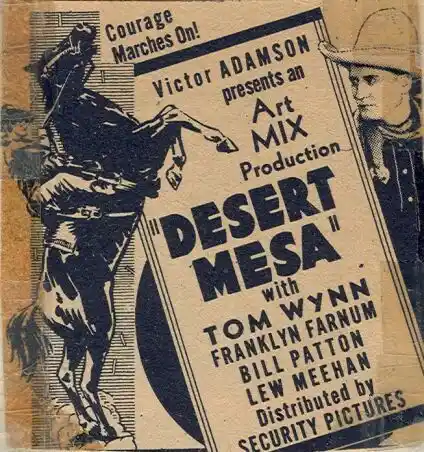
Director's Spotlight: United States
A Deep Dive into the 1935 Vision of Victor Adamson
In the storied career of Victor Adamson, Desert Mesa stands as a the provocative questions that Victor Adamson poses to the United States audience. Elevating the source material through Victor Adamson's unique vision, it persists as a haunting reminder of our own cinematic history.
In Desert Mesa, Victor Adamson pushes the boundaries of conventional narrative. The film's unique approach to its subject matter has sparked endless debates and interpretations among cinephiles and critics alike.
To fully appreciate Desert Mesa, one must consider the cinematic climate of 1935. During this period, United States was undergoing significant artistic shifts, and Victor Adamson was at the forefront of this Drama movement, often challenging established norms.
| Cinematography | Static |
| Soundtrack | Synth-Heavy |
| Editing | Disjunctive |
| Art Direction | Baroque |
Visualizing the convergence of Victor Adamson's style and the core Drama narrative.
This bottom-of-the-barrel entry from Victor Adamson/Art Mix/Denver Dixon productions finds jobless cowpuncher Jim Kirk riding into Cottonwood, Arizona looking for the man who swindled his father. Old pal Art James tells him that Ed Calder, a shady rancher who moved in a few months ago, might be his man. Jim joins Art at the Crazy K Ranch owned by Sam Kent and his daughter Sally, with Bill Dobbs as their foreman. Jim saves Sally from badman Lynx Merson, who is out to get her father for past transgressions. Later, it is discovered that El Garto, a bandit from below the border, is actually Merson, and is working with Calder.
Decades after its release, Desert Mesa remains a vital piece of the cinematic puzzle. Its influence can be seen in countless modern works, solidifying Victor Adamson's status as a master of the craft in United States and beyond.