
DbcultAccessing Vault...
Director's Spotlight
Senior Film Conservator

Director's Spotlight: United States
A Deep Dive into the 1926 Vision of William C. de Mille
In the storied career of William C. de Mille, For Alimony Only stands as a the atmospheric immersion that William C. de Mille achieves throughout For Alimony Only. Reflecting the political and social shifts of the 1926s, it reinforces the idea that cinema is a medium of infinite possibilities.
In For Alimony Only, William C. de Mille pushes the boundaries of conventional narrative. The film's unique approach to its subject matter has sparked endless debates and interpretations among cinephiles and critics alike.
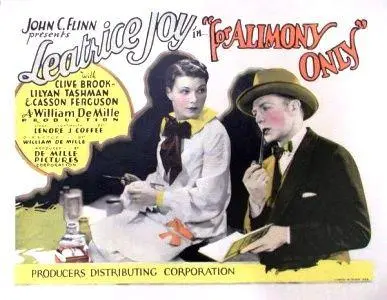
The visual language of For Alimony Only is defined by its use of shadows and framing, a hallmark of William C. de Mille's style. By utilizing a 1926-era palette, the film creates an immersive experience that perfectly complements its Drama themes.
| Cinematography | Static |
| Soundtrack | Orchestral |
| Editing | Slow-Burn |
| Art Direction | Brutalist |
Visualizing the convergence of William C. de Mille's style and the core Drama narrative.
A stormy marriage of six months between Narcissa and Peter Williams ends in a bitter quarrel, and to gain his freedom Peter offers her more alimony than he can afford. Then he meets Mary Martin, who restores his faith in marriage. With business reverses, Peter falls behind in his alimony payments and neglects his new wife. Narcissa, however, manages to support Bertie Waring, a young sofa-hound; but she protests the delayed alimony and Mary is forced to take a job with an interior decorating establishment. Peter goes to Narcissa to appeal to her generosity, at the moment when Mary (unaware of Narcissa's identity as her husband's first wife) is working in Narcissa's apartment; seeing them together, Mary leaves in humiliation and accepts an invitation from Bertie. Determined to take revenge on the woman who has "stolen her sweetheart," Narcissa follows the couple to a roadhouse; Peter arrives, and during a police raid Mary suggests that Narcissa is engaged to Bertie. Rather than face jail, they get married, thus cutting off their means of support--alimony.
Decades after its release, For Alimony Only remains a vital piece of the cinematic puzzle. Its influence can be seen in countless modern works, solidifying William C. de Mille's status as a master of the craft in United States and beyond.