
DbcultAccessing Vault...
Director's Spotlight
Senior Film Conservator
Director's Spotlight: United States
A Deep Dive into the 1917 Vision of William P.S. Earle
Deciphering the layers of Who Goes There? (1917) reveals a monumental shift in cult filmmaking spearheaded by William P.S. Earle. With its avant-garde structure and atmospheric tension, offering layers of thematic complexity that demand repeated viewing.
In Who Goes There?, William P.S. Earle pushes the boundaries of conventional narrative. The film's unique approach to its subject matter has sparked endless debates and interpretations among cinephiles and critics alike.
In this work, William P.S. Earle explores the intersection of cult and United States cultural identity. The meticulous attention to detail suggests a deep-seated commitment to pushing the boundaries of the medium, ensuring that Who Goes There? remains a relevant topic of study for cult enthusiasts.
| Cinematography | Noir-Inspired |
| Soundtrack | Experimental |
| Editing | Invisible |
| Art Direction | Kitsch |
Visualizing the convergence of William P.S. Earle's style and the core cult narrative.
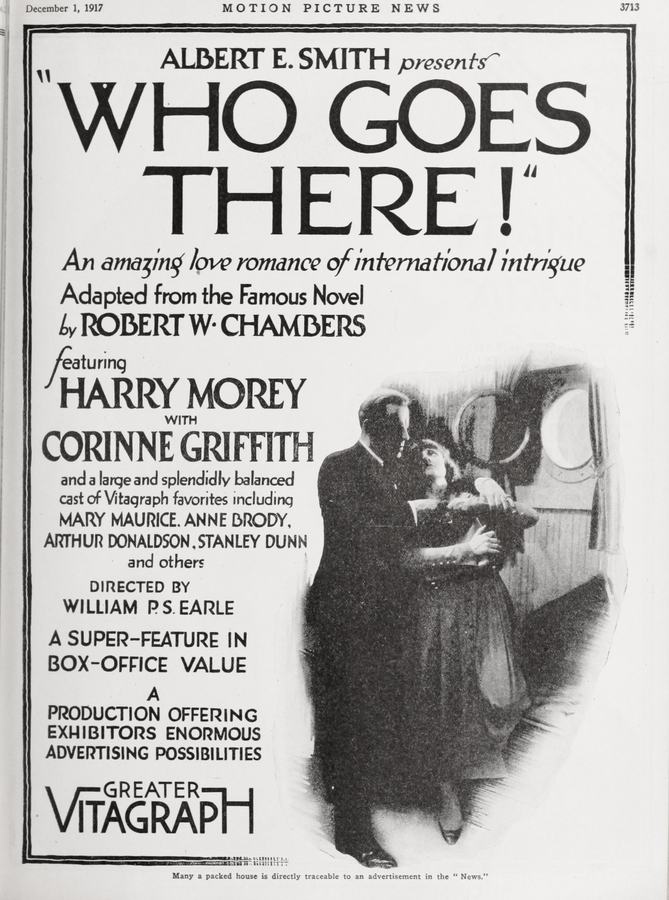
During World War I, Kervyn Guild, an American citizen who was born in Belgium, is captured with other Belgian refugees by the Germans. Brought before the commanding officer, General Von Reiter, Guild is offered his own freedom as well as that of the other refugees if he goes to London and returns with the officer's daughter, Karen Girard, who actually is his mistress. In the hope of saving lives, Guild consents and is sent to London where he locates Karen. Guild's suspicions are aroused when he notices that they are being protected by the German agents and hunted by the British. His instincts prove correct when he learns that Karen is carrying dispatches to the general. On their journey back, Karen falls in love with Guild and agrees to join the Belgian cause. Before they can escape, the general arrives and demands both Karen and the papers. Guild duels to defend both and fatally wounds the general. In a breach of military ethics, the dying general then gives the lovers his blessings, and grants them a pass to go through the German lines.
Decades after its release, Who Goes There? remains a vital piece of the cinematic puzzle. Its influence can be seen in countless modern works, solidifying William P.S. Earle's status as a master of the craft in United States and beyond.