Summary
From the meticulous orchestration of national defense, 'France in Arms' emerges as a compelling cinematic testament to a nation's indomitable will amidst the crucible of the Great War. This archival masterwork, meticulously captured by the French Army's Cinegraphic Section, plunges the viewer into the rigorous metamorphosis of raw recruits into hardened 'poilus,' detailing the exhaustive training regimens designed to forge combat-ready soldiers. The narrative then pivots to an expansive exposition of France's industrial mobilization, a breathtaking panorama of logistical prowess that transformed the civilian economy into a formidable war machine. Through a series of revealing charts and vivid scenes, the film illustrates the escalating efficiency of factories, munition plants, and supply depots, showcasing a nation's capacity to provision its forces with an astonishing array of food, clothing, ammunition, and heavy artillery. The relentless march of technological innovation is starkly presented, from the colossal railway-mounted guns unleashing devastating one-ton shells across vast distances to the revolutionary advancements in aerial combat. A breathtaking sequence, filmed daringly from within a French attacking squadron, captures the visceral intensity of an aerial dogfight, culminating in the dramatic, unsparing depiction of a German adversary's plummeting demise. The film's harrowing climax transports us to the front lines, where the 'poilus' execute a sunrise assault, scrambling 'over the top' into a hail of enemy fire. This unflinching portrayal of courage, sacrifice, and the brutal efficacy of bayonet charges culminates in the swift, decisive capture of enemy trenches and the emergence of disarmed prisoners—a powerful, if propagandistic, affirmation of French military ascendancy.
Synopsis
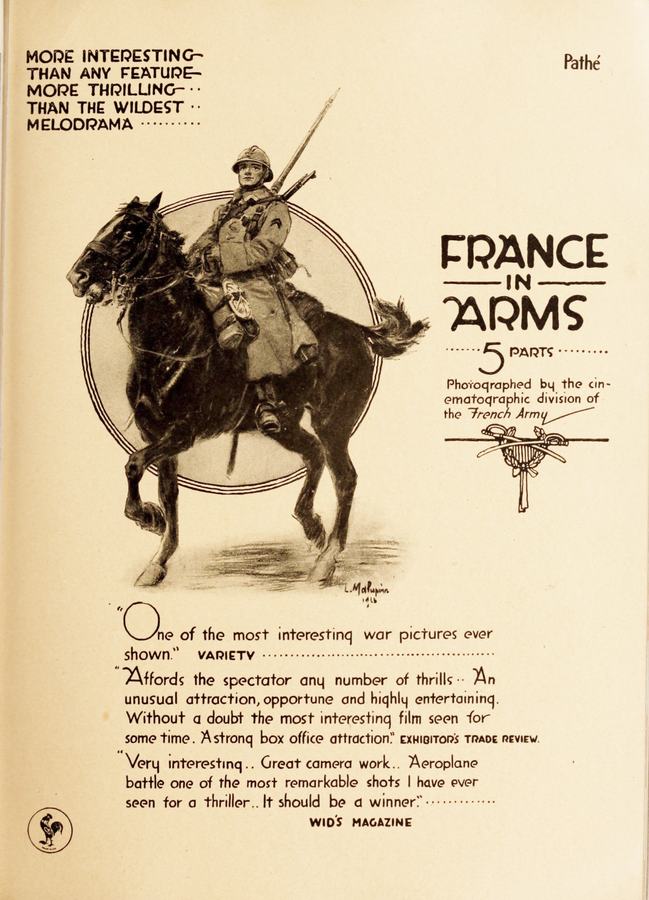
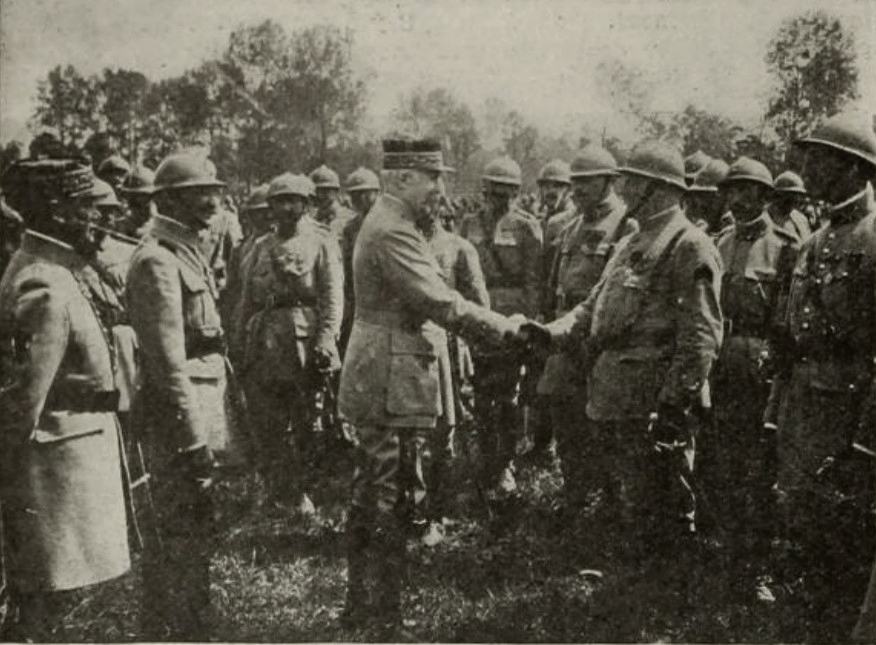
This picture was taken by the Cinegraphic Section of the French Army. At the young men who have called to the colors going through the course of training devised to render them fit to take their places on the battlefield. Then come scenes showing how France has mobilized her industries in order to enable her to supply her armies with food, clothing, ammunition, small arms and artillery. Charts are given with these scenes which make clear the ever-increasing efficiency of this effort and show that in 1917 the output of all manner of supplies is at the highest point yet attained in the war. Scenes of munition plants, storehouses filled with clothing, food of all kinds and military supplies, herds of cattle and flocks of sheep show forcibly that the development of the manufacturing and commissary departments has kept pace with the development of manpower. From the manufacture of the big guns we are taken to the front, where we see guns of every size from the smallest to the trench mortars and machine guns to the giants mounted on railway carriages which hurl shells weighing over a ton distances of nearly 30 miles. We are shown these guns in action and descriptive titles explain fully the nature of each gun, the size of the shell, and the distance of the range at which it is effective. After each shot a scene is inserted showing the character of the explosion and its effect. We are than shown the great advance made in aeroplane construction. We are told that at the outbreak of war France possessed only about 150 aviators, three types of planes, the Bleriot, Farman and Caudron, and very few aeroplanes ready for use. The old types of flying machines are shown and then the new. The 1914 machines placed alongside of the latest models look like baby carriages beside new model locomotives. In the aeroplane section are given views which are most thrilling. The cameraman was taken aboard one of the big flyers of a French attacking squadron and filmed every stage of a battle above the clouds with a German squadron. The cameraman was under fire all the time he was taking the picture. The plane in which he is a passenger selects an adversary from the German air fleet. Fire is opened on both sides. Both flyers maneuver at dizzy angles seeking to get a commanding position. Suddenly the German plane falters, begins to circle around aimlessly, and then plunges toward the earth. The cameraman records every second of her drop until she plunges her nose into the earth below, a total wreck. Another series of big scenes is given in an attack by the French at sunrise. We are shown the poilus, standing in the trenches waiting the signal for "over the top." The word is given. They scramble from the relative security of the trench out into the open where they are at once exposed to the fire of the Germans, whose trenches are in plain view not far away. Men begin to fall at once, but there is no faltering. With bayonets set the poilus go forward. We see them reach the German trench and plunge their bayonets at the foe beneath. They jump in and soon the strings of German prisoners come forth, proof that the trench has been captured.
Review Excerpt
"
Stepping back in time to the tumultuous era of the First World War, we encounter France in Arms, a profound and compelling cinematic artifact produced by the French Army's own Cinegraphic Section. This isn't merely a film; it's a meticulously crafted document, a window into a nation's monumental effort to survive and ultimately prevail in the most devastating conflict humanity had yet witnessed. Far from a detached historical record, this picture pulsates with the very spirit of Fr..."