DbcultAccessing Vault...
6.1/10
Senior Film Conservator
A definitive 6.1/10 rating for a film that redefined the boundaries of cult cinema. Dull Care remains a cornerstone of transgressive art.
To traverse the landscape of 1919 cinema is to witness an art form in the throes of a violent, joyous birth. While dramas like The Scarlet Pimpernel sought to anchor the medium in literary gravitas, the world of the short comedy was exploring an entirely different frontier: the limit of human physicality. Dull Care, directed by and starring the enigmatic Larry Semon, stands as a testament to this era of unbridled kinetic energy. It is a film that rejects the sedentary nature of its title, opting instead for a frantic, almost neurotic pacing that defines the Vitagraph aesthetic of the late teens.
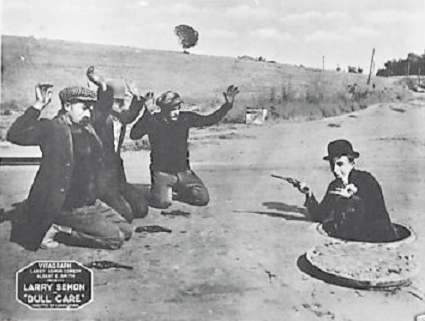
Larry Semon remains one of the most fascinating enigmas of the silent era. Unlike the soulful pathos of Chaplin or the stoic geometry of Keaton, Semon’s screen presence was that of a cartoon rendered in flesh and bone. In Dull Care, his detective character is a masterpiece of visual contradiction. Clad in ill-fitting garments that accentuate his spindly frame, Semon moves with a jittery grace that suggests a man constantly surprised by his own limbs. This isn't the calculated heroism found in The Mystic Hour; it is a chaotic survivalism that resonates with a modern, almost Dadaist sensibility.
The detective in Dull Care is fundamentally incompetent, yet his failures are so spectacular they achieve a sort of accidental brilliance. When he stumbles into the lair of criminals—men so fearsome that even the established police force trembles at their mention—the film shifts from a simple parody of the procedural into a high-stakes demolition derby. The villains, led by a formidable and surprisingly agile Oliver Hardy, provide the perfect ballast for Semon’s ethereal lightness. Hardy, long before his legendary partnership with Stan Laurel, was already a master of the 'heavy' role, utilizing his massive physique not just for intimidation, but for a nuanced comedic timing that anchored the more outlandish stunts.
The midpoint of the film features a transition that is as jarring as it is hilarious. Escaping the underworld through a window, our protagonist finds himself in the boudoir of a woman (played with spirited exasperation by Lucille Carlisle). This transition from the 'public' threat of the criminal element to the 'private' chaos of the domestic sphere is handled with a fluidity that speaks to Semon’s sophisticated understanding of space. If M'Liss dealt with the rugged external landscapes of the West, Dull Care finds its frontier in the interiority of the apartment, where every rug is a trapdoor and every piece of furniture a potential projectile.
"The genius of Dull Care lies in its refusal to breathe. It is a cinematic panic attack choreographed with the precision of a Swiss watch."
The misadventures that follow are a masterclass in escalating stakes. The detective's attempts to maintain a semblance of decorum while hiding from both the police and the criminals create a tension that is uniquely Semon-esque. Unlike the more grounded narratives of The Walls of Jericho, Dull Care operates in a realm where the physical laws of the universe are subservient to the punchline. The use of practical effects and high-wire stunts—many performed by Semon himself—lends the film a visceral quality that modern CGI cannot replicate. There is a palpable sense of danger in every fall, a reality to the dust and the debris that underscores the 'slap' in slapstick.
When we look at other films of the period, such as The Stolen Play or the dramatic weight of John Glayde's Honor, the sheer irreverence of Dull Care becomes even more pronounced. While mainstream cinema was busy codifying the rules of the feature-length drama, Semon and his crew were busy breaking them. The editing in Dull Care is remarkably modern; the cuts are quick, the gags are layered, and the visual information is dense. It shares more DNA with the experimental animation of the time, such as Kapten Grogg badar, than it does with the theatrical adaptations like The Chimes.
The film’s climax is a dizzying array of chases and near-misses that involve the entire cast. Frank Alexander and Al Thompson contribute significantly to the mayhem, acting as human pinballs in Semon’s grand design. The interplay between the characters is less about dialogue (which is sparse even for a silent film) and more about the geometry of movement. It is a silent symphony of collisions. One might find echoes of the social friction in The Love Hunger, but here, the friction is literally physical—bodies slamming into doors, sliding across floors, and tumbling through space.
Visually, Dull Care is a product of the Vitagraph high-key lighting style, which ensures that every grimace and every piece of slapstick business is captured with crystalline clarity. The set design is deceptively simple, providing a playground for the actors to dismantle. There is a specific joy in watching the destruction of a meticulously crafted 1919 interior; it represents a cathartic release of the era's rigid social structures. While films like Carmen of the Klondike sought to capture the grandeur of nature, Semon found his majesty in the spectacular ruin of a living room.
The cinematography, though largely static in its framing, utilizes the depth of the field to create multi-layered gags. Often, while Semon is occupied with a piece of business in the foreground, the villains—including the menacing yet agile Hardy—are seen approaching in the background, creating a sense of impending doom that fuels the comedic engine. This technique is far more advanced than the flat staging seen in many contemporary dramas like De forældreløse or One Dollar Bid.
Critics often overlook Larry Semon because his work lacks the emotional resonance of his peers. However, to judge Dull Care by the standards of Chaplinesque sentimentality is to miss the point entirely. This film is an exploration of pure cinema—motion for the sake of motion. It is as much a documentary of human capability as it is a comedy. In the same way that Amazonas, Maior Rio do Mundo documented the flow of a great river, Dull Care documents the flow of a great comic mind.
The film also offers a fascinating glimpse into the early career of Oliver Hardy. Even here, his ability to convey frustration through a simple look to the camera is evident. He provides the necessary gravity to Semon's levity. Without Hardy’s grounded performance, the film might have drifted off into pure abstraction. Together, they create a prototype for the dynamic duos that would define the next decade of comedy. The film’s resolution, or lack thereof, suggests that the journey is the destination—a sentiment that resonates with the avant-garde spirit of A béke útja.
Dull Care is a relic that refuses to stay buried. It is a vibrant, screaming, tumbling piece of history that demands to be watched at full speed. For the modern viewer, it offers a respite from the heavy-handed narratives of contemporary cinema, providing a pure, unadulterated shot of adrenaline. It is a reminder that before there were superheroes and CGI spectacles, there were men like Larry Semon and Oliver Hardy, who were willing to fall off a roof just to make us smile.
In the grand tapestry of 1919, where films were often moralistic or overly theatrical, Dull Care is a splash of neon orange on a grey canvas. It is bold, it is unapologetic, and it is profoundly funny. Whether you are a scholar of the silent era or a casual fan of comedy, this film is an essential viewing experience that proves that some things—like a well-timed trip or a perfectly executed escape through a window—are truly timeless.
Film Technical Specs:
IMDb 6.3
1924
Community
Log in to comment.