Summary
The Vero Educational Society presents a profound four-part cinematic exploration, 'The Colosseum in Films,' meticulously crafted in Rome with unprecedented governmental access and expert guidance from W. Stephen Bush. This educational feature unfolds a panoramic odyssey, commencing with the amphitheater’s majestic exteriors, framing its enduring presence against modern Roman vistas. Viewers are transported to the 'Meta Sudante,' the ancient 'Sweating Corner,' a pivotal hydrological nexus and post-combat sanctuary for gladiators, whose colossal scale once dwarfed the Arch of Constantine. The camera then gracefully sweeps across the Colosseum's venerable outer wall, observed from the world's oldest botanical garden, revealing the intricate architectural orders and twenty-century-old entrance numbering. A segment dedicated to the papal restorations, notably Pope Pius IX’s buttress, highlights centuries of preservation efforts, while the Travertine stone's mysterious Vandal-inflicted perforations narrate tales of barbarian impotency. The second part descends into the hallowed arena, a stage for countless sanguinary spectacles and a sacred ground marked by Christian martyr tablets. Exquisite black and white photography captures the first lobby's details, juxtaposed with the feature’s generally tinted palette. Glimpses of decayed yet resplendent sculptures, from imperial lodges to Vestal Virgin quarters, evoke past grandeur. A cryptic fresco, purportedly from Jerusalem and featuring a depiction of the crucifixion, adds an intriguing historical layer. The film meticulously details the auditorium, astonishingly conveying its 80,000-87,000 spectator capacity, replete with imperial inscriptions and the remnants of saffron-infused incense burners. The concluding reels delve into the Colosseum's subterranean secrets, exposed by the 1813 excavations. Audiences trace Emperor Commodus's private passage, gladiator waiting niches, Christian confinement cells, and the chilling provisions for housing and enraging wild beasts—up to five thousand at a time—along the 'Via Mortis.' Empress Helena's chapel, built above a Christian prison, offers a poignant counterpoint to the brutal history. The choked water mains, once feeding naval spectacles, are revealed, culminating in powerful final scenes titled 'Thus Passeth Away the Glory of the World,' where pigeons nest and lizards bask, underscoring the relentless march of time against human endeavor.
Synopsis
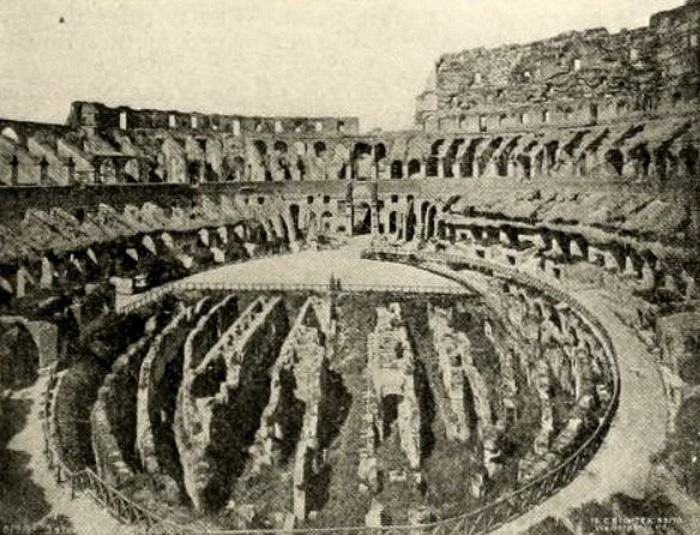
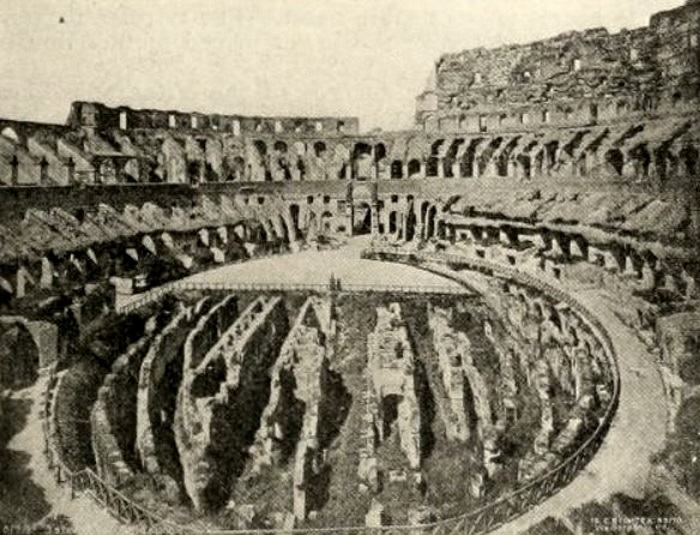
The Vero Educational Society has released a great original educational feature in four parts called "The Colosseum in Films." The films were made in Rome by special permission of the Italian government and according to directions by W. Stephen Bush, of The Moving Picture World. The first pact consists of the exteriors, the entrances and interesting views of modern Rome taken from the upper stories of the Colosseum. We see the famous "Meta Sudante," the ancient "Sweating Corner," so named after the sweating gladiators, who after the combats in the arena retired to the "Meta Sudante" to bathe their heated bodies in its cooling mains and fountains. It was through the "Meta Sudante" that the builders of the Colosseum introduced the vast water supply into the huge edifice. Indeed the "Sweating Corner," of which various views are introduced, was part of the Colosseum itself. It stands close to the famous arch of Constantine and in its original size was many times larger than the arch itself. The next view we get is that of the famous outer wall of the Colosseum, which we see from the oldest botanical garden in the world. The order of the columns in the different stories of the building is well portrayed and we are able to distinguish after the lapse of twenty centuries some of the numbers over the entrances to the Colosseum. The picture then goes on to show the wonderful work of restoration done by the Popes of Rome from 1750 to the pontificate of the late Pope Pius IX, whose buttress at the entrance commonly used by tourists is familiar in its graceful outline to many who have seen the more popular pictures of the great theater. All the walls made of the ancient Travertine stone which was brought to Rome from Tivoli mostly by Jewish captives which the Emperor Titus brought to the eternal city after the destruction of .Jerusalem show holes which it is said were made by the Vandals when they found that they were unable to destroy the Colosseum. These boles testify to the impotent rage of the barbarians. The views of Rome taken from the various stories of the Colosseum are full of panoramic beauty and historic interest. The second part shows the lower floor and the ever famous arena where so many bloody contests occurred between man and beast and more often between man and man. There are memorial tablets in honor of the Christian martyrs, who died in the arena rather than abjure their faith. The wonderful first lobby is shown with splendid detail and is a fine specimen of black and white photography. Most portions of the feature are tinted. We see the remains of the marvelous sculpture which adorned the various parts of the Colosseum from the upper stories down to the lodges of the Emperor and the Vestal Virgins. Even in its decay the heads and bodies of these columns and frescoes are surpassingly beautiful. There is also shown what remains of a mysterious fresco, said to have been brought from Jerusalem under the reign of Titus. In the left hand corner of this fresco is a strange representation of the crucifixion. Not a bit less interesting are the pictures of the stories and lodges. Every part of the auditorium proper is shown in detail and one realizes with amazement how entirely credible is the statement of the historians that not less than 80,000 spectators could be accommodated in the Colosseum and that often there were as many as 87,000 assembled in the vast structure. We see various interesting inscriptions said to have belonged to the Imperial and the Vestal Virgin lodges, we see the remains of the incense burners, in which a solution of wine and saffron was burned in order to purify the air during the performances. The most interesting part is perhaps the last reel showing what was hidden beneath the arena. The arena was partially removed in 1813 by the government in order to aid historic research. The revelations made were of a most startling nature and confirmed all that had been written about the Colosseum in contemporaneous literature. We see and trace, the secret passage-way which the Emperor Commodus built for himself in order to go directly from his palace into the arena; we see the niches where the gladiators waited their turn in the combats; we see the part where the Christians were confined and most interesting of all we see what provisions were made to imprison and starve into ferocity the wild beasts used in the arena. There were often as many as five thousand wild beasts of all varieties and from all countries kept in the subterranean passage-ways, hundreds of them were chained to ropes and posts along what was known as the Via Mortis (The Way of Death), through which dead or wounded gladiators were carried out. Above one of the Christian prisons is a chapel said to have been built by the Empress Helena, the mother of Constantine, in honor of the Christian martyrs. We see the water mains now choked up by rank vegetation through which water was introduced into the arena whenever naval spectacles were given. It would take up too much space to tell even half of the wonders of the Colosseum, but brief mention may be made of the last scenes which bear the significant titles, "Thus Passeth Away the Glory of the World." We watch the pigeons making their nests high up in the vast amphitheater and we wonder at the green lizards basking on the broken marbles.
Review Excerpt
"
Unearthing the Echoes of Empire: A Deep Dive into 'The Colosseum in Films'
Ah, the Colosseum. A name that conjures images of gladiatorial might, imperial spectacle, and the enduring grandeur of a civilization that once held the world in its grasp. For centuries, this monumental amphitheater has captivated historians, artists, and dreamers alike. But how often do we truly get to peel back the layers of time and witness its multifaceted story with such meticulous detail? The Vero Educati..."