Summary
In the oppressive shadow of Notre-Dame, Catherine de Médicis—widowed queen, Italian spider—spins a nuptial web: her daughter Margot will wed the Huguenot King of Navarre, luring the Protestant elite into the gilded mousetrap of Paris. Court musicians drip honeyed notes over cobblestones while, behind velvet arras, daggers are counted like rosary beads. Marie de Mornay—Huguenot heiress, reluctant bride-to-be—arrives with satin slippers and a heart already mourning its unborn freedom. She is pawn, prize, potential corpse. At the feast’s zenith, bronze bells mutate into scavenger crows; the signal clang of St-Germain l’Auxerrois looses a red tide through moonlit alleys. Nobles, urchins, priests, whores—anyone bearing the chalky cross—become custodians of a citywide abattoir. Amid the sulphurous glow of burning prayer-books, Raoul de Tournay, Catholic rake with a conveniently elastic conscience, bargains salvation for Marie’s family in exchange for her vow. What begins as extortion in a blood-slick cul-de-sac ends, through firelit absolution and shared brushstrokes of terror, as a forced union that might—against every canon of decency—flower into something perilously close to love.
Synopsis
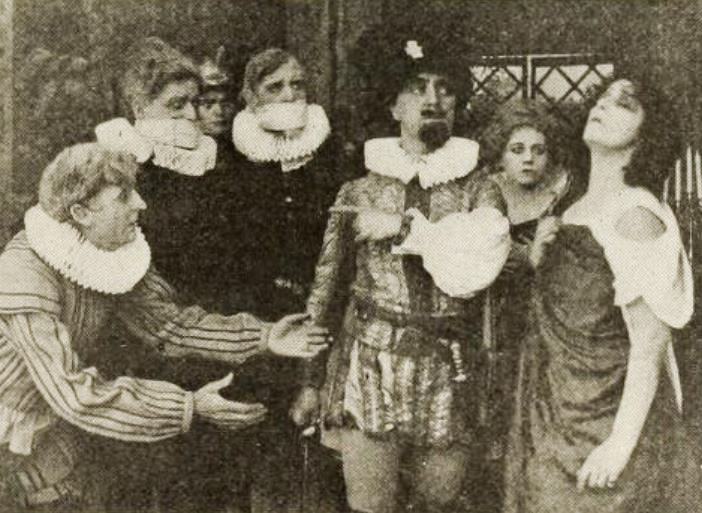
Catharine, the Queen Mother of France, urged by the noble and influential house of Guise, became jealous of the growing strength and popularity of the Huguenot, or Protestant party, the head of which was Henry, King of Navarre. The wily Italian Queen of France found that to make any success in her plots against this rising party, she would have to get the main body of them to Paris, and she therefore arranged a marriage between Marguerite De Valois and Henry, the Huguenot King. Thousands of the flower of the Huguenot faith flocked to Paris to witness the welding together of the two political and religious factions. The marriage was performed, while the Huguenots were feted and flattered until no vestige of suspicion of treachery could enter their minds. The feast of St. Bartholomew was nigh and all was ready for the blow to be struck. The King, a weak, hysterical boy of but 23 years, tried to stop the tragedy but was overruled by his mother and gave the order for the massacre of the Huguenots on the eve of the feast of St. Bartholomew. Never in the history of the world has a plot, known to practically every Catholic in Paris, including the scum of the streets, been kept so absolutely secret as was this one against the Huguenots. During the evening the streets of Paris were practically deserted, save for a few bands of priests and soldiers who nailed white crosses on the houses of all Catholics, to shield them from the fury of the blood-mad mob. Nobles mingled with beggars, hiding in tenements and archways and, in fact, anywhere which would be a vantage point for the killing of the hated Huguenots. At midnight the stillness of death spread over the city, and suddenly to the waiting thousands came the ringing of the bell of St. Germaine which was the prearranged signal for the massacre to commence. For the next twenty-four hours. Paris was a charnel house. Marie de Mornay. the daughter of a Huguenot nobleman, has been betrothed against her will to a childhood friend of the family. She loves her finance as a brother but not as a wife should love a husband, yet to save her father from financial ruin she consents to become the wife of the wealthier Huguenot noble. The two families attend the royal marriage, and there the king himself presents to her the dare-devil Catholic noble. Raoul de Tournay, a close confident of his majesty. On "The Fatal Night" he plans to save Marie's life from the general massacre, and forces her to become his wife in return for his services in saving her whole family and fiancé from death. She agrees, and in a well-told story of the thrilling events of the next few days, we see how Marie learns to love her husband, whose nobility and generosity find expression in his every act, despite the harshness of his wooing.
Review Excerpt
"
Paris, August 1572: a city corseted in silk and gunpowder. The Fatal Night—a one-reel miracle released in 1911—doesn’t merely depict the St. Bartholomew’s Day massacre; it exhales its charnel breath straight into your lungs. Constance Crawley’s Marie quivers like a taper in this hurricane of protocol and piety, her pupils reflecting first the sparkle of torchlight galas, then the crimson geyser that follows. Arthur Maude’s Raoul swaggers with rapier arrogance, yet the tremor in gloved fingers ..."