Summary
Sun-bleached Attic light ricochets off a jagged rock-islet where charcoal strokes of an Aegean noon become the first faint heartbeats of catastrophe: Helena, all spindle-limbed defiance and graphite-smudged fingers, sketches not merely waves but the fault-line of empires. Behind her, a skiff slips its painter the way history slips conscience, and the tide—half salt, half prophecy—starts to gnaw at the marble of identities. Enter Ali Bey, Ottoman uniform cutting a black scimitar of silhouette against the alabaster cliffs; he stands, hat in hand, a man caught between the etiquette of diplomacy and the barbarism of desire. What follows is no mere rescue but a transfusion of gazes: two children hauled from a watery amphitheatre, a breathless covenant sealed in brine and phosphorescence. Back on land, patriarchal Athens knots Helena’s future to Captain Humeroki—bronze epaulets, waxed moustache, a walking embodiment of cartographic certainty—while her heart, clandestine as a smuggled icon, keeps smouldering for the enemy. Borders ossify, cannons eclipse courtship, and the same surf that once tried to swallow her now carries the rumour of war. In the moon-hollow of her marital garden she betrays flag, kin, marriage bed, pilfering classified scrolls with the same fingers that once shaded breakers. Yet remorse detonates louder than nationalism; dynamite becomes her final penance, a bridge collapses into an abyss of thunder and iron, and a Greek flag—indigo cross on searing white—descends like a benediction over her expiring body, transmuting treachery into apotheosis.
Synopsis
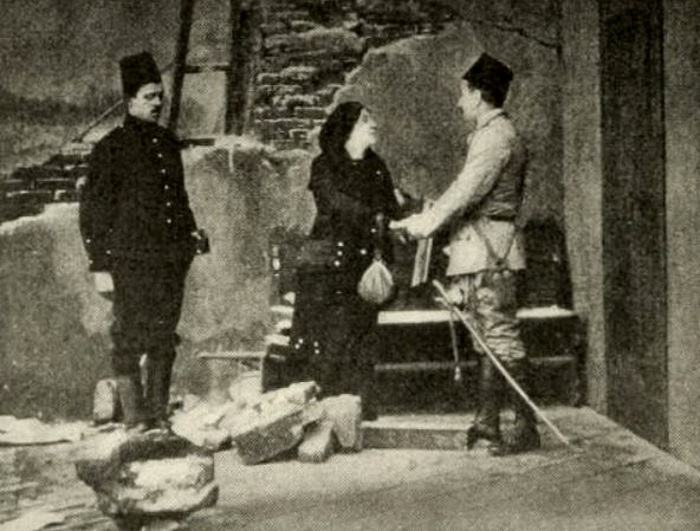
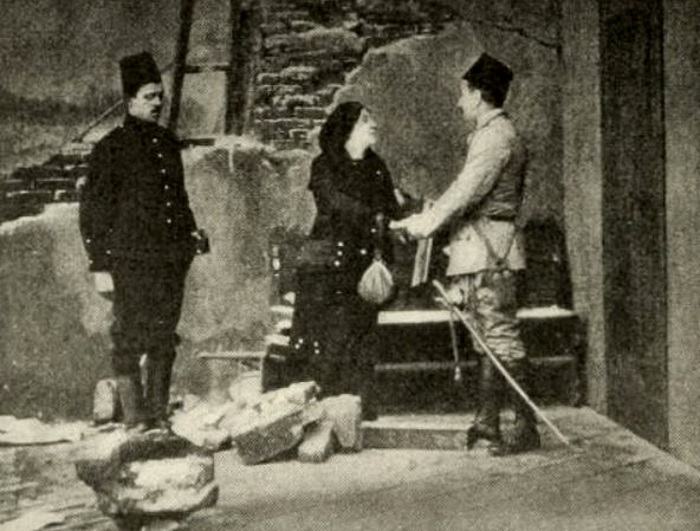
Helena, a Greek girl, who is spending her holidays at the seashore together with little cousin Mary, has taken a rowboat and gone on a sketching trip, having selected an advantageous spot on a large rock a short distance from the shore. Ali Bey, a Turkish military attache who is stationed at Athens, has been attracted by Helena's beauty. He follows them down to the shore and patiently awaits their return, when he is horrified by seeing that the boat has gone adrift and the tide is fast rising. He immediately raises an alarm and plunges into the water to save them. After a desperate struggle he manages to get them ashore safely. Helena falls in love with the Turkish officer, much to her father's displeasure, but after may arguments her father compels her to marry Captain Humeroki, a Greek officer, although she is in love with her rescuer, Ali Bey, the Turk. Some months later war is declared between Greece and Turkey. Important war documents are in the possession of Helena's husband, and the Turkish officer has been commissioned to secure them. He makes an appointment with Helena to meet her at night in the garden of her home. Here he takes advantage of her love for him by threatening to shoot himself unless she will agree to secure for him a copy of these documents, which she accomplishes while her husband sleeps and delivers them to him. Captain Humeroki has been ordered to the front. Helena becomes remorseful. She cannot stand the strain any longer, so with her butler, whom she has explicit confidence in. She drives to the Turkish headquarters determined to see and persuade her lover. Ali Bey, not to make use of the documents she placed in his possession. While waiting to see him she overhears arrangements being made that convinces her that use has already been made of the documents and the Greek army will surely meet defeat. She realizes that she can save the day, and immediately dispatches her companion, the butler, for a powerful charge of dynamite, which she places at the base of one of the piers of a great bridge, over which the Turks must pass to accomplish their design, thus blowing up the bridge over which is galloping her lover at the head of the Turkish cavalry. The bridge falls, entombing men and horses. Helena is mortally wounded and the Greek officers cover her with the flag while the dying heroine is pardoned by her husband, to whom she has confessed all.
Review Excerpt
"
A charcoal smear of sun across the Aegean: that is how the film announces itself—no title card, just heat haze and the faint creak of a rowboat.
Helena’s ankles, nut-brown and daubed with salt crystals, balance on the gunwale as if the world’s axis tilted a fraction more she might skid straight into myth. She is drawing, yes, but also divining; every graphite arc a hex cast upon the calm. Her cousin Mary, a slip of a thing with ribboned plaits, hums a tune that will later be weaponised as nos..."