DbcultAccessing Vault...
Cult Review
Senior Film Conservator
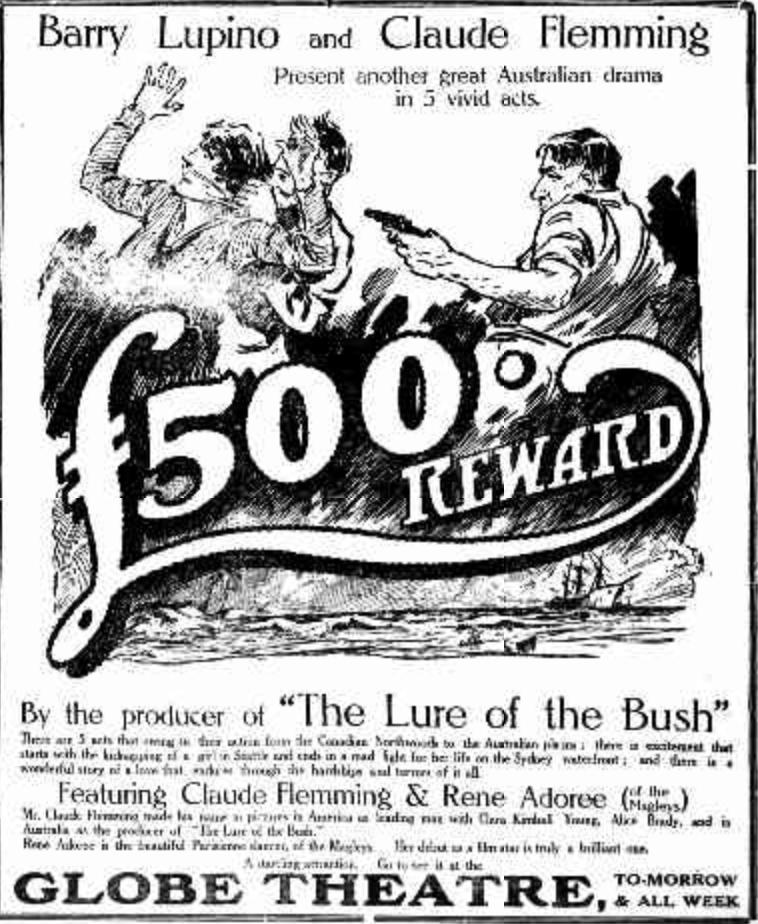
In the dusty annals of the Antipodean silent era, few artifacts shimmer with the raw, unvarnished ambition of 500 Pounds Reward. Released in 1918, a year of global transition and local cinematic experimentation, this work by Claude Fleming stands as a monumental interrogation of the 'wronged man' trope. While contemporary audiences might view the silent era through a lens of flickering antiquity, Fleming’s direction demands a more rigorous analysis. This isn't merely a relic; it is a sophisticated exercise in narrative tension that predates the polished noir aesthetics of the 1940s by decades.
Claude Fleming, taking the reins as both writer and lead talent, exhibits a profound understanding of the cinematic proscenium. In an era where many filmmakers were still tethered to the static staging of the theatre, Fleming injects a kinetic energy into the frame. The film’s protagonist is not just running from the law; he is running from the very concept of a defined identity in a society that has already priced his capture. This thematic weight elevates the film above the standard fare of 1918, such as the more structurally traditional Brother Officers, which relied heavily on established social hierarchies for its drama.
"The 500-pound bounty functions as a recurring ghost in the machine, a numerical value placed on a soul that the audience knows to be innocent. It is a cynical, yet hauntingly accurate, depiction of how capital intersects with the legal apparatus."
The cinematography in 500 Pounds Reward captures the Australian landscape not as a postcard, but as a prison. There is a grit here that contrasts sharply with the European sensibilities found in Manden med de ni Fingre III. While the latter utilizes urban mystery and sophisticated detective tropes, Fleming’s work is primal. The light is harsh, the shadows are deep, and the textures of the bushland feel almost tactile. It shares a certain rugged DNA with The Law of the North, yet it swaps the icy frontiers for the sun-scorched plains of the South.
John Faulkner delivers a performance of remarkable restraint. In a period often criticized for over-the-top gesticulation, Faulkner uses his eyes to convey the crushing weight of his predicament. Opposite him, Lorna Ambler provides more than just a romantic interest; she is the moral compass of the film, a beacon of faith in a world that has turned transactional. Their chemistry is the heartbeat of the production, providing a necessary counterpoint to the relentless pursuit sequences.
A fascinating historical footnote that deserves center stage is the presence of Renée Adorée. Before she became a luminary of the MGM era and captivated the world in *The Big Parade*, she was here, honing her craft in the burgeoning Australian industry. Her performance in 500 Pounds Reward hints at the luminous screen presence that would eventually make her a global icon. Seeing her in this context is like finding a rough diamond before the polish; the raw talent is undeniable, adding a layer of international prestige to this local production.
When we place this film alongside its contemporaries, its unique grit becomes even more apparent. It lacks the whimsical, almost satirical edge of Die Hochzeit im Excentricclub, opting instead for a somber realism. Even when compared to the socio-political weight of Uncle Tom's Cabin, Fleming’s film feels more focused on the individual’s struggle against a faceless, bureaucratic evil. It doesn't have the documentary-style observation of Giro d'Italia, but it possesses a narrative momentum that is equally captivating.
The film also engages with the concept of social barriers, much like The Stainless Barrier. However, where that film looks at the rigidity of class, 500 Pounds Reward looks at the fragility of reputation. It suggests that a single accusation can strip a man of his humanity, reducing him to a bounty to be collected. This theme resonates through other works of the era, such as Truthful Tulliver, though Fleming’s approach is notably more cynical and less rooted in the myth of the heroic frontiersman.
One cannot discuss this film without acknowledging the rhythmic editing. The chase sequences are cut with a precision that suggests an understanding of audience psychology. By alternating between wide shots of the desolate landscape and tight, anxious close-ups, Fleming creates a sense of encroaching doom. It’s a technique that would be further refined in later thrillers, but its roots are visible here. It stands in stark contrast to the more theatrical pacing of Annoula's Dowry or the stylized kabuki influences of Yakko no kôsan.
The use of tinting—a common practice in the silent era—is particularly effective here. The deep sepias and cold blues used for night scenes aren't just decorative; they are atmospheric tools that heighten the film's emotional temperature. It creates a visual experience that is as much about mood as it is about plot, a quality also found in the exoticism of Jungeldrottningens smycke, though applied here to a much more grounded, gritty reality.
As a piece of Australian heritage, 500 Pounds Reward is a vital link in the evolution of the national cinema. It moves away from the 'bushranger' myths of the early 1900s and toward a more modern, urban-adjacent sensibility. It deals with the corruption of the city and the sanctuary of the country, a dichotomy that would define Australian film for decades. It lacks the propaganda-adjacent fervor of The Nation's Peril, focusing instead on the internal peril of the soul.
When we look at Mary Pickford's work in Johanna Enlists from the same year, we see the power of the 'star' system. In contrast, 500 Pounds Reward feels like a director’s film. Every frame is imbued with Fleming’s specific, slightly paranoid worldview. It is a film that warns us about the ease with which we judge others and the difficulty of reclaiming a stolen life. Even the darker elements of Hop - The Devil's Brew feel somewhat moralistic compared to the cold, hard logic of Fleming's bounty system.
Ultimately, 500 Pounds Reward is a triumph of early independent spirit. It navigates the complexities of justice and the cruelty of the crowd with a sophistication that belies its age. For the modern cinephile, it offers a window into a world where the stakes were high, the film stock was flammable, and the stories were as vast as the continent itself. It is a stark reminder that while technology evolves, the human drama of the hunt—for truth, for safety, and for redemption—remains eternally compelling. It stands alongside The Governor as a foundational text of political and personal integrity under fire.
Review by the Cine-Aesthetic Collective. Exploring the shadows of silent history with a modern eye. No frames left unturned.

IMDb —
1925
Community
Log in to comment.