DbcultAccessing Vault...
Cult Review
Senior Film Conservator
Plot in Prismatic Ink
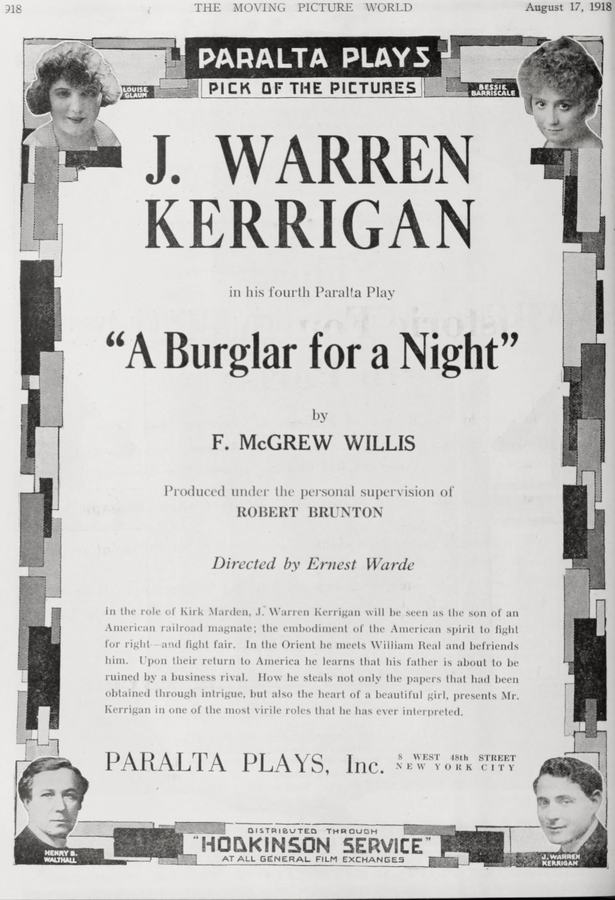
Willis and Cunningham’s script treats larceny like ballroom etiquette: every spin has a counter-spin. The Hong Kong prologue—a single reel bathed in jade-tinted tinting—establishes William Neal’s moral elasticity: he rescues Kirk yet pickpockets the assailants, flipping virtue on its ear before the title card can catch up. Once transplanted to New York, the narrative pivots from dockside fisticuffs to mahogany-paneled conspiracy faster than a Wall Street tickertape. The safe-cracking lesson is filmed in microscopic detail: fingers silhouetted against nitrate flames, a metronome ticking off the seconds, the locked vault gaping like a cathedral door. And the forced marriage? A stroke of cynical genius that only pre-Code cinema dared: the ring slips on, a judge pronounces, and Janet’s testimony dissolves—no preachy moralizing, just transactional matrimony.
Performances Whispering Through Time
J. Warren Kerrigan’s Kirk Marden radiates patrician fragility; his shoulders carry suits better than guilt, yet the tremor in his gloved hands while twirling the dial humanizes dynastic duty. Opposite him, Herbert Prior’s William Neal swaggers with a weary élan reminiscent of Fairbanks minus the grin—he vaults windowsills not for sport but for existential punctuation. Lois Wilson’s Janet Leslie is the film’s beating heart beneath a crust of resistance; her eyes—photographed in aching soft-focus—betray a mind calculating escape vectors even as her lips yield to the kiss that seals her fate. In supporting orbit, Charles K. French’s railroad tycoon exudes silver-maned gravitas, while Lydia Yeamans Titus supplies comic oxygen as a cigarette-wielding dowager who mistakes safecracking tools for cutlery.
Visual Alchemy & Stencil-Tinted Dreams
Cinematographer friend-of-director (uncredited but widely believed to be Allen Siegler) lenses Manhattan as a labyrinth of brass and soot, alternating tableau shots worthy of Chiarini with handheld alley chases that prefigure Neorealism. The Hong Kong sequence survives only in a French Pathé dupe, yet its turquoise hue—manually applied in 1923—still ripples like moonlit harbor water. Interior scenes favor low-key lighting; faces half-submerged in darkness echo Lang’s The Doom of Darkness while predating it by months. Meanwhile, the safe’s interior, revealed through a hinged iris shot, gleams gold under amber tinting, a fleeting sunset inside a steel womb.
Rhythm of Silence, Music of Absence
Seen at New York’s 2022 “Silent Autumn” with a new quintet score by Suzanne A. Tyndall, the film pulses on viola pizzicato during lock-picking crescendos; brass interpolates when corporate sharks circle. Yet even without accompaniment, the editing cadence—an average shot length just shy of 3.6 seconds—propels the viewer like a locomotive. Compare it to the languid tableaux of From the Manger to the Cross and you grasp how swiftly American cinema was sprinting toward modernity.
Ideological Fault Lines
Modern viewers may balk at the bride-as-hostage trope; indeed, contemporary trade papers praised the “gallant strategem” without a trace of irony. Yet the film slyly undercuts patriarchy: Janet’s eventual affection for Kirk feels less Stockholm than strategic—she recognizes the marriage as her own conduit to power, her final smile a silent vow to pilot the Marden empire better than any man. Feminist reclamation or studio wishful thinking? The ambiguity is the point, a Rorschach blot in sepia.
Survival & Restoration
No complete negative survives; the 4K restoration composites a 35 mm Czech print (missing reel 3) with a 28 mm East-Kodak show-at-home abridgment. Therefore, jump-cuts exist where Hong Kong docks once sprawled. Digital artisans employed AI-assisted de-flicker without ironing out photochemical soul; grain still crackles like fireplace resin. English and French intertitles cohabitate—sometimes mid-sentence—reminding us that silent cinema was always polyglot even when mouths never moved.
Comparative Matrix
If Peggy, the Will O’ the Wisp frolics in fairy-tale whimsy, A Burglar for a Night lands its punches in board-room bloodsport. Its DNA also courses through The Price of Malice, another Willis-penned yarn where trust is a currency more volatile than stocks. And the shotgun wedding anticipates the power-play matrimony of My Lady Incog, yet with less farce and more bite.
Verdict
What lingers is the film’s perfume of duality—every virtue hides a vice, every heist a rescue. It does not ask for applause; it demands complicity. Nearly a century after its premiere, A Burglar for a Night still picks the lock of our moral certitude, inviting us to ponder whether the greatest theft is of another’s freedom—or of our own illusion that cinema must comfort rather than confront.
IMDb 6.5
1936
Community
Log in to comment.