DbcultAccessing Vault...
Cult Review
Senior Film Conservator
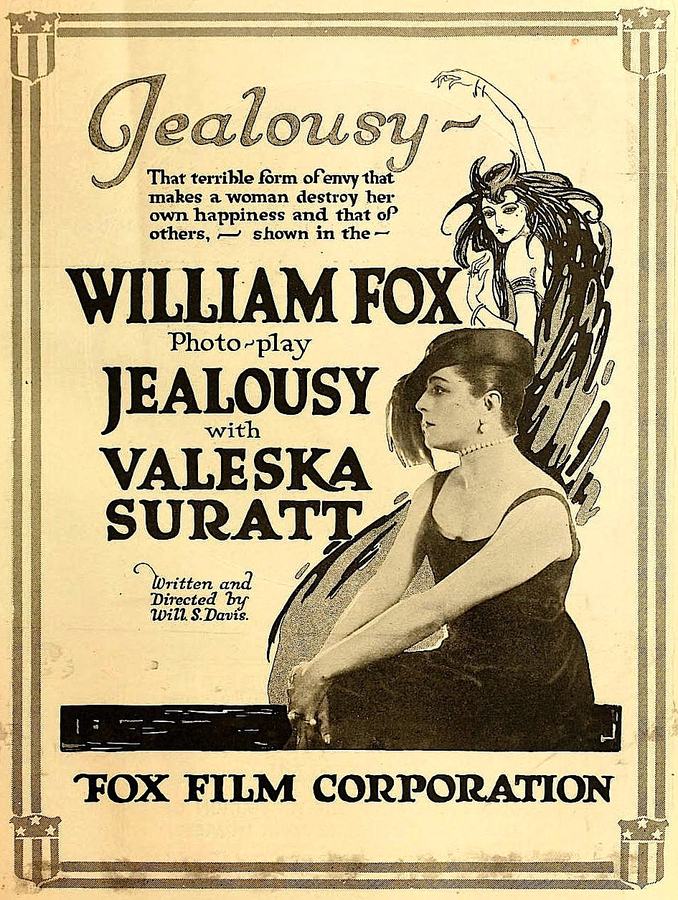
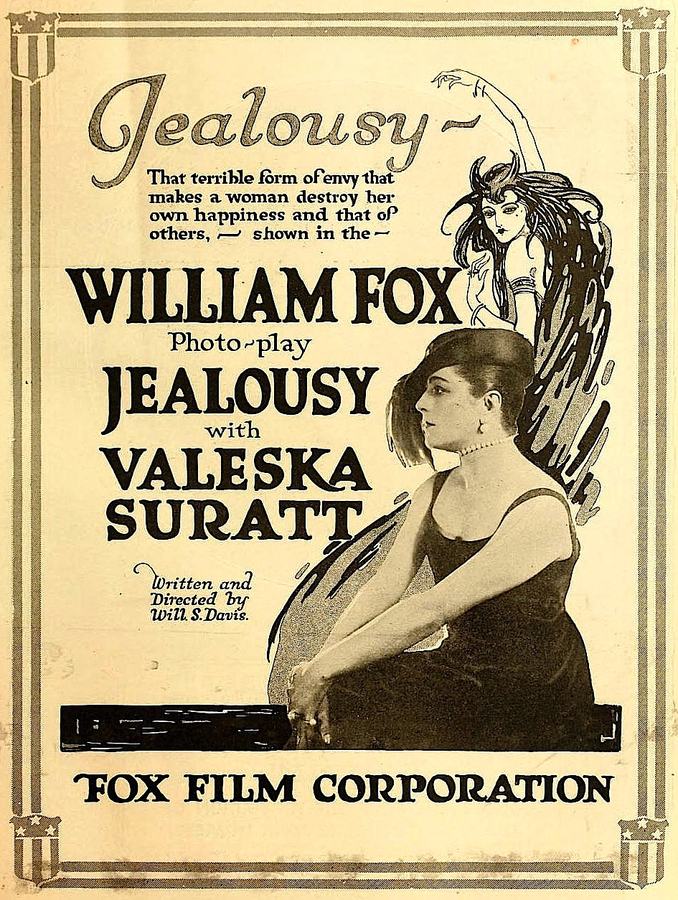
The year 1916 represented a pivotal moment in the evolution of American cinema—a time when the medium began to shed its stage-bound origins in favor of a more nuanced, albeit still melodramatic, visual language. Among the most tantalizing relics of this era is Jealousy, a film that serves as a vehicle for the enigmatic 'vamp' Valeska Suratt. To watch—or in the case of this often-elusive title, to reconstruct through contemporary accounts—this film is to witness the birth of the psychological thriller. It is a work that predates the cynical shadows of film noir by decades, yet it possesses a moral complexity that rivals the later works of Cecil B. DeMille, such as The Whispering Chorus.
Valeska Suratt was not merely an actress; she was an iconographic force. In Jealousy, her portrayal of Anne transcends the typical 'other woman' trope. Anne is a creature of profound dissatisfaction, her 'mock wedded life' serving as a catalyst for a scorched-earth policy against anyone experiencing the genuine affection she lacks. Unlike the more whimsical or lighthearted characters found in films like Little Eve Edgarton, Anne is a harbinger of domestic apocalypse. Her jealousy is not a passive emotion but an active, corrosive agent. It is fascinating to contrast her performance here with the more grounded social dramas of the period, such as The Breaker, where financial stakes are high but the psychological depravity is perhaps less pronounced.
The director, Will S. Davis, utilizes Suratt’s striking physical presence to emphasize the predatory nature of her character. Every gesture is calculated, every glance a potential weapon. In an era where acting often leaned toward the hyperbolic, the deliberate pacing of Anne’s manipulations feels remarkably modern. She doesn't just want Carney; she wants to possess the power to destroy him, a theme that echoes through other Fox 'vamp' features like The Spider and the Fly.
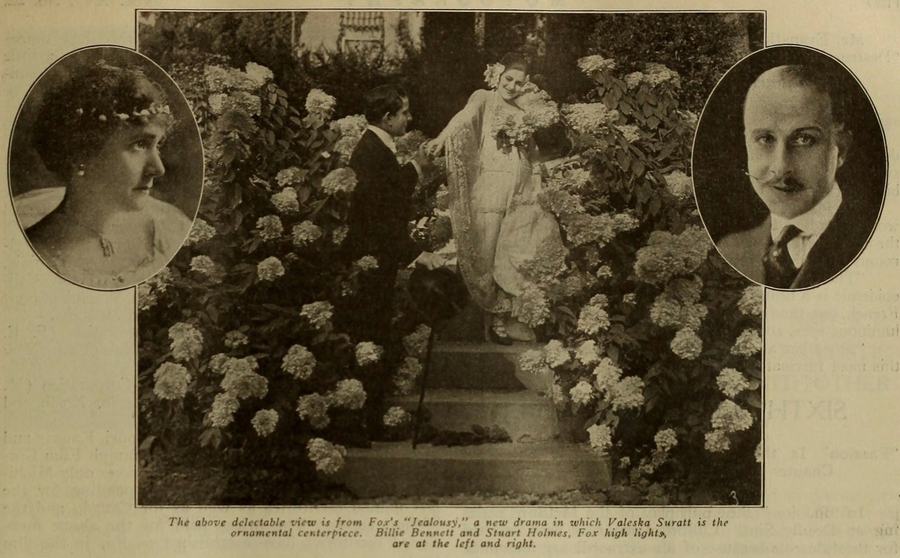
One of the most compelling aspects of Jealousy is its integration of high-stakes finance into the plot of a domestic drama. The use of the 'B.H.R. Stock' as a MacGuffin is a stroke of narrative genius. It moves the conflict from the drawing-room to the ticker-tape machine, suggesting that in the modern world, one's social standing and romantic happiness are inextricably linked to capital. This intersection of money and morality is a recurring motif in silent cinema, often seen in films like Time Locks and Diamonds.
The sequence where Anne discovers the memorandum on Martin’s desk is filmed with a tension that highlights the era's growing sophistication in editing. We see the gears turning in her mind—not just the desire to 'help' Carney, but the subconscious drive to be the architect of his fate. When Martin reverses his tactics to ruin Carney, the film makes a profound statement about the collateral damage of male ego and female spite. Carney’s ruin is not merely financial; it is a total stripping of his agency. This thematic weight elevates the film above the standard 'potboiler' fare of the mid-1910s, such as The Further Adventures of Stingaree, which relied more on episodic action than psychological depth.
The final act of Jealousy is a masterclass in silent film expressionism. Anne’s decision to tear her clothing, let down her hair, and scream 'assault' is a desperate, theatrical gambit. It is a performance within a performance. Here, the film touches on the dangerous power of false testimony, a theme that would later be explored with even more gravity in Redemption. The lighting in this scene—the turning out of the lamps to create a chaotic, shadowed environment—prefigures the visual language of the German Expressionists who would emerge a few years later.
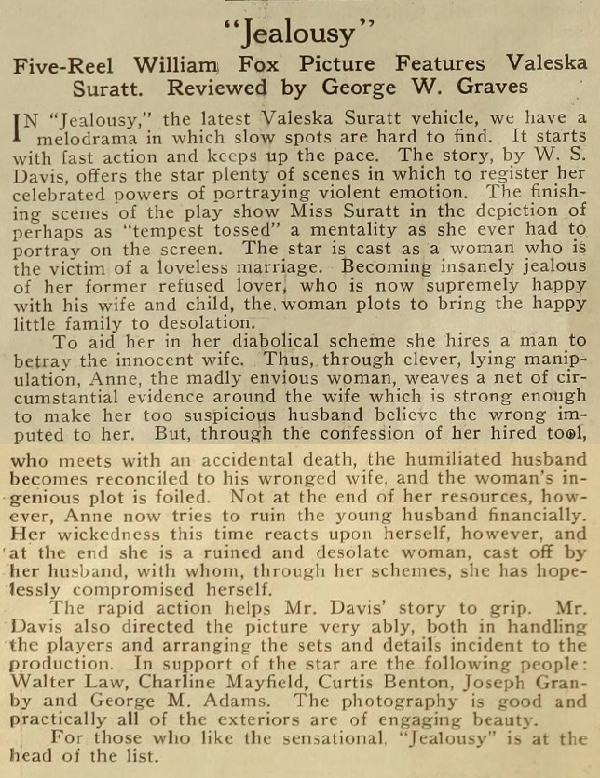
However, the true 'twist' is not the staged assault, but Martin’s reaction. In many films of this period, the husband might have been fooled, leading to a tragic duel or a wrongful arrest, much like the misunderstandings in Shadows from the Past. Instead, Martin is portrayed as a man who has finally seen through the veil. His calm dismissal of Carney and his subsequent abandonment of Anne is a cold, surgical strike. He doesn't just leave her; he invalidates her entire existence as a manipulator. The final image of Anne falling 'senseless to the floor' is the ultimate punctuation mark on her failure. It is a moment of total psychological collapse that feels more earned than the sudden redemptions found in The Luring Lights.
When we place Jealousy alongside its contemporaries, its unique flavor becomes even more apparent. While The Man from Painted Post or The Indian Wars focused on the expansive, rugged landscapes of the American West and the externalization of conflict, Jealousy is claustrophobic, interior, and intensely focused on the rot within the domestic sphere. It shares more DNA with the burgeoning international cinema, such as the Brazilian Paz e Amor, in its attempt to capture the zeitgeist of a world on the brink of profound social change.
Even compared to war-themed dramas like Lafayette, We Come, the stakes in Jealousy feel more personal and, therefore, more visceral. The film suggests that the greatest battles are not fought on foreign fields but in the quiet rooms of a mansion or the frantic floor of the stock exchange. It explores the concept of 'blood will out' or inherent nature, much like the obscure but fascinating What's Bred... Comes Out in the Flesh, asserting that Anne’s malevolence was an inevitable byproduct of her character.
Will S. Davis, though perhaps not as widely remembered today as Griffith or Ince, demonstrates a keen eye for spatial dynamics. The way he positions Agnes and Carney in the frame—initially as a cohesive unit, then gradually isolated by the intrusion of Anne’s 'tips' and 'visits'—visualizes the erosion of their marriage. The use of depth of field, though primitive by modern standards, is effective in scenes where Anne is seen lurking in the background while Agnes and Roland converse, a visual metaphor for her omnipresent threat. This technique is far more sophisticated than the flat staging seen in The Racing Strain.
The film’s pacing is also noteworthy. It builds with a slow, deliberate tension, allowing the viewer to feel the mounting pressure of Carney’s financial losses. By the time we reach the final confrontation, the audience is as exhausted by the machinations as the characters themselves. This is a film that understands the value of the 'long game,' both in its plot and its execution.
It is a tragedy of film history that so many of Valeska Suratt’s films, including Jealousy, are considered lost or exist only in fragmented forms. To analyze this film is to engage with a ghost—a specter of an era where the 'Vamp' ruled the box office and the moral lessons were as sharp as a razor. Jealousy remains a vital document of 1916, a testament to the power of silent acting and the timelessness of human envy. It stands as a precursor to the domestic thrillers of today, proving that while technology changes, the dark heart of human nature remains constant. If you ever have the chance to see a reconstruction or a rare screening, do not miss the opportunity to witness Anne’s descent into the abyss. It is a cinematic experience that resonates long after the final title card fades to black.
IMDb —
1925
Community
Log in to comment.