DbcultAccessing Vault...
Cult Review
Senior Film Conservator
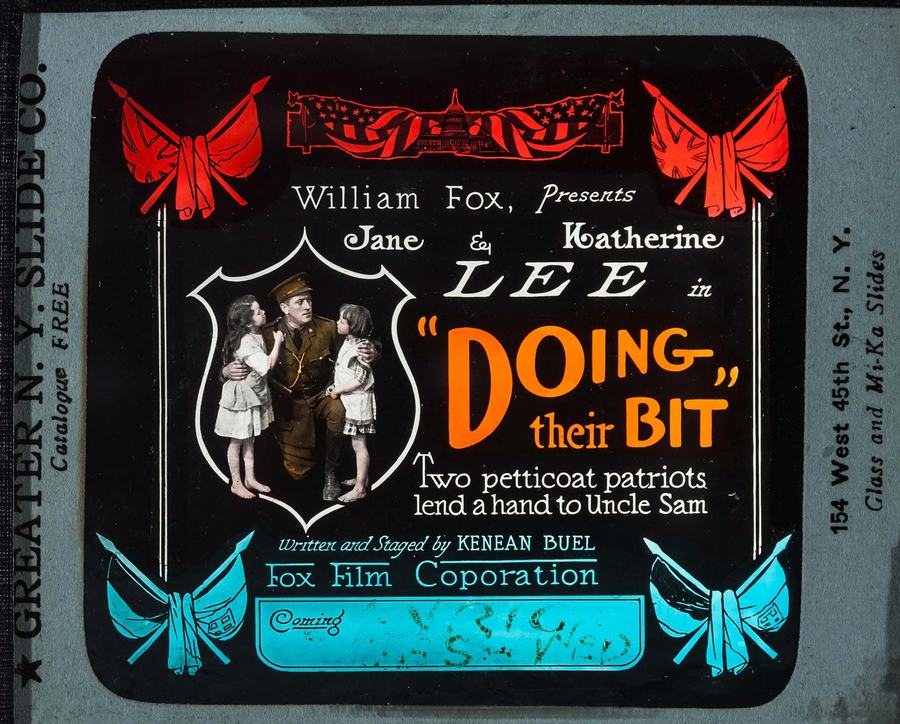
The first time I saw Doing Their Bit—a 1918 one-reeler that flickers like a magnesium flare against the velvet dark of forgotten newsreels—I understood how silence itself can become a percussion instrument. Kenean Buel, journeyman director of Biograph days, here conducts an orchestra of slammed iron doors, hiss-punctuated steam valves, and the Morse-like clatter of child feet on catwalk grating. The result is a war-bond fable disguised as junior sleuth hokum, yet it pulses with an anarchic energy that makes most flag-waving contemporaries feel embalmed.
From the opening iris-in on a Liverpool pier, where Kate and Janie clutch potato-sack luggage while foghorns groan like walruses, Buel weaponizes depth: ropes, crates, and orphaned shadows stack into a cubist precipice over which the war itself leans. The Atlantic crossing is rendered through double-exposed waves cresting like torn tin against a toy-sized ocean liner, the same vessel where our heroines first spot the spies—two men whose cheekbones could slice ham—signaling with a pocket-mirror that catches the moon like a dropped coin.
Cut to America: the O’Dowd mansion is all mahogany sarcophagi and oil-portraits whose eyes swivel, a Gothic preamble to the true cathedral—Uncle Michael’s munitions works, a Beaux-Arts fortress of girders and cathedral windows where every rivet seems sanctified by profit. The camera, drunk on verticality, tilts up past cranes cruciform against the night, then dollies through corridors of brass shell casings that gleam like organ pipes. When the children are accidentally locked inside, the factory becomes a Piranesi prison; every clank reverberates like a distant frontline howitzer.
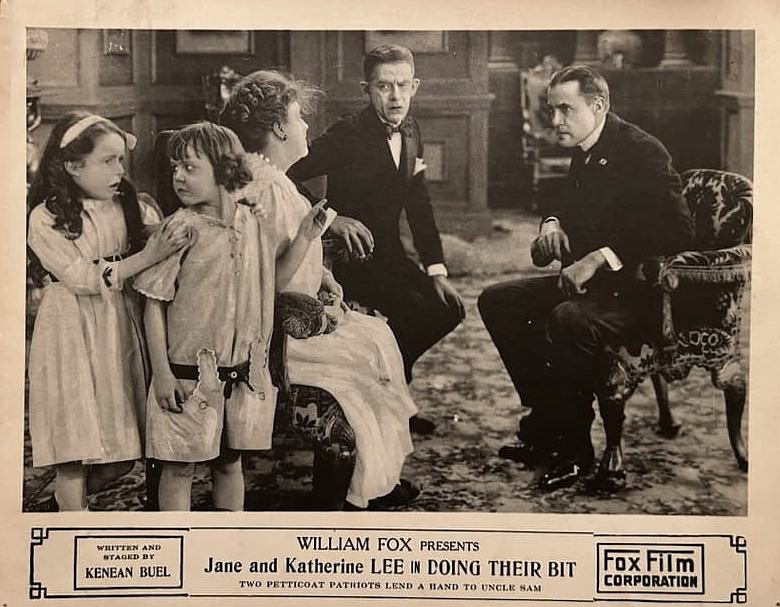
The set-piece arrives when cousin Miles, played by Alexander Hall with the dissolute grace of a John Barrymore understudy, staggers in with the enemy agents. Buel stages the reveal through a silhouette on corrugated iron: three hats, one of them Kaiser-peaked, stretch into gargoyle shadows while the girls peer through a brass pressure-gauge like Persephonal spies. Their retaliation is swift: they lure the intruders beneath a 40-ton Bliss press, yank the release, and the descending ram becomes both Old-Testament judgment and industrial ballet. Intertitles flash: “Tiny hands, big troubles.” The audience in 1918 reportedly cheered so loudly that projectionists feared nitrate ignition.
Yet the film’s true coup de grâce is tonal whiplash. Minutes after the spies are trussed like butcher’s parcels, the narrative pivots to enlistment propaganda: Miles and Jerry—now scrubbed of sin by contrition—march beneath a recruitment banner while a brass band stomps Sousa. Alfred Vanderspent’s subplot delivers class-satire scalpel-sharp: his matriarch, a bejeweled leviathan in a wheelchair, attempts to bribe a stenographer to back-date her son’s birth. Janie and Kate, hiding beneath the escritoire, swap the ledger pages, and the next cut shows Alfred dragged away in doughboy drab, his silk spats caked with parade-ground mud. The children’s grin is feral; the war machine hungers for fresh meat, and even the velvet settee set must donate its progeny.
Performances oscillate between melodramatic semaphore and proto-naturalistic glances. Katherine Lee’s Kate carries a Bolshevik fire in her saucer eyes, while Jane Lee’s Janie—older by a year in life, younger in story—delivers comic pratfalls with Chaplin-timing. Eddie Sturgis as Jerry Flynn manages to smuggle a whole unspoken romance into the way he fingers a rivet stamped by Patricia (Beth Ivins), who appears only in a portrait locket yet glows like a patron saint of shell-turners. John Gilbert, still months from stardom, cameos as a recruiting sergeant whose smile is all enamel and menace.
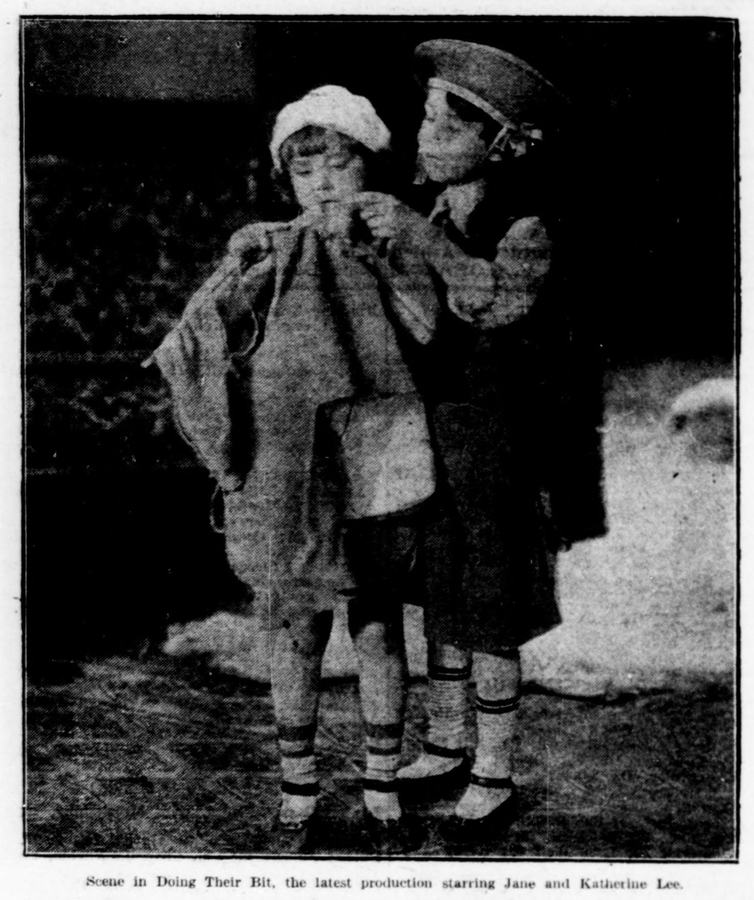
Buel’s visual grammar anticipates German Expressionism without its wood-grain angst. Staircases ascend into fog-blown skylights; steam blasts carve negative space around the children’s silhouettes until they seem cast in bronze. The tinting—cyan for night, amber for interiors, violent magenta for the explosion that never arrives—turns each frame into a hand-tinted Carte de Visite of anxiety. A comparative eye might invoke Madcap Madge for its proto-feminist derring-do, yet Buel’s film is less flapper romp than childhood crucible. Where The Eternal Law moralizes over cosmic justice, Doing Their Bit insists justice is a lever any urchin can pull if given proximity to heavy machinery.
Historically, the picture arrived six months after the Sedition Act, and its release was shadow-promoted by the Committee on Public Information. Lobby cards screamed: “Children fight Prussianism with wits!” Yet beneath jingoistic paint, the film is a meditation on surrogacy: orphans outsourced to American capital, factory workers outsourced to trenches, the wealthy outsourced to public shame. Even the spies—nameless, accent-shifting—are ciphers for the ambient paranoia that gripped the home front when neighbors became potential U-boat liaisons.
Archival fate has not been kind. Only two 35mm prints survive: one at MoMA, replete with Dutch intertitles (a mislabeled distribution reel meant for Batavia), and a 9.5mm Pathé-Baby abridgement in a Normandy barn, discovered beside crates of cider. Both versions lack the final reel, rumored to show Miles’s flag-draped coffin being lifted by the same factory crane that once stamped steel shells. The absence feels perversely correct: a film about collateral loss should itself be fragmentary.
Still, what remains detonates in the mind long after the lights rise. I carried its afterimage through a week of headlines—missiles in desert skies, drones like moonlit mirrors—and realized Buel’s fable prefigures our century’s reliance on whistle-blowing toddlers, on viral clips where small voices topple conglomerates. The die-stamp becomes algorithmic; the locked factory, a data silo; the spies, stateless hackers. The children, forever peering through grating, are us—citizens armed only with proximity to the machine and the audacity to yank the lever.
So if you track down a grainy YouTube rip, stained with watermarks and accompanied by a ragtime piano roll, do not dismiss it as quaint. Crank the volume until you hear the phantom hiss of steam, the ghost-clank of press on steel. Feel the floor vibrate under your sneakers. Remember that history’s leviathan is still stamping, and somewhere, a child’s hand hovers over the release valve—tiny, defiant, undeniably lethal.

IMDb —
1936
Community
Log in to comment.