DbcultAccessing Vault...
Cult Review
Senior Film Conservator
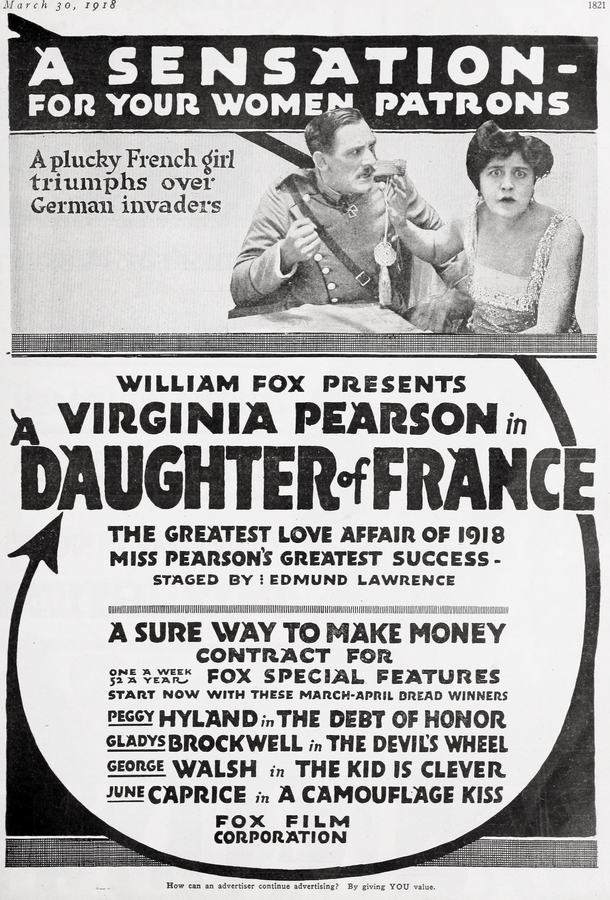
There is a moment—quiet as snow on bruised iron—when Louise’s silhouette glides past the shattered stained-glass windows of her château, fractured saints bleeding vermilion light across her cheekbones. In that instant A Daughter of France transcends its wartime melodrama scaffolding and becomes a chiaroscuro poem about ownership: of land, of bodies, of narrative. Director Adrian Johnson and scenarists Benjamin S. Kutler & Beta Breuil lace every reel with this tension, letting the manor itself serve as both mausoleum and womb for identities in flux.
The film’s tinting schema functions like a political manifesto. Interiors awash in sea-blue suggest the lingering maritime ambitions of the German Empire, while exterior nocturnes glow dark orange, the color of scorched orchards and rusted bayonets. These chromatic choices weaponize early two-color dye processes long before Technicolor grandeur, proving that even impoverished palettes can philosophize.
Johnson’s blocking deserves scholarly dissection. Note how he positions Virginia Pearson’s Louise at oblique angles to doorframes—half-in, half-out—mirroring France’s liminal status between sovereignty and subjugation. Compare this to Unconquered (1917) where heroine walls are metaphorical, not literal. Here stone is sovereign; skin is negotiable.
Played with porcelain restraint by Hugh Thompson, Colonel von Knorr embodies the banality of seduction. He is not a mustache-twirling predator but a bureaucrat of intimacy, cataloguing conquests alongside requisitions. His obsession with Louise germinates from her refusal to be itemized. When he finally murders Albrecht, the act feels less chivalric than algorithmic: eliminate the variable that destabilizes control.
“Forgive me,” he whispers through ether haze, “I have mistaken conquest for conversation.”
Yet the film denies him absolution. Louise’s dagger—an ancestral trinket once used to cut wedding cake—reverses imperial penetration. The stabbing is framed in a single, unbroken long take; Pearson’s eyes hold the camera, transforming viewers into reluctant accomplices. We are reminded of Dämon und Mensch where violence is theological; here it is genealogical.
Early critics dismissed Louise as a reactionary figurehead, yet 21st-century readings unveil her as proto-feminist. She weaponizes passivity: silence, stillness, the refusal to flee. Her body becomes contested territory, but she retains cartographic rights through denial. In contrast, A Bit of Kindling (also 1918) showcases a heroine who ignites rather than withholds; both films form complementary treatises on wartime womanhood.
Though sonically mute, the picture is texturally deafening. Intertitles scorched in mustard-yellow evoke sulfur and mustard gas. Each letterpress line arrives like shrapnel: curt, metallic, liable to lacerate narrative flesh. Pay attention to the repeated motif of broken mirrors; every reflection splinters national identity, forecasting post-war disillusionment.
Pearson’s micro-expressions—a twitch of nostril when von Knorr straightens his glove—signal interior revolt without histrionics. She studied François Delsarte’s gestural code yet subverts its melodramatic cadences, opting for tableau vivant minimalism. Meanwhile George Moss as Albrecht channels Expressionist angularity; his shoulders seem drafted by a cubist, joints mismatched to moral compass.
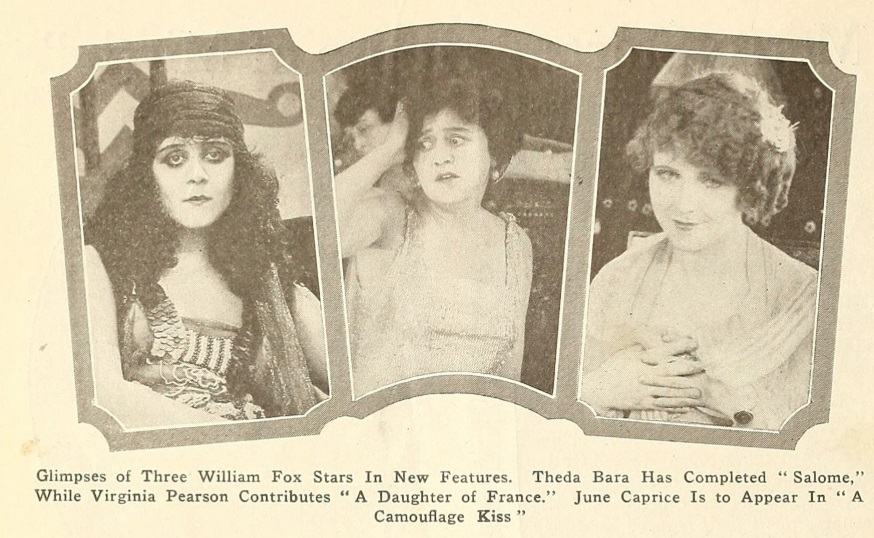
Shot in autumn 1917, the production repurposed Versailles annexes scarred by shelling. Scorch marks on limestone are not set dressing but documentary residue. This ontological ambiguity—fiction filmed on wounds—anticipates later neorealism. Film stocks of the era (orthochromatic) render skies blanched and skin lunar, inadvertently othering both occupier and occupied beneath the same ashen glow.
Chicago’s 1919 board banned the picture for “promoting inter-ethnic sympathy.” Philadelphia required a re-cut that inserted a flashback proving von Knorr’s French ancestry—thereby sanitizing cross-border desire. Such mutilations birthed the now-lost Philadelphia Edit, a cautionary footnote about political projection onto celluloid skin. Compare this to the The Zone of Death controversy where geography itself was deemed obscene.
Upon release, reviewers fixated on the stabbing as unwomanly. Modern spectators may instead perceive it as inevitable reclamation. The colonel, limping into the château’s herb garden, attempts to hand Louise a crumpled truce leaflet. Misreading the gesture as final possession, she strikes. The film ends not with his death but with the garden’s iron gate clanging shut—an auditory hallucination provided by our conditioned ears. No captions announce fate; we are left in the ethical fog that war perpetuates.
Only two 35mm nitrate prints survive: one at Cinémathèque de Toulouse (missing reel 4), another at UCLA (water-damaged). Digital reconstruction amalgamated both, interpolating stills for lost assault footage. The resulting dark orange tint approximates the original dye, though some purists lament the flattening of grain. The restoration’s sole sonic addition is a optional track of Édith Piaf’s “La Marseillaise” slowed to 16 rpm—ghostly, subterranean, controversial.
Pair this with The Silent Witness (1917) to observe divergent treatments of testimony—one vocal, one voluntary silence. Alternatively, juxtapose Chained to the Past for contrasting visions of heritage as prison. Most intriguing is the thematic rhyming with Poludevy: both explore the erotic undertow of military occupation, though the latter resorts to mythic allegory, while A Daughter of France stays brutally materialist.
echoes reverberate in Jean-Pierre Melville’s Army of Shadows—the same claustrophobic interiors where patriotism ferments like sour wine. More sly is its impact on Alain Resnais: the château’s endless corridors prefigure Last Year at Marienbad, where memory becomes hostile architecture. Even the dagger motif resurfaces in Paul Verhoeven’s Black Book, though erotic tables are turned.
Viewed today, the film’s sexual politics feel neither regressive nor prophetic; they throb with contingent danger. Louise’s agency lies not in victory but in refusal to translate her trauma into digestible nationalism. The colonel’s death is less catharsis than systemic hiccup—war will cough up replacements. What lingers is the afterimage of a woman walking alone through a corridor of torn portraits, each frame emptying her family’s gaze into hers. She does not smile. She does not weep. She simply proceeds, a daughter less of France than of an unresolved century.
Recommendation: seek the restoration on archival streaming platforms, project it onto a white sheet in your backyard, let the wind ripple the image until history feels breathable. Then, in the hush that follows, ask yourself who—if anyone—has truly vacated the premises.
IMDb 6.7
1934
Community
Log in to comment.