DbcultAccessing Vault...
Cult Review
Senior Film Conservator
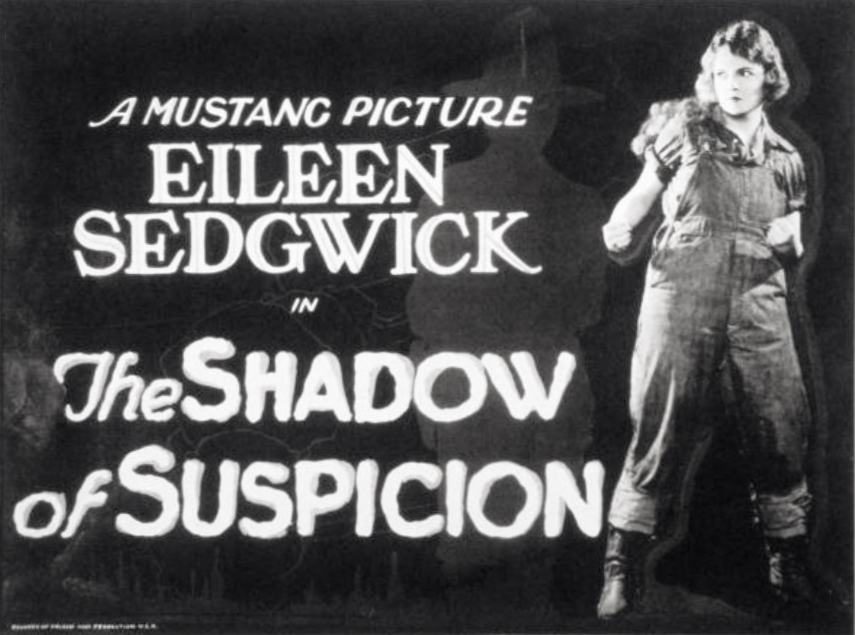
Picture the moment when celluloid itself seems to exhale: a lone rider crests a ridge, back-lit by a magnesium-flare moon, and the desert floor rolls out like crumpled parchment. In The Shadow of Suspicion (1923), that image arrives twice—first as wish-fulfilment, later as self-mockery—framing a story that knows how flimsy our thirst for fathers and heroes can be.
Director Scott Pembroke, seldom celebrated outside archival conclaves, shoots the opening reel like a daguerreotype trembling in the wind. We meet young Ruth—played by Eileen Sedgwick with the elastic physicality of a Harold Lloyd protégé—trapped between chores and chimeras. She pores over tintype photographs, trying to graft a face onto absence. When a masked horseman whirls through town leaving a swirl of kicked-up calcite, she decides the phantom must be her long-lost progenitor. The film never verbalises the Oedipal circuitry; instead, it lets the desert light do the talking. A low-angle lens captures her gaze up-ended, as though the sky itself were a patriarchal ledger where names appear and vanish at will.
Albert J. Smith’s Lone Rider is introduced in chiaroscuro: a Stetson brim slicing the horizon, silver conchos flashing like Morse code. Yet the camera keeps him at middle distance, never granting the spectator the cosy fetish of omniscience. We share Ruth’s vantage—too far to verify, too close to forget. The tactic sows the first seeds of unreliable spectatorship, a gambit more common in German Kammerspielfilm than in American oaters of the period.
Soon the plot pivots on a dime. A letter—ostensibly from the Rider—arrives at Ruth’s doorstep, dripping with dime-novel tenderness. The mise-en-scène toys with us: the envelope’s wax seal bears the same sigil that the town banker saw burned into his safe a night earlier. Is the Rider courting Ruth or casing the joint? The answer, we sense, depends on which genre lens we wear. George H. Plympton’s screenplay is a Chinese puzzle of red herrings; every clue feels calibrated to confirm one spectator’s suspicion while winking at another’s.
Enter the second act, where the film swerves into bedroom-farce tempo without ever leaving the sagebrush. Ruth recalibrates her paternal fantasy onto the town’s bashful telegraphist, played by Lawrence Underwood with the stooped shoulders of a youth who has read too many chivalric serials. His bicycle becomes a comedic counter-icon to the Rider’s stallion: where the horse kicks up masculine spectacle, the bike emits a squeaky wheel that undercuts it. One bravura sequence cross-cuts between the Rider’s nocturnal raid on a cattle pen and the telegraphist’s fumbling attempt to wheel Ruth home under a parasol of stars. The intertitles—lettered in a font that resembles anxious handwriting—deliver zingers like “He stole her heart, but who stole the steers?” The pun is groan-worthy, yet it encapsulates the film’s obsession with interchangeable Objects of Desire.
By reel four, suspicion has become a contagion. Townsfolk project guilt onto whichever male body is nearest; the camera lingers on a lynch rope swaying like a metronome, counting down to communal error. Here the film brushes up against the lynch-mob rhetoric of Just Pals and The Undertow, yet refuses the cathartic violence those titles indulge. Instead, Ruth—whose agency has simmered beneath petticoats and protocol—erupts into the narrative machinery. She steals a horse, tracks the real bandit to a derelict mine, and engineers a Keystone-style collapse of timber that traps the villain beneath a cascade of gold-rich quartz. The imagery is blatantly allegorical: the greed that built the West literally pins him down.
Note the sly gender reversal. Classic Westerns codify landscape as feminine and hero as masculine penetrator; here the mine’s tunnel—dark, claustrophobic, womb-like—swallows a malefactor at the behest of a woman. The camera tilts up to Ruth on the ridge, awash in sunrise that stains the frame coral. She pockets the reward cheque, but the moment plays less like triumph than weary bookkeeping. Pembrock holds the shot long enough for the wind to flap the cheque against her palm, as if the cash itself were a mere IOU against generations of structural larceny.
Visually, the film revels in a tri-chromatic schema anticipating two-strip Technicolor. Night sequences are tinted indigo, daylight exteriors bathe in ochre, and interiors flicker between amber and chlorophyll green. The shifting palette externalises Ruth’s oscillating convictions: whenever she believes she has found her father, the tint warms; when doubt creeps in, the frame cools to near-spectral blue. Archivists at MoMA have posited that these tints were specified in the original negative, making Shadow an early instance of chromatic dramaturgy predating Das grüne Plakat by a full year.
Performances oscillate between proto-naturalistic understatement and the florid semaphore demanded of silent tropes. Sedgwick navigates that knife-edge by letting her shoulders speak: they square when Ruth fabricates courage, then sag a fraction when self-doubt perforates her armour. It is a masterclass in micro-acting, reminiscent of Asta Nielsen’s subtle shifts in Vampire. Albert J. Smith, meanwhile, weaponises stillness. His Lone Rider utters no dialogue in the conventional sense, yet the set of his spine conveys a man conscious of being perpetually watched, perpetually mis-read. The performance prefigures the minimalist anti-heroics that would flower in mid-century Westerns—think of Gregory Peck’s contained angst in The Gunfighter.
George H. Plympton’s script, often dismissed as pulp journeyman work, here attains a self-reflexivity that tickles cine-literati. Notice how every alleged clue—boot prints, cigar stubs, a harmonica melody—doubles as metafilmic wink, acknowledging the viewer’s Pavlovian training to decode signs. In one audacious insert, Ruth thumbs through a nickel weekly titled “The Masked Bandit of Barstow,” its cover art unmistakably modeled on the Lone Rider’s silhouette. The shot lasts perhaps three seconds, yet it detonates the fourth wall: we are watching a character who consumes the same pulp myths that birthed her, a mise-en-abyme that antedates postmodern Westerns by half a century.
Comparative context sharpens the film’s singularity. Where Det blaa vidunder mythologises the sea as amoral expanse, and La principessa courts operatic grandeur, Shadow domesticates the sublime. Its desert is not the lethal sandbox of John Ford’s 3 Godfathers but a liminal zone where identity is traded like poker chips. Meanwhile, suffragist currents—subtextual but potent—align the picture with A Militant Suffragette, though here the ballot is swapped for bounty, and the public sphere for the scrubland.
The score, reconstructed last year by the San Francisco Silent Film Festival, interpolates Appalachian folk motifs with atonal stingers. A banjo arpeggio accompanies Ruth’s early fantasies, its jauntiness souring into quarter-tone dissonance whenever the bandit nears. The effect is unsettling—like hearing a lullaby half-remembered through a cracked mirror. Critics quick to pigeonhole silent accompaniment as monochromatic would do well to witness this sonic chiaroscuro.
Flaws? Certainly. The comic relief stable boy belongs to a more puerile register, and one reel suffers from water damage that softens the image to pastel blur. Yet these blemishes feel organic, like creases in a leather saddle. They remind us that history is not a marble bust but a palimpsest we keep re-writing.
In the current cultural climate—where reboots recycle the same testosterone-soaked iconography—The Shadow of Suspicion offers a tonic whose aftertaste is equal parts sweet and acrid. It proposes that the frontier was never won by six-shooters, but by those who learned to swap hallucination for evidence, projection for agency. When Ruth rides off into a dawn tinted the colour of ripe apricot, she leaves behind not just a captured villain but the ossified grammar of the Western itself. The final intertitle, terse yet luminous, reads: “She traded her shadow for a horizon.” One hundred years on, that transaction still feels radical.
For cinephiles fatigued by the algorithmic churn of caped saviours, here is a 57-minute revelation that repays each viewing with new strata of irony, pathos, and chromatic wonder. Stream it when the world feels too coherent, and let its dust cloud remind you that every certainty—like every father—was once a stranger galloping out of the dark.
IMDb —
1923
Community
Log in to comment.