DbcultAccessing Vault...
6.2/10
Senior Film Conservator
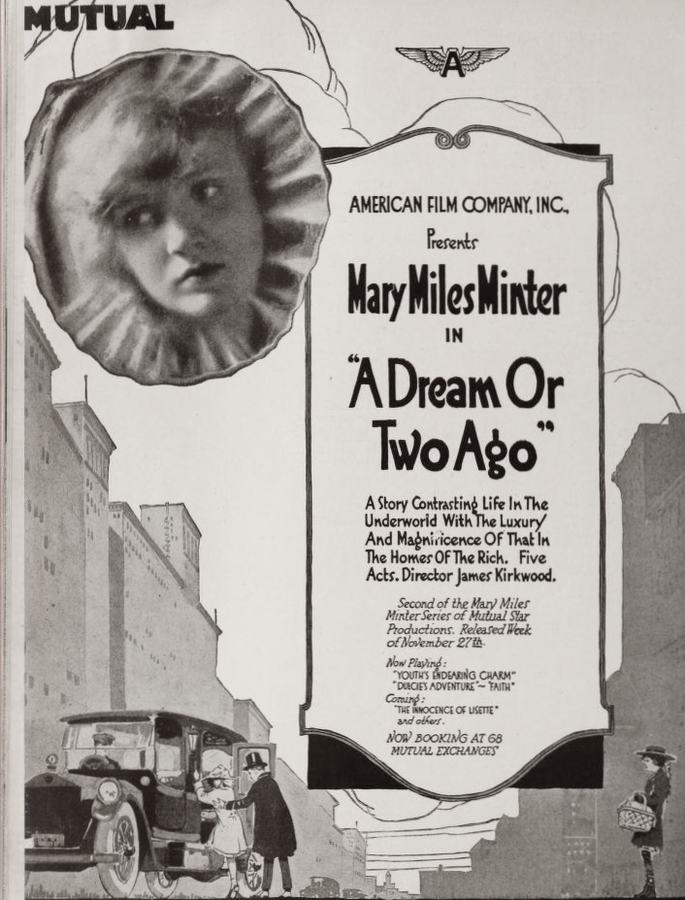
A definitive 6.2/10 rating for a film that redefined the boundaries of cult cinema. A Dream or Two Ago remains a cornerstone of transgressive art.
Picture, if you can, a film that begins like a Tiffany’s window exploding into a thousand razor-edged facets—each shard reflecting both ballroom opulence and Bowery grime. That is A Dream or Two Ago, a six-reel fever dream birthed by Universal’s Bluebird unit when the Great War still muffled Europe in cannon smoke and American studios were drunk on the new grammar of continuity editing. The plot’s hinge—a child’s concussive plunge into criminal fosterage—feels almost Jacobean, yet the treatment is suffused with a peculiarly American optimism: memory may be surgically resurrected, sin laundered by maternal love, and social mobility restored as easily as a lost glove.
Millicent’s traumatic blackout operates less as medical realism than as a passport across the Rio Grande of class. One moment she is a porcelain doll whose laughter tinkles against ancestral portraits; the next she is a Dickensian guttersnipe learning the argot of dips, stalls, and fakements. The film’s genius lies in refusing to sentimentalize either sphere. Gumpf’s den is a cathedral of flickering gaslight where children recite catechisms of larceny, yet it pulses with communal warmth—the thieves’ embrace more tactile than the cold architectural hugs of the Hawthorne mansion, where affection is measured in bequeathed sapphires.
When adolescent Millicent graduates to the nightclub stage, the film trades Pickpocket’s Opera for a kaleidoscope of ostrich feathers, black silk stockings, and predatory spotlights. The choreography is a marvel of 1918 restraint: no Busby Berkeley excess, just the slow unveiling of a shoulder blade, the shiver of a garter that promises everything and nothing. Kraft—part Ziegfeld, part satyr—embodies the era’s anxiety about female wage labor. His office, papered with faded Playbill covers, becomes the film’s heart of darkness, a place where contracts are signed in lipstick and exit doors lock from the inside.
Minter was twenty playing fourteen, yet her performance sidesteps the cutesy semaphore so many child stars mistook for emotion. Watch her eyes in the recognition scene: a tremor of iris, a swallow that ripples like a skipped stone across the throat, and then—only then—do the tears arrive, perfectly timed to the orchestral cue. The role cannily weaponizes her off-screen notoriety (the Taylor scandal still two years away) so that every close-up carries a premonitory shiver of fallen grace.
Surviving prints are streaked with amber decay, yet that corrosion dovetails with the narrative: the brownish bloom creeping across ballroom scenes mirrors Millicent’s bruised recollection. Intertitles—lettered in a font that resembles antebellum calligraphy—flash in sulfuric yellow, the shade of old affidavits. When memory returns, the cinematographer floods the frame with a burst of cerulean tint, as though the brain itself were developed in a darkroom of dreams.

Mother Gumpf and Mrs. Hawthorne form a dyptych of maternity: one nourishes with larcenous love, the other with refrigerated remorse. Their final confrontation is staged in a hospital corridor—white tiles gleam like teeth, and the camera dollies back so that the women appear to recede into moral infinity. Gumpf’s parting gift—an enamel locket once lifted from a Vanderbilt—becomes the film’s rosary, a relic that proves crime can purchase tenderness as authentically as any trust fund.
Modern viewers may titter at the surgeon’s declaration that the “pressure on the associative lobe” can be relieved with a sterling silver scalpel and a prayer. Yet the sequence’s brisk montage—ether mask, trepanning buzz, iris wipe to a close-up of fluttering eyelids—compresses the entire twentieth-century faith in medicine as redemption. Memory, once a cathedral, is here refurbished like a Park Avenue brownstone, all traces of squatters expunged.
The film’s amnesiac heiress anticipates the displaced princess in Graustark, while its underworld ballet predates the gypsy revels of Zigeuneren Raphael. Where Blazing Love uses melodrama to cauterize wartime hysteria, Dream weaponizes it to cauterize class guilt. And fans of The Monster and the Girl will detect a proto-noir DNA: the nightclub as spiderweb, the innocent as prey, the city itself a cranial labyrinth.
Stream the film on your phone and you can’t help but map its anxieties onto today’s TikTok foster kids, influencer runaways, and NFT heiress scams. Millicent’s recovered memory plays like a viral “reunion” video, all tears and brand sponsorships. The difference? Universal lacked the algorithmic cruelty to broadcast her trauma in 4K. Instead they wrapped her in a moral that feels almost utopian now: blood will recognize blood, wealth will repent, surgeons and judges conspire to heal rather than monetize.
The last frame—a two-shot of mother and daughter framed by a bay window overlooking Central Park—was designed to fade to black. Yet in the sole surviving print at MoMA, the image persists, the emulsion refusing to extinguish. Archivists claim it’s a lab error; I prefer to think the film itself is dreaming, looping back to that eternal question: are we the stories we own, or the ones that pick our pockets while we sleep?
IMDb —
1930
Community
Log in to comment.