DbcultAccessing Vault...
Cult Review
Senior Film Conservator
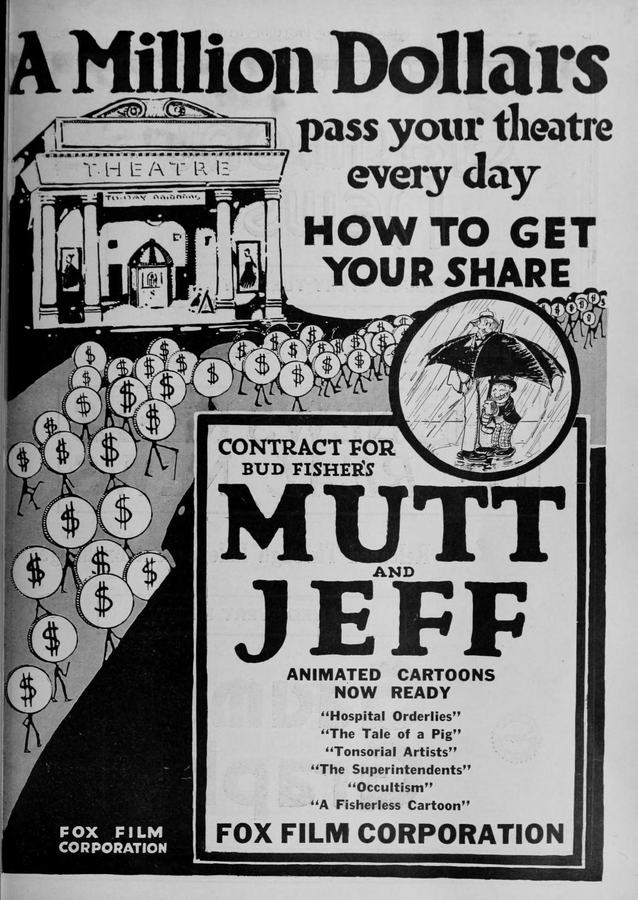
In the nascent, often experimental dawn of cinematic artistry, when the very language of moving pictures was still being vigorously defined, a peculiar and profoundly self-aware gem emerged: Bud Fisher’s A Fisherless Cartoon. Far from a mere ephemeral flicker on the silver screen, this animated short stands as a testament to early creative audacity, an audacious narrative gambit that playfully dismantled the fourth wall long before such concepts became commonplace. It's not just a film; it's a philosophical inquiry into the nature of creation, authorship, and the surprising agency of fictional characters. The premise, deceptively simple, unfurls with a delightful meta-textual flourish: the venerable cartoonist Bud Fisher, himself the architect of the iconic Mutt and Jeff, is depicted in the throes of his craft, his drawing board a crucible of emerging forms. Suddenly, the mundane intervenes – a telephone rings, a jarring intrusion from the 'real' world that yanks the creator away from his nascent universe. What transpires next is nothing short of revolutionary for its era, a pivotal moment where the created dare to assume the mantle of the creator.
The very moment Fisher’s hand departs the frame, his half-sketched protagonists, Mutt and Jeff, spring into uncanny, vibrant existence. They are not merely animated figures following a predetermined path; they are characters imbued with a nascent consciousness, left stranded on the pristine, intimidating expanse of their own unfinished narrative. This narrative pivot is where A Fisherless Cartoon transcends mere novelty. It transforms into an early, unwitting treatise on existentialism within a two-dimensional plane. Faced with an abandoned storyline and the looming threat of narrative stasis, Mutt and Jeff take matters into their own hands, quite literally. They pick up the discarded pen, becoming their own illustrators, their own scriptwriters, their own directors. This startling act of self-authorship is a vibrant, humorous, yet deeply insightful exploration of agency. It posits a world where creations, once brought into being, possess an inherent drive to complete their own stories, even if it means subverting the traditional hierarchy of creator and created. This is a profound conceptual leap for early animation, a genre often preoccupied with simple gags and physical comedy. It hints at the potential for animation to explore complex ideas, laying groundwork for future generations of animators to push boundaries far beyond the immediate visual spectacle.
Bud Fisher’s role in this film is fascinatingly paradoxical. As the titular 'Fisherless' element, his absence is precisely what galvanizes the narrative. His brief, on-screen appearance as himself sets the stage, grounding the fantastical conceit in a veneer of reality before the cartoon world takes over. His departure is the catalyst for the entire meta-narrative. This ingenious framing device, where the creator steps out of the frame to allow his creations to flourish, speaks volumes about Fisher’s own understanding of his craft and perhaps a playful self-awareness of the enduring power of his characters. It’s a testament to the strength of Mutt and Jeff as personalities that they could sustain such a narrative, even in their nascent, half-drawn state. Their very incompleteness becomes a source of dramatic tension and comedic opportunity, highlighting the fluidity and malleability of the animated medium. The film, in essence, becomes a collaborative effort across dimensions, a fascinating dialogue between the artist and his art, orchestrated by the artist himself to demonstrate the vivacity of his creations. This kind of self-referential storytelling was remarkably ahead of its time, providing a glimpse into the intellectual possibilities of a medium often dismissed as mere children's entertainment.
The brilliance of A Fisherless Cartoon also lies in its effective portrayal of Mutt and Jeff’s distinctive personalities, even within this unconventional framework. Mutt, typically the taller, more assertive figure, and Jeff, his shorter, often more bewildered counterpart, retain their established dynamic as they grapple with their newfound artistic responsibilities. Their attempts to finish the cartoon are infused with the slapstick humor and character-driven gags that made them newspaper darlings. We witness their struggles with perspective, their arguments over narrative direction, and their eventual, often clumsy, collaborative efforts. This provides not only comedic relief but also reinforces their individual identities, proving that their essence transcends the mere lines on a page. Their actions demonstrate a form of practical intelligence, an adaptability born of necessity, as they literally draw themselves out of a predicament. This showcases the depth of characterization Bud Fisher had already achieved with his creations, allowing them to carry a narrative that challenged the very conventions of their existence. It's a charming display of animated resilience, a visual metaphor for the power of imagination and collaboration when faced with an unexpected void.
In an era where cinema was still finding its footing, often exploring grand narratives of human drama or capturing fleeting glimpses of reality, A Fisherless Cartoon offered a starkly different, yet equally compelling, path. While many films of the period, such as the intense emotional journey depicted in The Great Love or the stark realism of On the Belgian Battlefield, sought to immerse viewers in external realities, Fisher’s short pulled the curtain back on the very act of creation itself. It was an internal, self-referential exploration, a stark contrast to the outward-looking narratives that dominated. The animation style, while simple by modern standards, was revolutionary in its conceptual daring. It wasn't about fluid motion or intricate detail; it was about the idea, the meta-narrative, and the playful subversion of expectations. This intellectual playfulness sets it apart from many contemporary animated shorts, which often focused on simpler sight gags or rudimentary storytelling. It demonstrated that animation could be a vehicle for complex ideas, not just visual spectacle. This early meta-commentary prefigures later artistic movements that would similarly question the boundaries between art and life, creator and creation, showcasing a remarkably prescient vision for the medium.
The enduring impact of A Fisherless Cartoon, though perhaps not immediately evident in direct stylistic imitations, resonates deeply within the broader history of meta-fiction and self-referential art. It planted a seed, a conceptual blueprint, for how characters could transcend their narrative confines. This early exploration of character agency stands in fascinating contrast to the more straightforward, plot-driven narratives prevalent in films like The Plow Woman or The Range Boss, where characters are firmly bound by the exigencies of their dramatic situations. Here, Mutt and Jeff become active participants in their own genesis, a creative act that imbues them with a unique vitality. It foreshadows later works across various media that would similarly play with the fourth wall, from theatrical productions where actors address the audience, to novels where characters comment on their own literary existence. While other early films, such as the intriguing Spiritisten, might have pushed boundaries with their thematic content or nascent special effects, A Fisherless Cartoon carved its niche through an intellectual and structural innovation that was arguably even more radical for its time. It’s a subtle yet powerful declaration of animation's capacity for intellectual depth, demonstrating that even in its infancy, the medium could engage with profound ideas about art, identity, and narrative construction.
Moreover, the film serves as an implicit commentary on the creative process itself. It highlights the often-unseen struggles and spontaneous decisions that shape artistic output. Bud Fisher, as both writer and on-screen presence, offers a glimpse into his world, then playfully cedes control. This act of relinquishing control to his creations is a profound artistic statement, suggesting that once an idea takes root, it can develop a life of its own, evolving beyond the initial intentions of its progenitor. This resonates with any artist who has felt their work take an unexpected turn, guided by an internal logic that seems to emerge from the art itself. The film’s minimalist aesthetic, with its focus on the drawing board and the evolving lines, further emphasizes this theme. It strips away elaborate backdrops and intricate movements to focus on the fundamental act of creation, making the process itself the central drama. Unlike the complex narrative unraveling in The Mystery of St. Martin's Bridge, which relies on external events and detective work, A Fisherless Cartoon's mystery is internal: how will these characters complete their world? It’s a testament to Fisher’s innovative spirit that he could distill such a complex idea into a concise and humorous animated short.
A Fisherless Cartoon remains a captivating artifact not just for its historical significance, but for its enduring charm and intellectual playfulness. It’s a reminder that true innovation often springs from challenging fundamental assumptions. By asking 'what if the characters drew themselves?', Bud Fisher opened a Pandora's box of narrative possibilities for animation and beyond. It’s a delightful paradox: a film about an unfinished work that feels remarkably complete in its conceptual execution. Its influence, while perhaps subtle and indirect, can be felt in every subsequent work that dares to break the fourth wall, that questions the nature of its own reality, or that playfully blurs the lines between creator and creation. This short, often overlooked, stands as a quiet yet powerful monument to the boundless imagination that characterized the earliest days of cinema, proving that even with rudimentary tools, visionary artists could craft narratives that continue to provoke thought and inspire wonder. It’s a piece that demands re-evaluation, not just as a historical curiosity, but as a vibrant, living example of early meta-fiction, a tiny masterpiece that continues to draw new interpretations with every viewing. Its simplicity belies a profound conceptual richness, making it a truly remarkable entry in the annals of animated film history.
In conclusion, A Fisherless Cartoon is more than just an early animated short; it is a foundational text in the canon of meta-narrative storytelling. It stands as a vibrant, humorous, and remarkably prescient exploration of artistic autonomy and the dynamic interplay between creator and creation. Bud Fisher, through his ingenious premise and the enduring appeal of Mutt and Jeff, crafted a work that continues to resonate with its intellectual playfulness and groundbreaking approach. It reminds us that even in the most nascent forms of media, the human (and in this case, animated) imagination knows no bounds, constantly seeking to redefine the limits of storytelling. It’s a compelling argument for the power of animation to not only entertain but also to challenge our perceptions of reality and authorship. A must-see for anyone interested in the origins of meta-fiction or the philosophical underpinnings of early cinematic experimentation.
IMDb —
1926
Community
Log in to comment.