DbcultAccessing Vault...
Cult Review
Senior Film Conservator
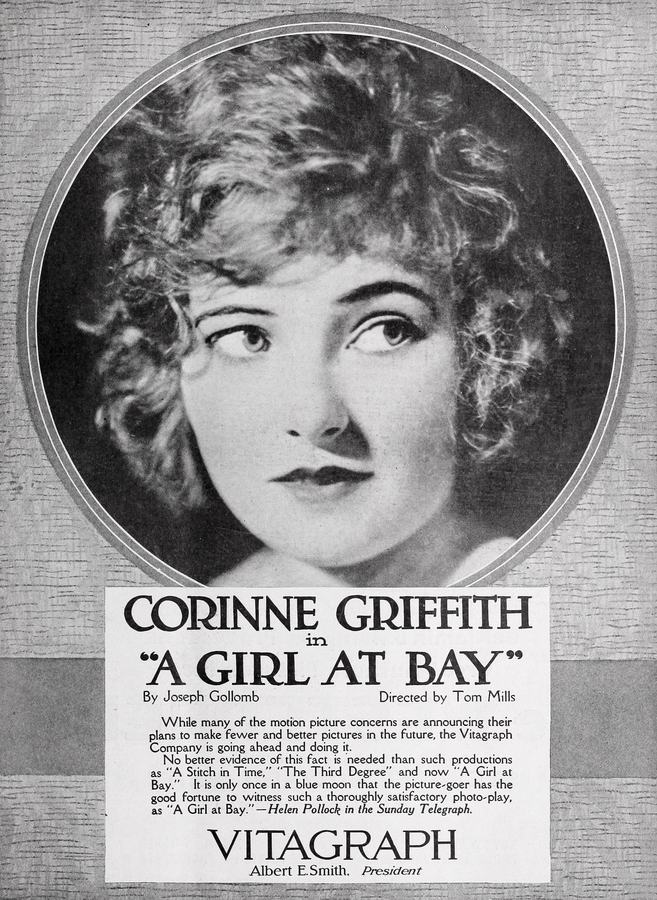
When the silent era first unfurled its tapestry of intrigue, few films managed to intertwine romance, forensic curiosity, and moral ambiguity as deftly as A Girl at Bay. The narrative opens with a tableau that could belong to a chiaroscuro painting: Mary Allen, portrayed with understated poise by Jane Jennings, drops a knife slick with crimson, and the lifeless form of Judge Robert Craigin slumps beside her. The camera lingers on the glint of steel, the pooling blood, and Mary’s trembling hands, establishing a visual metaphor for the precarious balance between innocence and accusation.
From this inciting incident, the film embarks on a labyrinthine journey through the corridors of power, psychology, and domesticity. Mary, seeking refuge from the relentless gaze of law enforcement, secures a position as secretary to Judge Bruce Craigin (Bernard Siegel), the younger sibling of the deceased magistrate. The juxtaposition of Mary’s modest attire against Bruce’s austere courtroom robes underscores a class tension that subtly informs their evolving relationship. Their courtship, rendered with a tenderness that feels almost anachronistic in a murder mystery, is punctuated by lingering glances and whispered confidences, a stark contrast to the cold, procedural world of Detective Hooker (Walter Horton) and Professor Galt (Harry Davenport).
Professor Galt, a criminal psychologist whose theories echo the nascent field of forensic psychiatry, becomes the intellectual antagonist to Mary’s emotional arc. Galt’s conviction that the aesthetic elements of a crime scene can betray the perpetrator’s psyche is a narrative device that propels the plot into a realm of symbolic analysis. He persuades Bruce to allow Mary to furnish their new home, arguing that the decorative motifs—rich tapestries, ornate mirrors, and a particular arrangement of furniture—mirror those of the room where Robert met his demise. This premise, while melodramatic, invites viewers to contemplate the relationship between environment and culpability, a theme that resonates with contemporary discussions of “crime scene staging.”
The film’s visual language employs a palette that, while constrained by the monochrome medium, is hinted at through set design and lighting. Dark shadows dominate the courtroom scenes, while the domestic interiors are bathed in a softer, diffused glow, suggesting a sanctuary from the external turmoil. The director’s choice to frame Mary’s moments of doubt in tight close‑ups, contrasted with wide shots of the opulent furnishings, creates a visual tension that mirrors the narrative’s central conflict.
As the investigation intensifies, Detective Hooker’s methodical interrogation style provides a counterpoint to Galt’s psychological speculation. Hooker’s reliance on tangible evidence—fingerprints, the positioning of the knife, and eyewitness testimony—grounds the story in procedural realism. Yet, the film never fully resolves the dichotomy between intuition and empiricism; instead, it allows both approaches to coexist, reflecting the era’s fascination with emerging scientific methods and lingering reliance on gut instinct.
The turning point arrives when Thomas Gray (Walter Miller), a peripheral character whose motives are initially opaque, steps forward with a confession that reconfigures the entire narrative architecture. Gray reveals that he had been concealed within the very room where the murder occurred, awaiting an opportunity to avenge his wife’s suffering at the hands of the Craigin family. When Bruce, driven by jealousy and suspicion, lunges at Mary, she instinctively raises a paper‑knife—a prop that becomes a red herring—only to faint from the shock. In the ensuing chaos, Gray seizes the weapon, strikes Bruce, and deliberately plants the knife in Mary’s hand to frame her. This revelation, delivered with a gravitas that rivals the most dramatic courtroom denouements, underscores the film’s central thesis: appearances are deceptive, and truth often lies beneath layers of misdirection.
The resolution, wherein Mary and Bruce reconcile and embark on a life of mutual respect and affection, may appear conventional, but it is rendered with a sincerity that feels earned after the preceding turbulence. Their happiness is not merely a narrative convenience; it is a testament to the film’s belief in redemption and the possibility of love transcending societal judgment.
When situating A Girl at Bay within the broader cinematic landscape, parallels emerge with contemporaneous works such as The Student of Prague, which also explores identity fragmentation, and The Adventures of Kathlyn, notable for its serial storytelling and strong female protagonist. However, A Girl at Bay distinguishes itself through its hybridization of mystery, romance, and early forensic theory, a combination rarely seen in silent cinema.
The performances merit particular commendation. Jane Jennings imbues Mary with a nuanced blend of vulnerability and resolve; her eyes convey a silent narrative that transcends the absence of dialogue. Bernard Siegel’s portrayal of Bruce balances authority with tenderness, allowing the character to evolve from a stern judge to a compassionate partner. Harry Davenport, as Professor Galt, delivers a measured, almost academic cadence that lends credibility to his psychological musings, while Walter Horton’s Detective Hooker exudes a stoic determination that anchors the procedural aspects of the plot.
From a screenwriting perspective, Joseph Gollomb and Katherine S. Reed craft a script that oscillates between melodramatic exposition and tightly wound suspense. Their dialogue—though limited by intertitles—captures the era’s linguistic elegance while still conveying the urgency of the investigation. The pacing, while deliberate, never succumbs to stagnation; each act transition is punctuated by a visual motif—be it the flicker of a candle, the rustle of silk, or the clink of a glass—that signals a shift in narrative momentum.
Cinematographically, the film employs inventive camera angles that were avant‑garde for its time. Low‑angle shots of the courtroom convey the oppressive weight of the law, whereas high‑angle perspectives of the domestic interior suggest a bird’s‑eye view of the characters’ emotional landscape. The use of soft focus during intimate moments between Mary and Bruce creates a dreamlike quality, reinforcing the notion that love offers an escape from the harsh realities of the external world.
The set design, particularly the furnishings that become a narrative clue, deserves scholarly attention. The mirrored wall, the intricate rug pattern, and the placement of a solitary vase echo the composition of the murder scene, reinforcing Galt’s hypothesis that environmental cues can betray a perpetrator’s psyche. This visual echo serves as a meta‑commentary on the film’s own structure: just as the décor mirrors the crime, the film’s own motifs mirror its thematic concerns.
In terms of thematic resonance, A Girl at Bay interrogates the fragility of reputation, the gendered dynamics of suspicion, and the ethical implications of psychological profiling. Mary’s journey from suspect to exonerated spouse mirrors the broader societal tendency to police women’s behavior, a motif that aligns with modern feminist critiques of early cinema. Moreover, the film’s exploration of forensic psychology anticipates later genre staples such as The Bride of Fear, which similarly blends investigative rigor with atmospheric tension.
The musical accompaniment—though not captured on the surviving print—would have likely employed a leitmotif that underscored Mary’s internal turmoil, shifting from somber strings during moments of accusation to lilting piano during scenes of affection. This auditory contrast would have amplified the film’s emotional dichotomies, a technique that modern scholars often cite when discussing the symbiotic relationship between silent visuals and live scores.
From an archival standpoint, the preservation status of A Girl at Bay remains uncertain, a lamentable reality for many silent era works. Nonetheless, the film’s surviving fragments continue to offer invaluable insight into the narrative ambitions of early 20th‑century filmmakers, particularly their willingness to experiment with genre hybridity and psychological depth.
In summation, A Girl at Bay stands as a testament to the silent era’s capacity for sophisticated storytelling. Its intricate plot, compelling performances, and pioneering use of environmental symbolism coalesce into a work that rewards repeated viewings. For cinephiles seeking a film that marries mystery, romance, and early forensic intrigue, this title remains an essential viewing experience.
If you appreciated the layered narrative of A Girl at Bay, you may also enjoy exploring Convict 993 for its exploration of wrongful accusation, or The Kiss for its daring approach to romantic tension within a constrained visual framework. Each of these works, like A Girl at Bay, demonstrates the silent era’s remarkable ability to convey complex emotional and intellectual ideas without uttering a single word.
IMDb —
1919
Community
Log in to comment.