DbcultAccessing Vault...
Cult Review
Senior Film Conservator
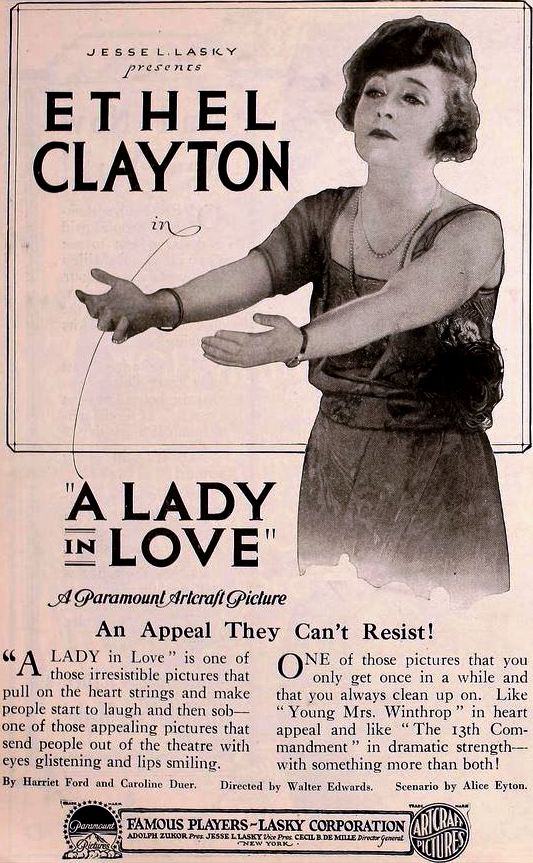
Bigamy has never looked this gorgeous on celluloid.
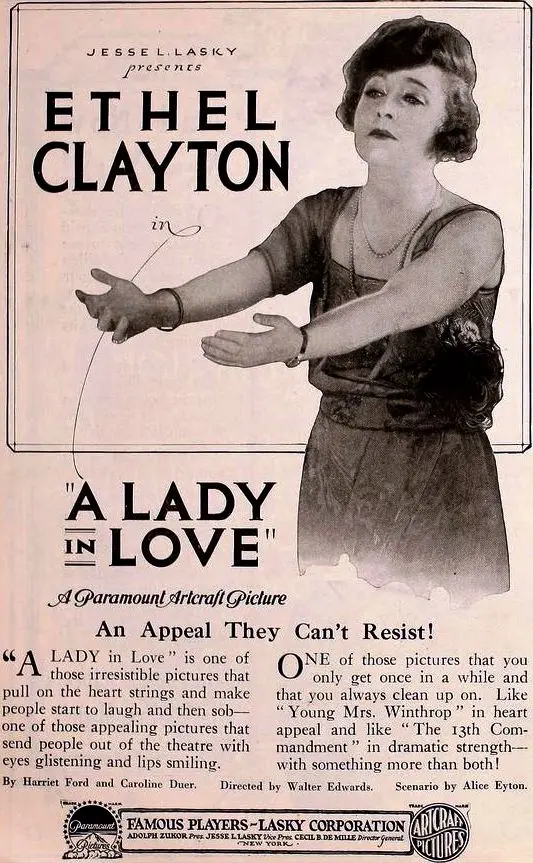
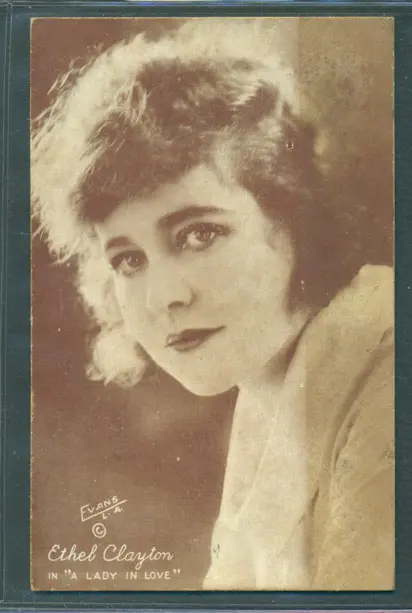
There is a moment—wordless, iris-shuttered—when Barbara Martin, played by the luminous Ethel Clayton, stands beneath a gas lamp’s sodium halo, clutching a crumpled marriage certificate that might as well be her death warrant. The city behind her is a tangle of elevated rails and clanging newsboys, yet director Caroline Duer lets the frame go almost still, so that the rustle of that paper becomes a thunderclap. In that hush you grasp the entire moral architecture of A Lady in Love: a woman’s reputation is currency, easily forged, never refunded.
The film’s first reel unspools like a baptism in acid. Barbara’s convent walls—shot in high-key whites—give way to Barton Sedgewick’s drawing room, all umber shadows and predatory velvet. Boyd Irwin plays Barton with the languid cruelty of a man who collects souls like cufflinks; when he leans in to kiss Barbara’s glove, the camera tilts upward, as if even the lens cannot stomach the intimacy. The marriage is achieved through a elopement montage—train wheels, veil flutter, a priest whose face we never see—cut so rapidly that you feel the heroine’s vertigo. Harriet Ford’s intertitles, usually florid, here condense to a stark whip: “One sin, one signature, one carriage ride to perdition.”
News of Barton’s prior wife arrives not via letter but through a child’s porcelain doll left on Barbara’s hotel pillow—a visual stab that out-horrors any dialogue. Frances Raymond as the discarded first Mrs. Sedgewick appears only twice: once in a doorway silhouette, once in a courtroom sketch. Each glimpse is a haiku of anguish, ensuring we never forget the collateral damage of male appetite.
Barbara’s desertion in the second act is staged against a rain-soaked pier; Clarence Geldert’s cinematography turns every raindrop into a liquid interrogation lamp. She walks, soaked, toward a horizon that the matte painting refuses to soften. You sense the entire silent era pressing its face against the glass, whispering: this is what happens when women believe they can author their own stories.
Ernest Joy’s George is no mustache-twirling Victorian; he is a man exhausted by the upkeep of virtue. When he advises “Divorce—swift, surgical, absolute,” the line is delivered with the resignation of a surgeon who knows the patient will refuse the operation. Their parlor scene—two-shot, medium close-up—lets Clayton’s eyes dart between hope and humiliation while Joy’s fingers drum the armchair like a metronome counting down her reputation.
Harrison Ford (no, not that one—this is the velvet-voiced silent fox) strides into frame wearing a three-piece suit the color of wet sand. His first exchange with Barbara occurs over a library ladder: she climbs upward seeking law tomes, he stands below holding the ladder base, a literalization of male support that never feels heavy-handed. The chemistry is immediate—eyebrow arches, a shared smile that the camera undercranks to half-speed, as if even time wants to eavesdrop.
Of course the cosmic gag is that Brent’s brief is to dissolve the very union she dreads exposing. When Barbara learns this, Duer inserts a subliminal flash—barely three frames—of Barton’s mocking visage, a cinematic hiccup that predicts the coming montage age.
The final act is a thriller disguised as a social picture. Barbara’s intrusion into Rhodes’ apartment is lit like a cathedral of vice: venetian-blade shadows, a single green banker’s lamp. She finds Barton asleep, champagne bottle erect like a middle finger to propriety. The papers she needs protrude from his jacket pocket as delicately as a poisoned flower. The theft is accomplished without score—only the metronomic tick of a wall clock—until a floorboard creaks loud enough to wake Morpheus. In that instant Clayton’s face registers six emotions at 18 frames per second, a masterclass in micro-acting that modern close-ups still envy.
The courtroom climax is a single-take tableau: judge, lawyers, Barbara, and the first wife arranged like chess pieces. Barbara presents the marriage certificate; the judge’s gavel falls; the iris closes in on her trembling hand now sans ring. Cut to Brent waiting on the courthouse steps, hat in hand, backlit by an overexposed sun that obliterates the city’s grime. The final intertitle reads: “The law absolves what love already forgave.” Cue embrace, fade-out, applause in 1920 that you can almost hear through the grain.
Ethel Clayton never raises a gloved hand, yet her performance is seismic. Watch how she modulates respiration: convent scenes—shallow, birdlike; honeymoon—deep, almost drugged; post-abandonment—ragged, as if each inhale tears cartilage. By the final reel her breathing has synchronized with the audience’s, a corporeal empathy that talkies later chased with violins and monologues.
Boyd Irwin’s Barton is slither incarnate, but note the micro-shrug when he pockets alimony cash—half a second of self-loathing that keeps him from cartoon villainy. Harrison Ford’s Brent is the prototype for the sexy ethical baritone Hollywood still recycles; his cheekbones alone could file briefs.
Cinematographer Geldert employs a tri-color palette of moral zones: convent whites, urban ambers, courtroom greys. A recurring visual motif is the veil—Barbara’s bridal lace, Barton’s first wife’s mourning crepe, the translucent curtain through which Brent first sees her—suggesting femininity as both revelation and occlusion. The camera’s 90-degree shutter angle deepens blacks until pupils dilate like keyholes, forcing viewers to lean in, complicit.
Alice Eyton’s card copy eschews the era’s typical verbosity. Examples: “Two wives, one lie.” or “A signature in haste, a lifetime in chains.” Each card is framed by a thin black border that feels downright funereal, a design choice that predates The Merry-Go-Round’s stark minimalism by several years.
If Skinner’s Dress Suit lampooned marital anxiety through farce, A Lady in Love dissects it with a scalpel dipped in iodine. The bigamy twist here is less gimmick than gauntlet, flung at an audience still reeling from post-Victorian mores. Likewise, where Cheating Cheaters used crime-genre kinetics to absolve its heroine, this film trusts silence and paperwork—a radical stance that trusts female agency over gunpowder.
Viewers of When Dawn Came will recognize the redemptive sunrise finale, yet here the dawn feels earned through jurisprudence rather than deus-ex-machina murder. Conversely, fans of Her Fatal Shot might miss the femme-fatale gunplay, but Barbara’s weapon is legality—infinitely more subversive in 1920.
The surviving 35 mm print, housed at UCLA, carries ammonia burns and a haunting vertical scratch across reel three—damage that ironically heightens Barbara’s psychological scar. Digital restoration in 2019 repaired intertitles yet left emulsion bubbles intact, preserving the patina of peril. The new 2K scan reveals texture on Clayton’s silk stockings so tactile you expect the hiss of fabric on skin.
One hundred winters after its premiere, A Lady in Love still scalds because its tension is not historical but hormonal. Bigamy may now be tabloid relic, yet the terror of being defined by another’s lie remains electric. The film’s ultimate coup is its refusal to punish Barbara for desire; the law, so often the villainess’ noose, becomes her liberating sword. In the final iris-out, Barbara and Brent walk toward a city that has learned nothing and forgotten nothing—yet for the first time, she strides rather than stumbles.
Seek this film not as antique curio but as living jurisprudence of the heart. Let its shadows pool in your retinas, its intertitles echo in your pulse. And when the lights rise, notice how your own breathing has synchronized with a woman who fought gossip with parchment and won. That, dear viewer, is the quiet earthquake silent cinema was built to deliver.
IMDb —
1921
Community
Log in to comment.