DbcultAccessing Vault...
Cult Review
Senior Film Conservator
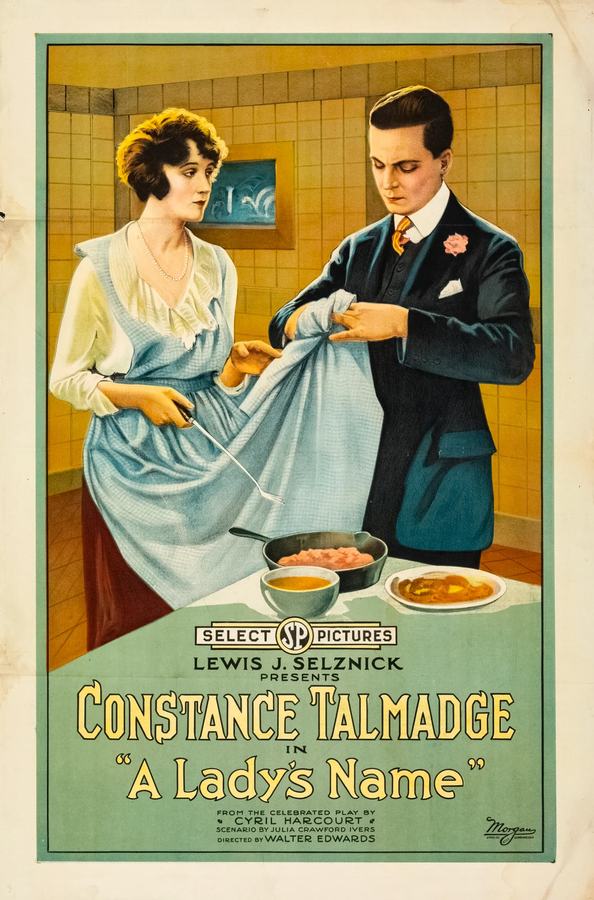
The first time we see Mabel Vere’s profile, it is sketched by cigarette glow against a darkened study—an image that feels smuggled out of chiaroscuro rather than committed to celluloid. A Lady’s Name understands, with preternatural confidence, that every close-up is a duel: the camera wants to possess her, she wants to author herself. Constance Talmadge, all feline eyebrows and kinetic shoulders, wins that duel, and the victory reverberates through the next eighty brisk minutes.
Julia Crawford Ivers’s screenplay, adapted from Cyril Harcourt’s stage piece, shears away the proscenium’s fat. What remains is a Manhattan fable that anticipates That Sort’s acidic gender games and the manic pixie energy later monetized by 1930s screwball. Yet 1922 is still too early for the Hays straitjacket; the film can flirt with risqué correspondence, linger on a lingerie strap, and let a woman relish the power of refusal without moral whiplash.
Mabel’s newspaper ad—“Young novelist seeks husband for research purposes only”—is less a plot hinge than a dare hurled at patriarchal certainty. Each letter she opens becomes a Russian-doll narrative: the butcher who claims to wrestle bears, the banker who encloses a lock of hair still smelling of macassar, the widower whose ink blots suggest tears or gin. Director Emory Johnson orchestrates these revelations with Eisensteinian montage—superimposed handwriting, match-cut to the correspondent’s imagined visage—yet keeps the tone frothy as champagne sabered at a lawn party.
Gerald Wantage, played by a stiff-spined Harrison Ford (no, not that one), is the film’s necessary killjoy. His wager at the club—white-gloved cynics betting cases of Napoleon brandy that Mabel will abandon her stunt—echoes the toxic gossip mills seen in The Suburban. When Mabel uncovers the wager, her retaliation is delicious: she answers the most florid letters, schedules simultaneous assignations at the Astor bar, and lets the farcical collisions do the rest. The camera cranes above the marble staircase as tuxedoed suitors bump into stevedores, monocles spin like tossed coins, and Mabel escapes in a brass-buttoned hansom, grinning like a cat who has licked the cream and framed the dog.
Lillian Leighton’s Maud is no mere sidekick; she is the film’s kinetic manifesto. Clad in bloomers that scandalize the dowagers, she launches into Swedish gymnastics on the penthouse terrace, using a champagne bottle as impromptu dumbbell. Her slapstick dispatch of one particularly handsy baron—she hoists him into a coal scuttle with a single clean-and-jerk—earned a reported eight-second mid-film applause when the picture premiered at the Rialto. In an era when female strength was either vamp or virgin, Maud occupies the liminal third space: muscle with mirth.
Enter Noel, essayed by the velvet-voiced Truman Van Dyke—yes, voices matter even in silence. His first appearance is a masterclass in privileged diffidence: top hat tilted just enough to suggest he’s read Nietzsche but apologizes for it. Noel’s fortune is derived from railroads that displace tenement families, a biographical detail conveyed only by a newspaper headline glimpsed beneath a café saucer. The film trusts the audience to connect the dots between his guilt and his eventual willingness to become Mabel’s co-conspirator. Their courtship unfolds in stolen interludes: a library where dust motes swirl like galaxies, a fire escape exchange scored by the distant wail of harbor horns. When he proposes, the yacht’s prow slices through black water as if carving open a future unshackled from clubland wagers.
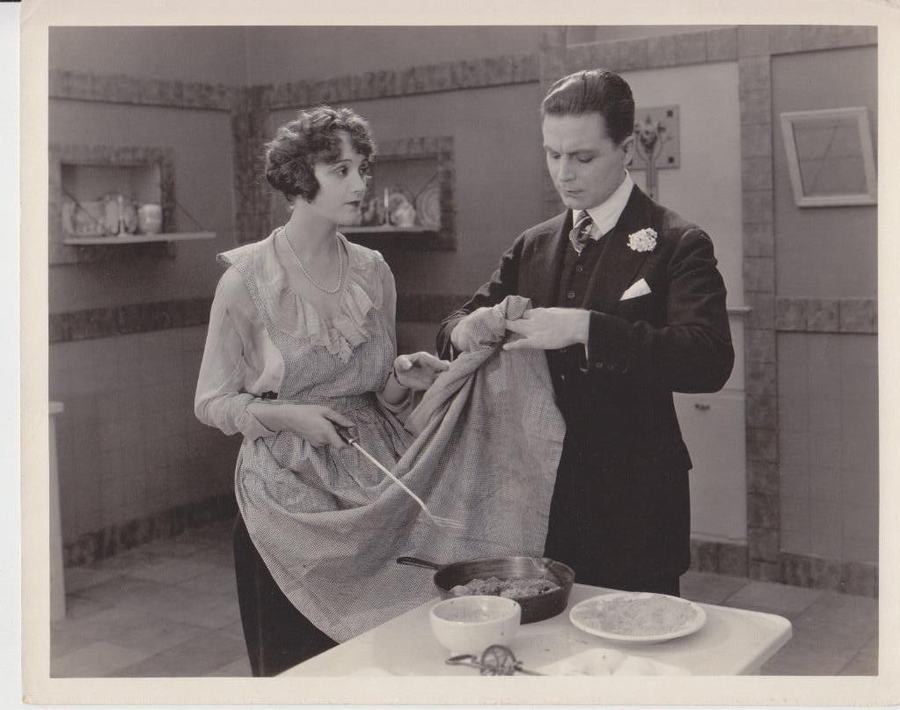
Cinematographer Allen Siegler shot most interiors at the United Studios in Fort Lee, but the night exteriors are pure, guerilla New York. The reflection of a yellow taxi in a puddle becomes a harbinger of change; the fractured image foretells Mabel’s splintering engagement. Johnson repeatedly frames Talmadge against mirrors, letting her double haunt herself—an early articulation of the self-surveillance that later noir vamps will weaponize. The tinting, preserved in the 4K restoration by EYE Filmmuseum, alternates between amber for interiors lit by gaslight and a nocturnal cyan that feels decades ahead of its time.
What makes A Lady’s Name feel startlingly modern is its insistence that courtship is authored text. Mabel does not seek a husband; she seeks material, and in the process rewrites the contractual fine print of wedlock itself. Compare this to the static marital fatalism of Hearts and the Highway or the infantilized heiress in The Millionaire Baby. Here, the woman holds the pen, the eraser, and the publishing deal. Even the final acceptance of Noel’s proposal lands less as capitulation than as collaborative sequel—note how she pockets the engagement ring in a notebook compartment, literalizing the marriage of life and art.
Silent comedy often ages like cream left curbside, but the gags here retain their snap thanks to rhythmic precision. Watch the escalating absurdity of the letter-reading montage: each new envelope cues a faster cut, a tighter iris, until the celluloid itself seems to hyperventilate. The payoff—Mabel fleeing a restaurant disguised in a waiter’s jacket—earns laughs not from pratfall but from the audacity of her calm. She strides past Gerald, dips a finger into his consommé for a taste, and exits without breaking stride. The insult is elegant, gastronomic, and unanswerable.
Place A Lady’s Name beside Law of the Land (1921) and you see a diptych of American womanhood negotiating the shift from Victorian corset to flapper fringe. Where the latter film punishes its heroine for sexual inquiry, the former rewards its protagonist with authorship. The tonal midpoint is Friday the 13th (1916), whose jilted seamstress spirals into melodrama; Mabel Vere refuses that spiral by monetizing her heartbreak into copy.
For the 2022 centennial, composer Mariana Sadovska created a new score commissioned by the Pordenone Silent Film Festival. Her accordion breathes Central European melancholy into the Manhattan sequences, while a toy-piano motif underscores Mabel’s more capricious schemes. During the yacht-board proposal, strings surge then abruptly cut to heartbeat percussion, mirroring the lovers’ shared terror that happiness might be another genre they cannot control.
Despite Talmadge’s megawatt popularity—her films out-grossed Pickford’s in certain territories—A Lady’s Name languished for decades, victim of a legal snarl over Harcourt’s estate. The recent 4K restoration, streaming on Criterion Channel and available on region-free Blu from Kino Lorber, reveals textures unseen since 1922: the glint of Mabel’s ink-stained fingers, the faint bruise on a suitor’s ego. Extras include a video essay by Layla Olvera tracing the film’s influence on Hawks’s His Girl Friday and a commentary track where Molly Haskell dissects the cultural amnesia that recategorized Talmadge as “minor” simply because she made comedy look effortless.
Watch it once for the guffaws, again for the subtext, and a third time to witness the precise moment American cinema discovered that a woman’s name—advertised, retracted, rewritten—could be the sharpest weapon in the comedic arsenal.
IMDb 5.9
1912
Community
Log in to comment.