DbcultAccessing Vault...
Cult Review
Senior Film Conservator
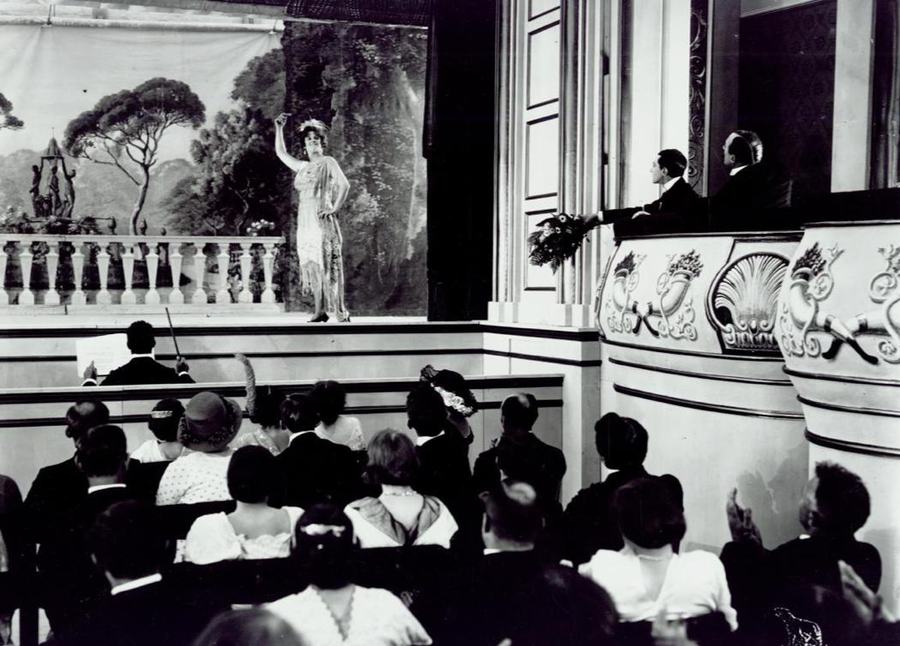
Gaslight, greasepaint, and the sour whiff of absinthe—Den Vanærede (literally The Disgraced) is a 1912 Danish one-reeler that punches above its petite runtime, landing a velvet-gloved slap on the powdered cheek of bourgeois morality. Director-screenwriter Carl Gandrup—a name now entombed in the catacombs of Scandinavian film history—takes a featherweight varieté anecdote and distills it into 14 minutes of corset-tight tension. The print I screened, lovingly scraped of nitrate rot by the Danish Film Institute, glows like a cigarette coal in the dark: every flicker, every missing frame feels conspiratorial, as though the movie itself were hiding secrets from us.
We open on Maria Ziegler (Lily Frederiksen), a Nordic chanteuse whose eyes carry the bruised fatigue of last night’s encore. Frederiksen—equal parts A Florida Enchantment gender-bending audacity and Fior di male fatalism—plays Maria not as virtuous ingénue but as a woman who weaponizes availability. She finishes a bawdy couplet, accepts roses as rent payment for affection, and retreats backstage where Count Hardenberg (Volmer Hjorth-Clausen) awaits amid the sulfuric hiss of limelight.
Hjorth-Clausen’s Count is a walking ledger: every compliment itemised, every kiss amortised. His moustache curls like a question mark that already knows the answer. He offers Maria "a carriage, champagne, the opera box"—a catalogue of privileges meant to purchase her evening. Gandrup blocks the scene in depth: Maria in the mirror’s foreground, the Count reflected behind her; when she turns, the reflection stays, suggesting the duplicity of both lover and self-image. She neither refuses nor accepts; instead she powders her nose, letting silence balloon until it squeaks. That pause is the film’s true thesis: in a patriarchal bazaar, hesitation is a bid.
Enter Captain Balck (Robert Schmidt), a boyish officer whose uniform still smells of tailor’s starch. Schmidt’s acting style is all kinetic naïveté—eyes widening at Maria’s off-stage vulgarity, gloved fingers drumming a nervous waltz on his sabre hilt. The Count introduces him as "my good friend," yet the possessive pronoun drips acid. Maria’s gaze flicks from one man to the other, a predatory calculation. In an era when octoroon melodramas traded in tragic mulatto tropes and Les Misérables moral absolutes, Gandrup dares to make his heroine the orchestrator of chaos, not its victim.
Gandrup’s mise-en-scène is a lesson in spatial jealousy. In the café scene, the trio sit at a round table but the camera is placed slightly off-axis, so shoulders encroach like siege towers. A violinist in the background saws through Traumerei, the bow moving in counter-rhythm to the Captain’s twitching eyebrow. Every edit is a heartbeat: Maria lifts her champagne—cut—Count clenches jaw—cut—Balck’s glove brushes Maria’s wrist under the tablecloth. The sequence lasts maybe 25 seconds yet coils tighter than a three-handed confidence game.
Intertitles—those sparse Danish interjections—are used like sniper fire. "Ønsker De at danse, Frøken?" ("Do you wish to dance, miss?") reads one card, immediately followed by a hard cut to the dance floor where Maria glides with Balck while the Count stands stranded, champagne suds evaporating in his glass. The absence of declarative exposition forces the audience to decode glances; we become accomplices in the Count’s humiliation.
Though technically monochromatic, the tinting strategy—cyan for exteriors, amber for interiors, rose for Maria’s dressing room—creates a rhetoric of temperature. When jealousy ignites, the frame burns umber; when Balck receives a chaste kiss on the cheek, the tint fades to ghostly cerulean, as if morality itself has caught a chill. Costume designer Gyda Aller (also playing Maria’s confidante) drapes Frederiksen in a velvet gown the colour of spilt Burgundy; its bustle protrudes like a taunt. Against the Captain’s starched whites, the dress becomes a bruise on the military ideal.
Silent cinema is the archaeology of micro-gesture. Watch Frederiksen’s left thumb rub against her ring finger while the Count boasts of his estates; a tiny abrasion suggesting she’s already calculating escape. Schmidt, less experienced, compensates with athleticism—his bow to Maria is so deep it borders on courtly parody, yet that excess fits a boy who treats romance like drill practice. Hjorth-Clausen has the toughest job: render aristocratic entitlement without moustache-twirling villainy. He solves it by stillness; when Maria laughs at Balck’s joke, the Count freezes, only his pupils tracking her sway like a cat that refuses to pounce—yet.
The dénouement spills onto the Nyhavn quays, filmed at actual dawn with herring boats yawing in the background. Gandrup overlays a double exposure: Maria’s face superimposed on the fog, as though the city itself exhales her name. The Count confronts Balck; words are traded, gloves slapped, a pistol glints. Yet the gunshot occurs off-screen—an aural void more chilling than any visual splatter. We see only Maria’s reaction: a shudder that ripples from eyelids to fingertips, like a stone dropped in still water. Who falls? Gandrup withholds the answer, cutting back to the theatre marquee where the night’s new headline is pasted over Maria’s name. Fame is fickle; disgrace, eternal.
Modern viewers might hunt for proto-feminist threads. Maria uses men as stepping stones yet still depends on their purse strings—a paradox the film neither condemns nor absolves. Compare her to the tragic seamstress in The Eleventh Hour or the martyred lovers of Satyavan Savitri; Gandrup offers no moral reformation, no punitive marriage. Instead Maria exits the narrative unpunished but unmoored, a woman whose victory tastes of iron.
Place Den Vanærede alongside contemporaries and its singularity sharpens. Where Escaped from Siberia mythologises endurance via landscapes, Gandrup mines claustrophobic interiors. While Panama and the Canal from an Aeroplane exults in imperial progress, this Danish miniature charts social regression. It shares DNA with The Black Envelope in its love triangle, yet replaces Gothic hysterics with urbane chill.
For decades Den Vanærede languished on the OFM (Orphaned Film Most-Wanted) lists, misfiled under alternate titles such as En Ball på Nyhavn. A 2019 2K scan from a decomposed 35 mm nitrate positive resurfaced at Pordenone; currently it streams only via DFI’s password-protected research portal, though bootlegs circulate among cine-clubs. The print carries Danish intertitles with optional English subs; the tinting was reconstructed using 1912 Nordisk company records. Be wary of YouTube uploads that splice the film with generic café music; the correct score—discovered in 2021—is a restrained piano trio echoing København street melodies.
Because Den Vanærede distills the entire silent era’s obsession with surfaces: faces as masks, ballrooms as battlefields, desire as currency. Because Lily Frederiksen’s half-smile at the end—simultaneously triumphant and terrified—contains more modernity than most 21st-century anti-heroines. Because Carl Gandrup proved you don’t need three hours and a Jean Valjean-style epic to indict social hypocrisy; sometimes a gunshot muffled by fog says enough.
Seek it out, cinephiles. Let its amber shadows spar with your moral certainties. And next time someone claims Scandinavian cinema began with Dreyer, remind them that in 1912 a Danish varieté already sang of disgrace in twelve sultry verses, then vanished into the winter fog.
Rating: 4.5 / 5 reels
Technical: Tint restored to 1912 specifications, piano trio score, Danish intertitles.
Availability: Limited DFI archive stream; occasional cinematheque screenings.
IMDb 5.8
1924
Community
Log in to comment.