DbcultAccessing Vault...
Cult Review
Senior Film Conservator
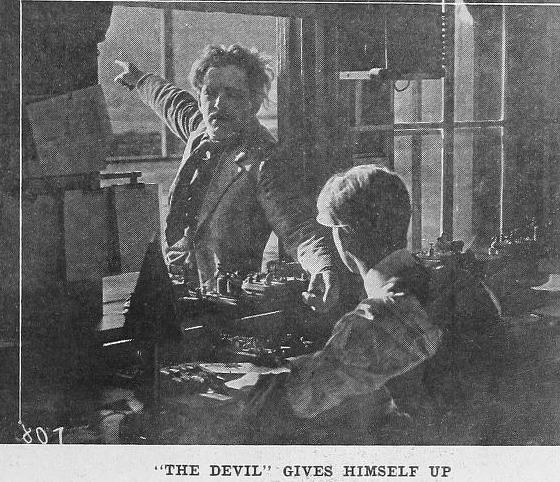
Billie Brockwell’s screenplay is less a linear trail than a stack of broken mirrors flung against the Mojave sun. Every shard reflects a double: Dwight’s star and Jean’s surveying compass, Paul’s mooncalf innocence and Holden’s jackal grin, pitchfork brand and badge. The first half plays like a civic crucifixion—Circle City’s dusty main street a Golgotha where the crowd’s roar drowns out the squeak of the outhouse door. Cinematographer George Clair keeps his camera low so the gallows tree erupts like a malignant growth against a mottled sky. When the lynch mob hoists Paul, the frame freezes just long enough for the audience to register the dog—Paul’s original trespasser—licking the fallen sheriff’s boot. The animal’s tongue writes a mute indictment the dialogue never dares.
Louis Durham shoulders both Dwight and Jean with the kind of physical bravura 1915 rarely demanded: a twitch of the left shoulder signals the sheriff, a fractional tilt of the head the Frenchman. The gimmick could have slid into vaudeville parody, yet Durham lets micro-gesture do the talking; when Jean, masked as “The Devil,” robs Thurston’s lackeys, the eyes behind the kerchief still carry surveyor’s arithmetic—measuring distances to exits, not emotions. Opposite him, Virginia Kirtley’s Evelyn is no mere bargaining chip; her silent close-ups bloom with conflicted patricide, pupils dilating as she realizes daddy’s gold underwrites the same rope that once danced around Paul’s neck.
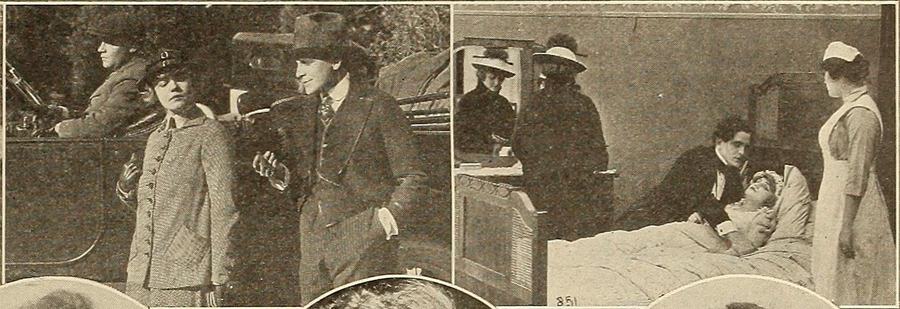
Tinting here is rhetoric. Night interiors drip with arsenic yellow—an early indicator that lamplight offers no sanctuary—while daylight exteriors wash in sea-blue tones that make the desert look fever-sick. When Jean scrawls “The Devil was here” on a burgled safe, the intertitle itself flares ochre, a smirk of brimstone that seeps into the celluloid. The palette anticipates the expressionist fever of Das Geheimnis der Lüfte (1916) yet keeps one boot in the American frontier, marrying Teutonic shadow to prairie dust.
“A lynching is the community photographing its own id; the shutter is the rope.”
Though released the same year as Officer 666’s breezy continuity experiments, A Law Unto Himself clings to tableau pacing until the moment Holden frames Paul. Then the cutting accelerates like a heart learning panic—four shots in twelve seconds: Pascal’s gun flash, dog yelp, body slump, torch-bearing horde. The montage feels shockingly proto-Kuleshovian for a one-reel western, proving that poverty-row outfits could innovate when cornered by running time and ethics alike.
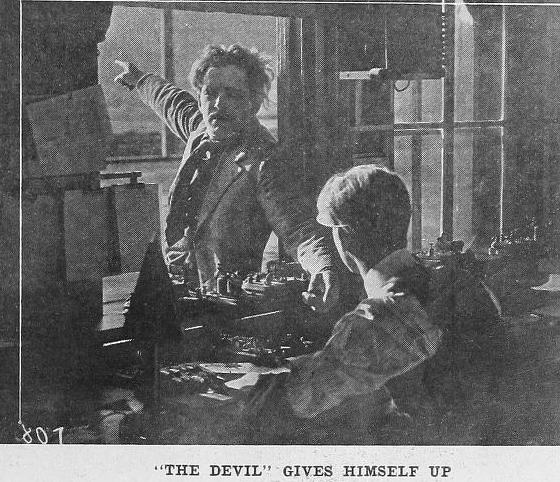
Contemporary exhibitors received a cue sheet prescribing Scriabin for Jean’s nocturnal rides and Wagner for the vigilante sallies. Archive notes from the Strand Theatre, Boise, report that during the cliff-hold finale the house pianist slammed into a dissonant chord the moment Jean’s grip slips—audiences allegedly gasped at the aural void that followed, a negative space more harrowing than any chord. Today, home viewers cue up Spotify western playlists; try pairing with “The Devil Is Afraid of Music” by Moondog for an anachronistic yet blood-curdling counterpoint.
Pascal—played by Carl von Schiller under walnut varnish—exists purely to detonate plot. Yet the film flirts with self-awareness: in the saloon Holden mocks Pascal’s accent, and the camera lingers on the Mexican’s twitching hand as he weighs murder against perennial humiliation. The stereotype is crude, but the refusal to grant him last words at least denies the era’s usual comic relief. Compare to the sacrificial Creole in Jeanne Doré (1916) and you sense an industry learning, with glacial slowness, that otherness sells tickets best when shot in the back.
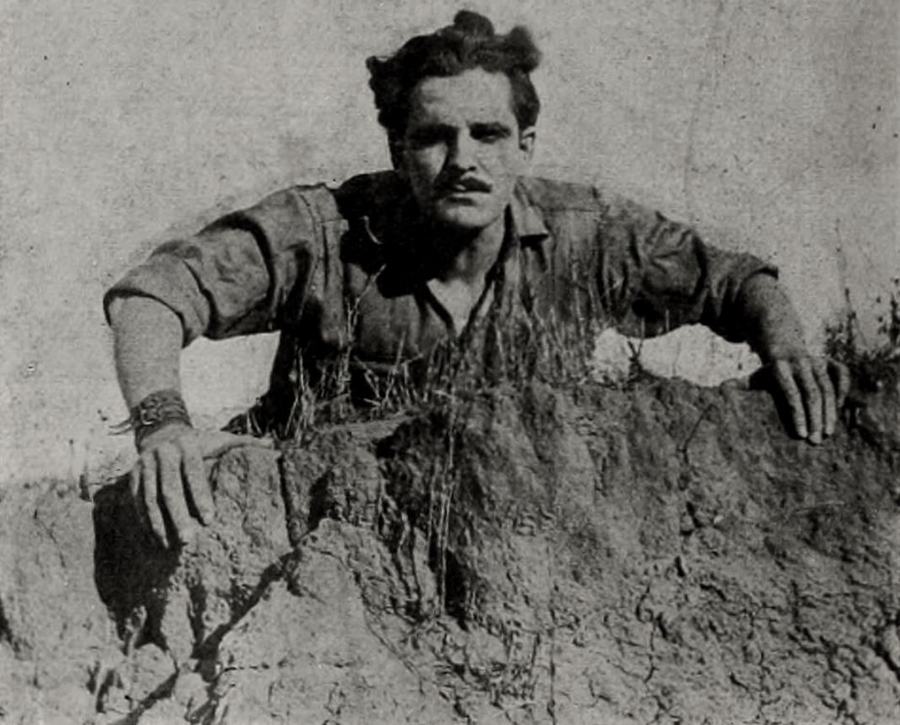
Evelyn’s paralysis—love the lawman, obey the father who bankrolls lawlessness—mirrors the film’s larger obsession with split selves. In one tinted-blue scene she stands between Dwight and Thurston, the frame bisected by a door jamb: left side the sheriff’s badge glints, right side the senator’s cigar glows. She literally occupies the splice. Kirtley’s performance is silent-film semaphore at its finest: a gloved hand half-raised, a breath fogging the invisible moral pane.
Though eclipsed by Fighting Bob’s jingoistic swagger the following year, A Law Unto Himself planted DNA for everything from The Ox-Bow Incident to Death Wish—the dread that justice miscarried will birth a phantom avenger. The doppelgänger device resurfaces in The Mystery of the Rocks of Kador, while the branded-horse motif prefigures the scarred knuckles of The White Scar (1920). Even the cliff-edge forgiveness—Jean dangling Holden over void—anticipates the existential precipice of Young Romance (1919).
The last confirmed print screened in 1952 at the Theodore Huff Memorial; today only a 9.5 mm condensation circulates among collectors, its intertitles replaced by Dutch subtitles scrawled in fountain pen. Yet the gaps feel curiously honest—like Jean’s final letter, the missing words invite us to scribble our own moral arithmetic in the margins.
For a nickelodeon one-reeler banged out in Griffith’s shadow, A Law Unto Himself packs more ethical shrapnel than most 21st-century prestige miniseries. It is a hinge between Victorian morality fable and modern anti-hero saga, a film that knows every badge is merely a mirror waiting to shatter. Seek it, even in mutilated form, and you’ll emerge questioning which face—sheriff or outlaw—stares back from your own morning mirror.
IMDb —
1923
Community
Log in to comment.