DbcultAccessing Vault...
Cult Review
Senior Film Conservator
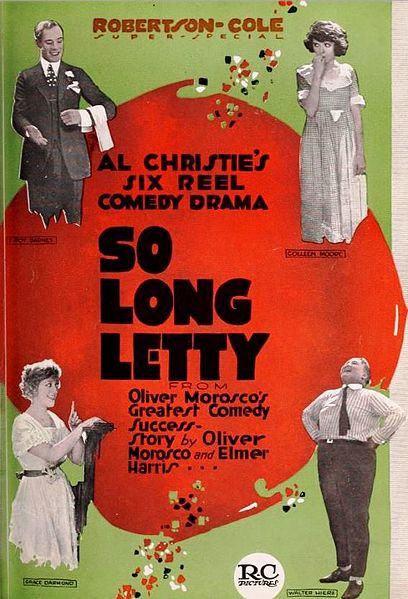
The first thing you notice is the citrus glare of the print—amber and sea-foam flickers, like watching the film through a glass of iced Tom Collins. Paramount’s 1929 part-talkie So Long Letty survives only in a 16 mm reduction, crackling like a lo-fi phonograph, yet that very fragility intensifies its champagne fizz: every skipped frame feels like a missing heartbeat between scandalous laughs.
Oliver Morosco’s original stage farce—already a riposte to Fighting Mad’s melodramatic divorce courts—gets transposed to the suburban frontier of convertible sofas and paper-thin morals. The conceit is simple: two husbands want new wives, the wives want new power, and the bungalows want new paint. But within that geometry director Lloyd Bacon (yes, the future 42nd Street guy) stages a tart, almost anthropological study of how the American living room became the last frontier of sexual contract negotiation.
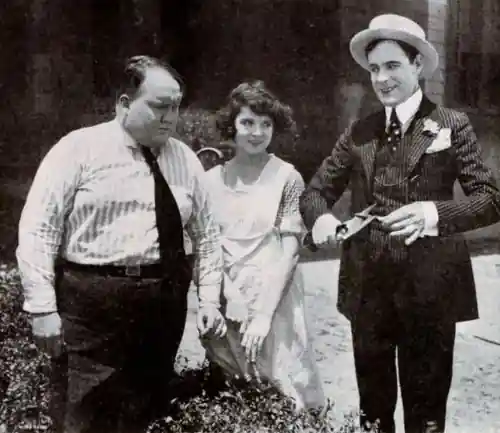
Walter Hiers, all eyebrow semaphore and waistcoat strain, plays Harry Miller like a man who has mistaken his libido for a stock tip: bullish, reckless, doomed to margin-call. Opposite him, T. Roy Barnes’ Tommy Robbins is a study in beta-male masochism—his spine seems to liquefy whenever Colleen Moore’s Letty aims her kohl-ringed gaze. Moore, freed from her customary flapper innocence, sashays through the picture with the predatory languor of a woman who knows the exact calorie count of every man’s ego. Grace Darmond’s Grace Miller, often dismissed as the "straight" role, is the film’s stealth weapon: her arched readings of domestic platitudes feel like Dorothy Parker improvising on a cook-book.
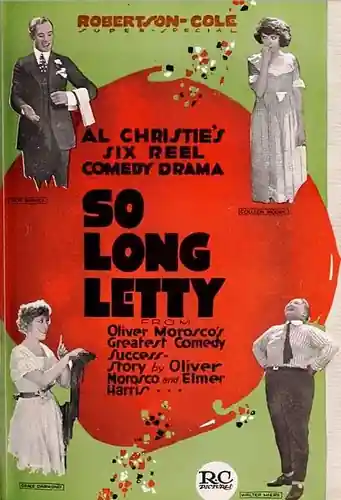
Released the same month as The Broadway Melody, So Long Letty hedges its bets between synchronized musical numbers and intertitle wit. The result is a film that literally stutters—dialogue scenes drop into a cavernous audio hiss, while silent passages bloom with visual gags so brisk they feel like flip-books. Paradoxically, the sonic interruptions heighten the comedy: when Letty purrs "You may call me pet names—but not on an empty stomach," the line lands like a slap because the soundtrack itself seems embarrassed to be caught eavesdropping.
Art director Carroll Clark—later the visual brain behind Bringing Up Baby—fills each set with what we might call "transitional modern": Chinese paper lanterns strung across Mission-style beams, a wicker peacock chair parked beside a brand-new RCA Radiola. The clash of textures mirrors the film’s central tension between Victorian marriage and modern companionship. Notice the repeated motif of folding screens: every time a screen collapses, a secret overhears itself, as though the architecture were conspiring in the farce.
Writing in 1929, the New York Herald called the picture "a handbook for husbands who underestimate the home.” Today it reads more like an ur-text for second-wave feminism: the wives do not merely punish their spouses; they re-educate them in the labor of maintenance—emotional, sartorial, gastronomic. In one sublime sequence Grace forces Tommy to iron his own tuxedo shirt while she recites Baudelaire; the camera lingers on the sweat darkening his collar, a sly visual pun on the masculinity being steamed out of him.
Cinephiles will detect DNA strands borrowed from The Countess Charming’s operetta of mistaken ardor, and the DNA recombines in 1933’s Burning the Candle, where the gender arms race escalates into actual fisticuffs. Yet Letty remains unique for its ambivalence: it ridicules the husbands’ entitlement without sanctifying the wives’ vengeance. Everyone exits scorched, a tonal gamble that prefigures the caustic endings of Moral Suicide and Sealed Valley.
One cannot ignore the film’s reliance on off-screen domestic labor. The bungalows sparkle, meals appear, shirts press themselves—all performed by invisible Black and immigrant help, unmentioned yet economically indispensable. When Harry complains that Grace’s household "runs like a Swiss watch," the line reverberates with the unseen cogs. A modern viewer is invited to ponder whether the wives’ triumph is also a bourgeois sleight-of-hand, transferring the burden of their revenge onto subaltern shoulders.
Bacon ends on an iris-in of the Miller front door—an antique visual trope, yet here it feels sinister, as though the camera is winking complicity at the audience: "We’ve settled nothing, but we’ve enjoyed the fracas." From inside, a radio leaks the strains of "Ain’t She Sweet,” the same tune that opened the film. The circular structure implies that the cycle of desire, boredom, and retribution will reboot with the next sunrise. The comedy is acid-etched; the aftertaste is metallic.
So Long Letty is a brittle, effervescent artifact that survives its own decay. Watch it for Moore’s flapper-turned-sociologist, for the anthropological décor, for the way silence and staccato sound wrestle inside the same reel. But mostly watch it because it dares to suggest that marriage is not a sacrament or a prison, but a continuing education—one where the syllabus is written by whoever stays awake longest.
If you’re hunting for context, pair this with North of Fifty-Three’s rugged divorce frontier, or contrast it against A Woman’s Honor for a more melodramatic take on post-marital fallout. And if anyone claims the sex-comedy began with Billy Wilder, show them this 63-minute rebuttal—slightly scratched, eternally grinning.
IMDb —
1917
Community
Log in to comment.