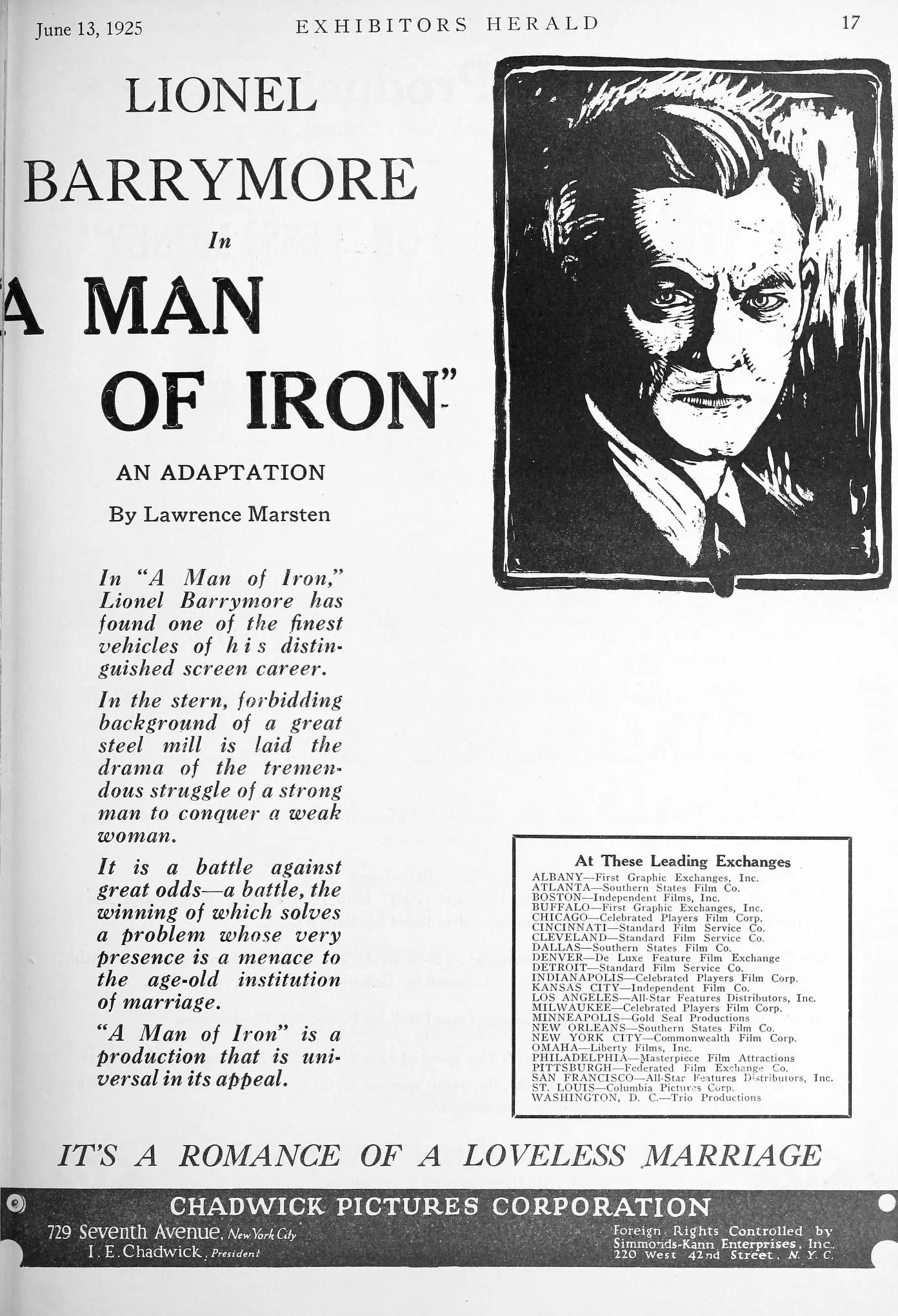
In the opulent yet brittle world of early 20th-century high society, 'A Man of Iron' (1921) emerges as a poignant and nuanced exploration of the human condition. Directed with a blend of elegance and intensity, the film masterfully intertwines the personal and the political, creating a narrative that resonates with both the era's audiences and contemporary viewers alike.
At the heart of this tale is Philip Durban, a wealthy iron manufacturer whose life is as structured and rigid as the metal he fashions. His marriage to Claire Bowdoin, the young daughter of a family of impoverished blue-bloods, is initially a pragmatic alliance motivated by financial necessity rather than romantic yearning. Claire, on the other hand, is initially cold and aloof, driven by a desire to support her mother's welfare. This initial disconnect sets the stage for a complex emotional journey that unfolds with subtlety and depth.
As the story progresses, Claire and Philip's relationship begins to evolve. Despite their initial reluctance, Claire finds herself drawn to Philip, her cold exterior gradually melting under the warmth of his affections. However, Philip, with his rigid sense of duty and pride, remains emotionally distant. The tension between their growing feelings and his steadfast reserve creates a palpable sense of anticipation and longing.
The turning point in their relationship comes when Claire leaves for Italy, where she encounters the charming Prince Novakian. Her newfound love for Philip is tested as she is drawn into the world of courtly intrigue and romantic entanglements. This pivotal moment serves as a catalyst for Philip's own realization of Claire's true feelings, but it is the subsequent duel he faces to defend her honor that truly crystallizes the intensity of their bond. The duel, a climactic scene of physical and emotional conflict, is not just a duel between two men but a battle of wills and emotions, with the fate of their relationship hanging in the balance.
Philip's wounding in the duel marks a turning point in their journey. The stress and excitement of the moment break down the barriers between them, allowing Claire to finally express her love and tend to his wounds. This moment of vulnerability and intimacy is a powerful affirmation of their love, transcending the initial economic motivations of their union. The film concludes with a bittersweet resolution, one that acknowledges the complexities of love and the sacrifices required to nurture it.
The performances in 'A Man of Iron' are uniformly strong, with Alfred Mack delivering a nuanced portrayal of Philip's inner turmoil and Isobel De Leon bringing depth and vulnerability to Claire's character. J. Moy Bennett and Winifred Barry also add significant depth to their roles, contributing to the rich tapestry of characters that bring the story to life. The film's visual style, with its elegant costumes and detailed settings, further enhances the sense of a bygone era, immersing the audience in the world of Edwardian high society.
'A Man of Iron' stands out among its contemporaries for its sophisticated narrative and emotional depth. While films like 'No Parking' (1921) and 'Boomerang Bill' (1921) may offer more action-packed fare, 'A Man of Iron' delves into the intricate dynamics of human relationships with a level of insight and artistry that is rare in early cinema. It is a film that not only entertains but also challenges and moves its audience, making it a timeless classic in the annals of film history.
For those with a fondness for early cinema and a keen interest in the evolution of narrative storytelling, 'A Man of Iron' is an essential watch. It is a film that reminds us of the enduring power of love and the complexities of human emotion, even in the most rigid of societal constructs. Whether you are a seasoned film buff or a newcomer to the world of silent films, 'A Man of Iron' offers a rich and rewarding viewing experience, one that transcends the boundaries of time and culture.
So, if you are looking to explore the depths of early cinema, 'A Man of Iron' is a film that you should not miss. It is a testament to the artistry and craftsmanship of its era, a true masterpiece that continues to captivate and inspire audiences more than a century after its initial release.