DbcultAccessing Vault...
Cult Review
Senior Film Conservator
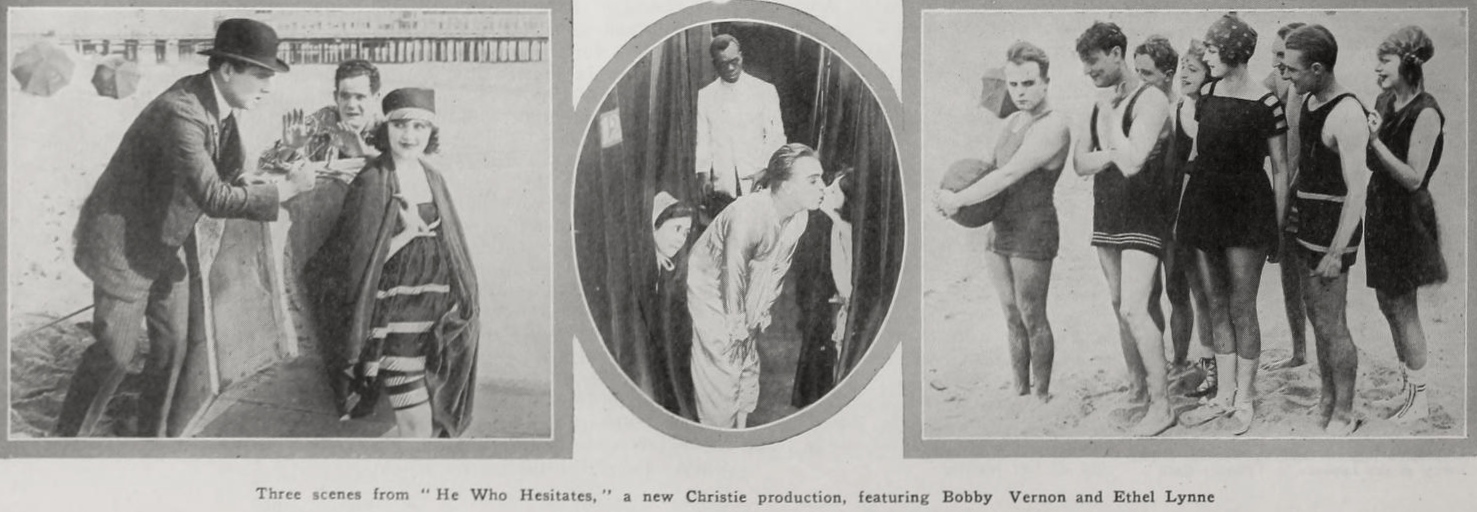
The year 1918 represented a pivotal juncture in the evolution of the motion picture. While the world was gripped by the closing chapters of the Great War, the cinematic medium was undergoing a metamorphosis from primitive nickelodeon attractions to sophisticated narrative art. Within this ferment, Al Christie established a distinct comedic voice—one that favored situational irony and character-driven vignettes over the purely visceral impact of the Keystone style. He Who Hesitates stands as a testament to this philosophy. Unlike the somber social examinations found in Public Opinion, Christie’s work sought to find the universal in the trivial, magnifying the minute anxieties of the common man into a grand theatrical spectacle.
The film’s title is more than a mere proverb; it is a structural mandate. In the hands of writers Al Christie and Margaret A. Taitinger, the concept of hesitation is weaponized as a comedic engine. We see a protagonist who is not merely slow to act, but one who is intellectually over-leveraged by the possibilities of failure. This psychological depth was rare for the era’s short subjects, which often relied on external obstacles rather than internal neuroses. By focusing on the internal landscape of its lead, He Who Hesitates anticipates the more complex comedic personas that would later be perfected by the likes of Harold Lloyd and Buster Keaton.
Bobby Vernon’s performance in this film is a revelation of physical economy. In an age where many actors leaned toward the histrionic, Vernon utilized a more subtle, almost balletic approach to his character's paralysis. His face is a canvas of micro-expressions—the darting eyes of a man seeking an exit, the subtle twitch of a lip before a word is left unspoken. There is a specific rhythm to his movements that suggests a coiled spring, ready to release but held back by the weight of his own doubt. This creates a tension that is far more engaging than the relentless movement of contemporaneous comedies like Bill's Sweetie.
Vernon’s chemistry with Ethel Lynne provides the film’s emotional core. Lynne, often underrated in the annals of silent film history, possesses a screen presence that is both ethereal and commanding. She does not merely exist as a prize to be won; she acts as the catalyst for Vernon’s eventual transformation. Her reactions to his dithering are played with a mix of genuine affection and mounting frustration, a dynamic that feels remarkably modern. When compared to the more traditional gender roles seen in The Rise of Jenny Cushing, the interplay here suggests a more egalitarian approach to comedic partnership.
To fully appreciate He Who Hesitates, one must contextualize it within the broader output of 1918. While films like Tangled Lives explored the intricate webs of human relationships through a dramatic lens, Christie’s film does so through the distortion of the comic mirror. The film manages to pack an extraordinary amount of narrative density into its brief runtime. Every frame is utilized; every prop is a potential pitfall. The pacing is relentless, yet it never feels rushed, a testament to the editing prowess of the Christie studio.
Consider the contrast between this film and the more atmospheric, somber European imports of the time, such as the Italian masterpiece Sperduti nel buio or the Swedish Brottmålsdomaren. While those films delved into the shadows of the human condition, He Who Hesitates operates in the bright, unforgiving light of the American dream. It posits that the greatest threat to an individual’s happiness is not a cruel judicial system or a decaying social order, but one's own inability to seize the moment. This optimism, even when couched in failure, was a hallmark of the burgeoning American cinematic identity.
"In the silent era, silence was never an absence of sound, but a presence of intention. Christie understood that a look could convey more than a page of dialogue, and in Vernon, he found the perfect vessel for this visual language."
Technically, He Who Hesitates exhibits a level of proficiency that belies its status as a 'short.' The cinematography is crisp, with a deep focus that allows for simultaneous action in the foreground and background. This layered approach to visual storytelling is something we also see in the more high-budget productions like The Woman on the Index. The lighting, while largely functional, occasionally dips into more expressive territory, particularly during the protagonist’s moments of solitary reflection. These brief shadows offer a visual synecdoche for his internal conflict.
The intertitles, written with a sharp, epigrammatic wit by Margaret A. Taitinger, do not merely explain the plot; they augment the humor. They possess a rhythmic quality that complements the visual pacing. Where a film like Pique Dame might use text to heighten the drama, Christie uses it to puncture the protagonist’s ego. It is a sophisticated use of the medium that respects the audience's intelligence, avoiding the redundant exposition that plagued many lesser films of the decade.
While He Who Hesitates is ostensibly a lighthearted comedy, it is impossible to ignore the subtextual echoes of its era. 1918 was a year of profound global transition. The themes of decisiveness and action were not just comedic tropes; they were national imperatives. In this light, the protagonist’s struggle takes on a new dimension. He represents the civilian anxiety of a world where the stakes have suddenly become much higher. Unlike the explicit propaganda of On the Fighting Line, Christie’s film offers a more domestic, relatable form of tension.
Even the more exotic or melodramatic offerings of the year, such as Die Königstochter von Travankore or the moralistic A Factory Magdalen, share a common thread with this short: the exploration of the individual's role within a rapidly changing society. Whether through the lens of a princess in a far-off land or a factory worker in a gritty city, the cinema of 1918 was obsessed with the idea of agency. He Who Hesitates approaches this through the back door of comedy, suggesting that our greatest failures are often the ones we invite through our own inaction.
The enduring appeal of He Who Hesitates lies in its fundamental humanity. We have all been Bobby Vernon at some point—standing at the precipice of a decision, frozen by the potential for embarrassment. The film’s resolution, which involves a frantic, high-stakes chase, serves as a cathartic release for both the character and the audience. It is a reminder that while hesitation may be a part of the human condition, the world eventually forces our hand. This narrative arc is as satisfying today as it was over a century ago.
In comparison to the familial dramas of Father and Son or the youthful idealism of The Kingdom of Youth, He Who Hesitates feels remarkably lean and focused. It doesn't waste time with moralizing or sentimentality. It is a pure, distilled shot of cinematic energy. The film also highlights the importance of the medical professional in the cultural zeitgeist, albeit in a much different way than the dramatic Kitty Kelly, M.D., by showing how social status and professional standing are often the very things the 'hesitator' fears losing most.
Ultimately, Al Christie’s work, and this film in particular, deserves a more prominent place in the conversation about the development of film comedy. It bridges the gap between the chaotic origins of the medium and the sophisticated narrative structures of the 1920s. It is a film that rewards multiple viewings, not just for the laughs, but for the sheer craftsmanship on display. In a world of loud, aggressive blockbusters, there is something profoundly refreshing about the quiet, calculated brilliance of a man who just can't make up his mind.
Historical Note: He Who Hesitates is part of the legendary Christie Comedies series, which served as a training ground for dozens of future Hollywood stars. Bobby Vernon and Ethel Lynne remained one of the most popular screen pairings of the late 1910s, their chemistry often cited as the gold standard for 'light' romantic comedy.
IMDb 4.5
1931
Community
Log in to comment.