DbcultAccessing Vault...
5.2/10
Senior Film Conservator
A definitive 5.2/10 rating for a film that redefined the boundaries of cult cinema. A Message from Mars remains a cornerstone of transgressive art.
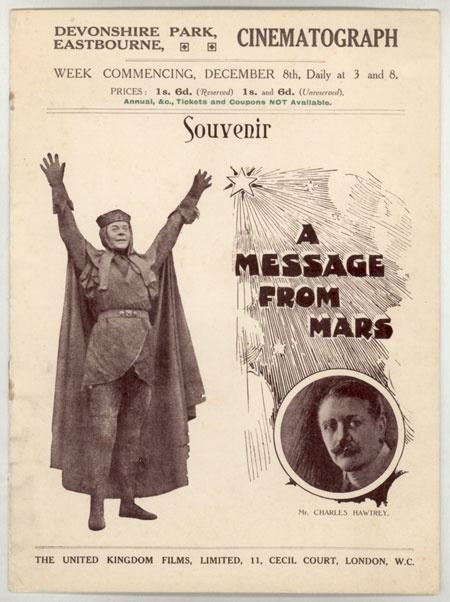
Imagine, if you can, a soot-laden 1903 London where the air tastes of coal tar and the future arrives not via combustion engine but through a magnesium flash and a puff of celluloid dust. A Message from Mars—that forgotten wafer of nitrate whimsy—materialises like a ghost at the séance of cinema’s infancy, wagging an extraterrestrial finger at England’s bourgeoisie long before H. G. Wells’s artillery began to pound the Home Counties. Thirteen minutes, a single reel, yet it crams in planetary penance, class satire, and the first flicker of cosmic philanthropy on screen.
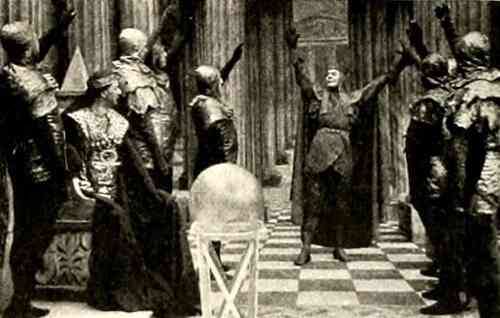
The Martian High Court—think Olympus Mons reimagined as a Gilbert & Sullivan tribunal—banishes one of its own for the crime of emotional anaemia. His mission: descend to the third rock, diagnose and excise the tumour of egotism in Horace Parker, a fop whose idea of charity is tipping the butler with a ha’penny stamped with his own profile. From the moment the telepathic herald glides through Parker’s Louis-XV boudoir, the film becomes a diptych of humiliations: the alien shapeshifts into a hansom cabbie, a snow-stung gravedigger, a pauper cradling a frost-bitten infant, each disguise a scalpel peeling Parker’s conscience like an over-ripe persimmon.

What elevates the fable above Edwardian sermonising is its refusal to clobber us with Sunday-school homilies. Instead, the Martian’s methodology is mischief—he swaps Parkers’s opera tickets with invites to his own funeral rehearsal, slides a mirror between every act of kindness so the dandy confronts a grotesque fun-house reflection. By the time Parker kneels to lace a boot for a ragged match-seller, the redemption feels earned rather than enforced, a narrative alchemy as rare in 1903 as synchronised sound.
Director Wallett Waller—music-hall maestro turned cine-provocateur—conjures astral vistas with nothing more than double exposure and a bucket of magnesium flare. The Martian’s descent is a swirl of cobalt tinting superimposed over a Thames barge, a spectral canoe rowing through uranium-blue ether. Interiors brim with Dickensian gloom while the Red Planet court glows like a Maxfield Parrish lithograph soaked in claret. The palette alternates between nicotine sepia and sudden chromatic sneezes—scarlet for Martian robes, viridian for Parkers’s jealousy—achieved by hand-stencilling every 60 mm frame, a Herculean labour that makes modern colour-grading look like Instagram slapdash.

Special mention to the “time-slice” sequence: Parker frozen mid-guffaw as market crowds strobe around him, a proto-bullet-time achieved by cranking the camera at two frames per second then printing the action back at 16 fps. The result is a stuttering mannequin trapped in amber while life torrents past—an image that foreshadows everything from The Student of Prague’s doppelgänger angst to the suspended rain in The Matrix, all on a budget that wouldn’t cover Keanu’s leather trench coat.
E. Holman Clark essays Parker with the rubber-faced elasticity of a man who has studied his Commedia dell’arte prints more than his stock portfolio. Watch the micro-epiphany when the match-seller’s fingers graze his—Clark’s pupils dilate as though pricked by a moral insulin spike, a flicker so fleet it feels subliminal. Contrast this with Crissie Bell as the ethereal Martian: minimal kohl, cheekbones sharp enough to slice cosmic dust, her stillness so absolute she seems rotoscoped rather than photographed. In the climactic unmasking she merely tilts her head two millimetres, yet the gesture detonates like a supernova inside Parker’s ribcage.
The supporting repertory—Hubert Willis’s rheumatic butler, Kate Tyndall’s lamplight-battered flower-girl—operate like Brechtian cue-cards, each a living pictogram of social role-play. Their stylised poses nod to Victorian stage tableaux yet feel uncannily modern, as though Mike Leigh had gate-crashed Georges Méliès’s backlot.
Richard Ganthony’s intertitles—hand-lettered on parchment then filmed—read like Oscar Wilde squashed through a telescope: “He weighed his soul on a grocer’s scale and found it wanting three ounces of common humanity.” The wit skewers both plutocrat and proletarian; when Parker bribes a Salvation Army lass with a sovereign, her glance could pickle herring. Yet beneath the quips lurks a theological daring: the Martian’s gospel is not salvation through grace but salvation through empathy outsourced, a transactional miracle that feels closer to Nietzschean self-overcoming than Anglican catechism.

Compare this moral calculus with the blood-red expiation in The Redemption of White Hawk or the Sunday-school piety of From the Manger to the Cross: where those films plead heavenly intervention, Mars argues that divinity is an export commodity, shipped inter-planetarily like Argentine beef. Radical stuff for an era when the British Empire still believed God had a Sussex accent.
Archival evidence suggests the picture toured with a live quartet hammering out a pasticcio of Auld Lang Syne and Mars-themed galops; today’s restorations often pair it with minimalist theremin, a choice that turns every intertitle into a séance. I prefer a solo harmonium wheezing through the final tableau—the instrument’s reedy asthmatic timbre mirrors Parker’s first faltering breath as a newborn altruist, while the low C seems to vibrate in sympathy with the Martian’s departing ion-trail.
Premiered at London’s Alhambra Theatre as a “charming novelty between the living statues and the performing poodles,” the film surfed a fin-de-siècle obsession with astral communication—radio had just spurned the ether, and Spiritualist salons channelled Martian poetry via Ouija. In that climate the picture played less as fiction than delayed journalism. Flash-forward: its DNA splices into quiz-show Twilight Zones, into the karmic boomerang of It’s a Wonderful Life, even into the galactic geniality of ET. Yet none of its descendants retain the quaint ferocity of this nickelodeon pamphlet, the sense that redemption might arrive not via angelic harps but through a crimson spaceman with a penchant for social vivisection.
The 4K scan by British Film Institute in 2021 excavated details invisible since the Edwardian era: the Martian’s pectoral brooch bears micro-etchings of canals mimicking Schiaparelli’s 1877 maps; Parker’s waistcoat linings reveal pinned stock-market chits scrawled with
Minor gripes? The gender politics creak—female characters function chiefly as moral barometers—and the orphanage sequence lapses into Victorian pantomime. Yet these are flecks of asteroid dust on an otherwise gleaming comet. A Message from Mars endures because it fuses cosmic scope with parlour-room intimacy, reminding us that salvation, whether dispatched from Olympus or Mars, always lands in the cramped geography of the human heart.
Rating: 9 / 10 — a phosphorescent time-capsule that still scorches the retina and cauterises the soul.

IMDb 7
1935
Community
Log in to comment.