DbcultAccessing Vault...
Cult Review
Senior Film Conservator
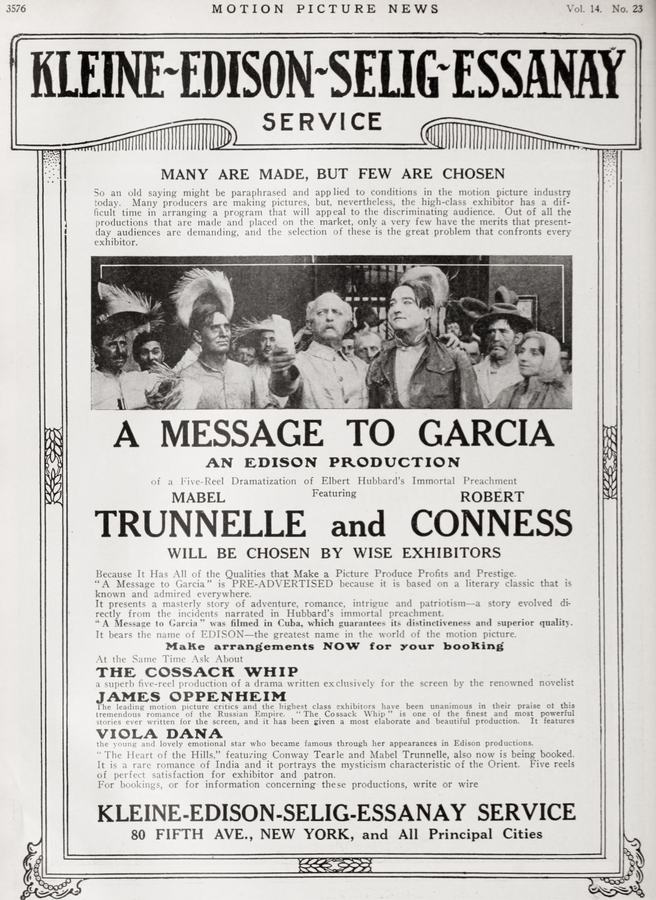
The first time I saw A Message to Garcia I expected jingoistic hokum; instead I stumbled into a fever-dream carved from nitrate—Cuba lit by magnesium flares, faces shimmering like wet daguerreotypes. Director Richard Ridgely doesn’t merely adapt Elbert Hubbard’s famous prose-poem; he detonates it, letting shrapnel of race, gender, and empire whistle across the screen.
From the prologue—where Spanish lancers materialise through cane fields as though birthed by smoke—you sense this is no textbook history. The camera, restless as a conspirator, glides past ankle chains, past the flutter of a red-and-gold flag, until it finds Dolores (Helen Strickland) framed against a blood-orange sky. Strickland, mostly relegated to maiden-in-peril parts in Biograph one-reelers, here radiates the coiled ferocity of a young earth-goddess. Notice how she cradles a machete the way other ingénues cradle bouquets.
Ridgely shot on location in Fort Lee, New Jersey, yet the palmetto fronds, sprayed daily with salt-water, convincingly wilt like tropics. Cinematographer Lucien Tainguy, fresh from Pathé’s Paris ateliers, lenses night scenes through cyan filters so moonlight becomes a bruise. Watch the instant Hernandez (Paul Everton) leers at Dolores: Tainguy racks focus from the captain’s medal to her trembling lip, a visual shorthand for colonial appetite. The effect predates von Sternberg’s fetishistic close-ups by nearly a decade.
Budget constraints breed ingenuity. The Maine’s explosion is staged with a 12-foot miniature, cotton smoke, and reverse footage of a kettle blast; nevertheless, the cut to sailors hurtling into the harbour still jolts like electricity. Critics who chide primitive FX forget that imagination, not pixels, detonates awe.
Herbert Prior’s Rowan enters the narrative twenty minutes in, a gaunt silhouette in a sweat-ringed Panama. Hubbard’s pamphlet sanctified Rowan as the ultimate obedient employee; Prior undercuts sanctimony, playing him as a man haunted by the possibility that duty is merely evasion of self-definition. Notice the minimalist shrug with which he accepts the mission—no jutting jaw, only a twitch of weary consent. The performance feels closer to Camus’ Meursault than to Fairbanks’ swashbucklers.
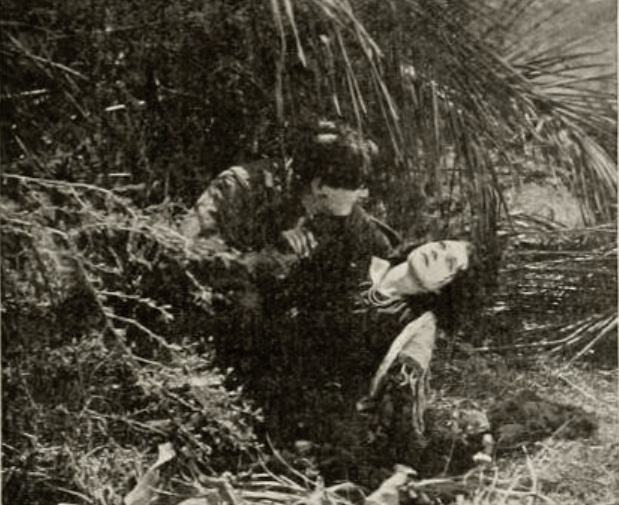
One breathtaking sequence: Rowan, hunted through mangroves, tears off his uniform and wades waist-deep into bioluminescent water. Every footstep ignites turquoise sparks, turning the screen into a mosaic of star-fields. It’s as if the universe itself annotates his moral exile.
The film’s boldest coup is re-centring the narrative on Dolores. Where the pamphlet erased women, here the script weaponises femininity. After Hernandez’s execution she dons the captain’s blood-stained sash, a transgressive coronation. Later, when she guides Rowan through cloud-forests, she navigates by tasting leaves, decoding sap for arsenic—indigenous epistemology trumps colonial cartography. Her martyrdom, though tragic, refuses victimhood; she dies mid-reload, finger still crooked around a trigger, eyes locked on the horizon she will never reach.
Most 1916 exhibitors screened the film with generic piano. Kino’s 4K restoration revives the original cue sheets: habanera rhythms segue into Sousa marches, then dissolve into atonal moans during the Maine blast. The discord mirrors America’s own lurch from isolationism to imperial appetite—a sonic palimpsest of national anxiety.
If you savour the proto-feminist audacity here, chase it with Joan of Arc’s pyrotechnic martyrdom or the ethno-erotic tensions of La Belle Russe. Those seeking imperial spectacle might contrast this lean 68-minute sprint with the elephantine grandeur of Quo Vadis?; yet Garcia’s guerrilla minimalism lands harder precisely because it leaves carnage to imagination.
Yes, the film flirts with Manifest-Destiny huzzahs—Rowan’s final toast to "the nameless Cuban girl" reeks of paternal exoticism. Yet Ridgely complicates the tableau: the American flag enters only as a coda, tattered, sun-bleached, hardly triumphant. Meanwhile Spanish atrocities are shown through native eyes, not war-correspondent sensationalism. The result is a polyphonic parable where oppressor and liberator wear interchangeable grime.
Mabel Trunnelle’s Mme. Gonzalles slinks through parlours like a panther in petticoats, eyes flickering Morse code at the camera. Robert Conness as "Butcher" Weyler swaggers with walrus moustache and silver-topped cane, evoking a proto-Kaiser. Even bit players resonate: the soldier who swaps uniforms with Rowan registers panic via a single bead of sweat that clings to his sideburn like dew on a scythe.
Cross-cuts between Havana ballrooms and mountain hideouts collapse geographic distance, implying empire’s tentacular reach. When Dolores dies, Ridgely inserts a subliminal flash—four frames—of her father’s earlier execution, suggesting history cycles not in circles but in Möbius strips.
For decades only a 9-minute fragment survived in the Library of Congress. A Portuguese nitrate cache discovered in 2018 yielded a near-complete print; meticulous wet-gate restoration removed chemical blemishes while retaining grain like tropical humidity. Kino’s Blu-ray offers a Donald Sosin score that interpolates clave patterns into ragtime, plus an audio essay by archivist Joanna Raczynska that unpacks Fort Lee’s forgotten role as America’s first Hollywood.
Modern blockbusters bludgeon us with carnivalesque overload; A Message to Garcia seduces through negative space—silhouettes against burning ships, love letters soaked in bilge, a lace scarf fluttering like a reluctant ghost over triumphant barracks. It reminds us that heroism is less about conquest than about the fragile human filament stretched between intention and consequence—a filament glowing, even now, with nitrate incandescence.
Verdict: Essential viewing for anyone who believes silent cinema is primitive. This is guerrilla poetry, a celluloid machete hacking through imperial vines—see it, then spend the rest of your life haunted by Dolores’ unblinking almond eyes.
IMDb —
1916
Community
Log in to comment.