DbcultAccessing Vault...
Cult Review
Senior Film Conservator
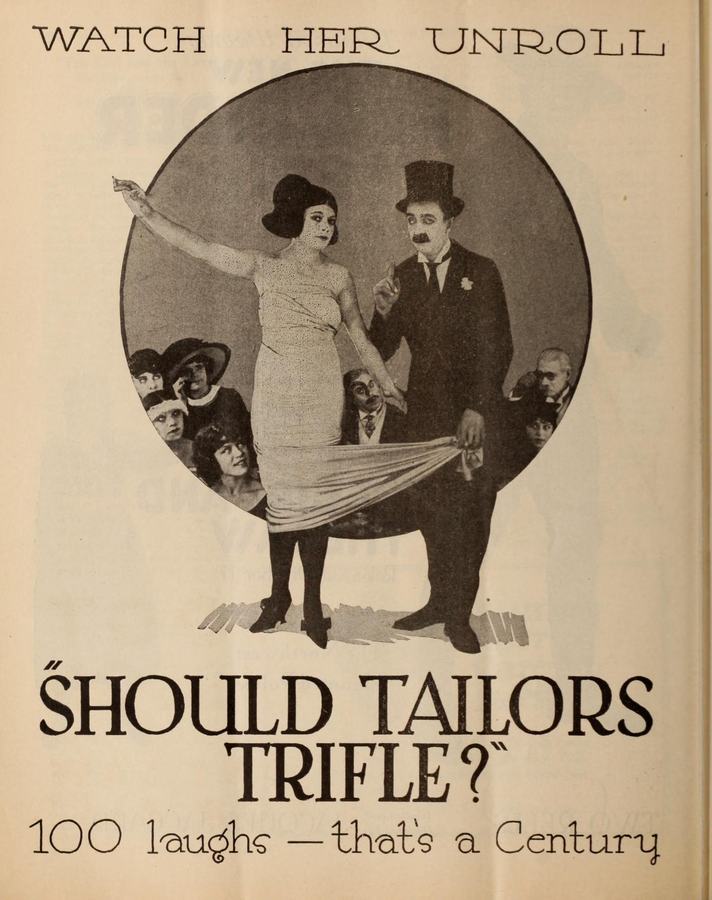
Tom Buckingham’s Should Tailors Trifle?—a two-reel whirligig cranked out in the dog days of 1922—ought to be as forgotten as the tissue paper once wedged inside Edwardian collars. Yet, like a stubborn crease, it lingers, begging for forensic scrutiny. Ostensibly a barn-door-broad farce about competitive cloth-cutters, the film is really a pocket treatise on transactional affection: every hug comes with a meter running, every kiss tallied like a line on an invoice.
The alley itself, rendered in high-contrast monochrome that pools ink-black shadows beneath awnings, feels like a tailor’s nightmare: measuring tapes slither across cobblestones like urban pythons, and mannequins leer from windows with glass-eyed accusation. Buckingham, who also wrote, refuses to let the mise-en-scène relax; the camera jitters, as though stitched to the nervous pulse of a sewing-machine needle. The result is an urban fable that anticipates the frantic visual puns of Eyes of the Soul yet lacks that film’s metaphysical swagger, opting instead for the blunt-force slapstick endemic to Hal Roach’s lesser shorts.
Charles Dorety’s Charlie exudes the rubber-faced elasticity of a man who’s learned to survive on lint and day-old bread. Watch how his shoulders ride up when confronted—an improvised shrug that says both "I’m innocent" and "so what if I’m not." Opposite him, Peggy Prevost essays a slyer spin on the flapper archetype: her Peggy is no naïf waiting to be hemmed by matrimony but a calculating strategist whose batting eyelashes double as semaphore for "open wallet." The chemistry between the two is less romantic than transactional, a ledger constantly rebalanced with kisses for down-payments and recriminations for interest.
Enter Bud Jamison’s Bud—beefy, mustachioed, and radiating the dim confidence of someone who believes women swoon at the rustle of paper money. His function in the narrative is to be human collateral, the blank promissory note on which Peggy writes her ambitions. The seduction sequence, framed in a cramped backroom where bolts of fabric cascade like waterfalls, is a marvel of economic storytelling: Peggy circles Bud as though measuring inseam, the camera alternating between close-ups of her predatory grin and his Adam’s apple bobbing like a captive moth. Within forty-five seconds she’s relieved him of enough cash to stave off the landlord, and the film has already hinted that virtue—tailored or otherwise—cuts no cloth against necessity.
Marriage arrives not as culmination but as corporate merger. The wedding night—depicted via a iris-in on a closed door—feels like an anti-punchline, a visual shrug that mocks the audience’s hunger for emotional payoff. The subsequent appearance of the titular baby, ferried in by Brownie like a stork with a taste for gabardine, detonates the film’s central irony: a man who spends his life sizing up strangers is suddenly measured by a lie he never stitched.
Accusations fly, seams burst, and in a narrative pirouette that would make Molière’s head spin, Charlie is branded philanderer. Buckingham’s script, for all its briskness, relishes this moment of public shaming: townsfolk crowd the shop, their shadows looming like jury members, while Charlie’s mannequins appear to lean inward, cloth ears hungry for gossip.
Yet the film’s true coup arrives with the intervention of the infant’s biological father—a figure whose entrance is so abrupt he might as well have been clipped from another reel. His gratitude, a crisp cash reward, functions as deus ex machina and moral reset, yanking the narrative back onto an axis of poetic if implausible justice. Charlie, exonerated, sets off in pursuit of Peggy and Bud, and the climactic confrontation crackles with a screwball energy that prefigures A Bachelor’s Wife’s gendered sparring matches, though without that film’s urbane sheen.
Face-to-face, Charlie flips the accusation: Bud, he claims, is the real deadbeat dad. The lie—a deliberate echo of Bud’s earlier slander—lands with the precision of a well-aimed shears, slicing Bud’s credibility to ribbons. Peggy, realizing she’s been draped in deceit, reverts to Charlie, not out of renewed love but of comparative honesty: better the tailor you know than the con you don’t.
On a micro-budget, Buckingham squeezes maximum mileage from location work: laundry lines zigzag above alleyways like bunting, and passing streetcars provide free kinetic backdrop. The soundscape—silent, of course—invites modern viewers to furnish their own clatter of pedals, shears, and barking, a synesthetic canvas that paradoxically feels richer than many early talkies.
Still, the picture is not without frays. The racial caricatures populating the margins (a Chinese laundryman whose queue gets caught in a press) land with the thud of period prejudice, reminding us that even anarchic comedy can double as cultural scar tissue. Likewise, the women’s ultimate reconciliation with patriarchal norms—Peggy’s meek return—undercuts the film’s proto-feminist potential, leaving modern audiences to wince even while chuckling.
Yet its thematic threads—commodified affection, rumor as currency, the dog-eat-dog economy of small business—remain startlingly contemporary. In an era when gig workers hustle for ratings, Charlie’s canine-driven lead generation feels prophetic, a Yelp avant-la-lettre where every star is paid for in shredded gabardine.
Performances oscillate between proto-method and outright vaudeville. Dorety’s double-takes—head jerks, eyebrow semaphore—echo Lights of New York’s harried everyman, while Prevost’s sideways glances hint at the sly subversions later perfected in The Amazing Wife. Jamison, saddled with the villain role, opts for bluster over nuance, yet his physicality—those collapsing shoulders when cornered—imbues Bud with a comic cowardice that prevents outright contempt.
From a formal standpoint, the editing is surprisingly dynamic for a Poverty-Row quickie. Cross-cuts between Brownie’s street-side mauling and Charlie’s in-shop measurements create a causal loop—chaos outside, commerce inside—that foreshadows the dialectical montage of Pristiganeto na bulgarskata delegatziya ot konferentziuata v Parizh, albeit minus geopolitical gravitas.
Credit must also go to the anonymous set dressers who festoon Peggy’s parlor with fashion-plate clippings: their yellowed edges flutter whenever the door slams, suggesting the ephemerality of haute-couture dreams within proletarian reality. It’s a detail easily missed, yet it encapsulates the film’s central tension—aspiration stitched to limitation, beauty sewn with shoddy cotton.
Contemporary critics—those who bothered—dismissed it as “a patchwork of cuffs and cuffs” (Variety, Sep ’22). Modern reappraisal reveals a sharper ideological cut: a silent-era ancestor to neoliberal rom-coms where love equals liquidity and trust is merely another commodity to trade.
So, should tailors trifle? Buckingham’s answer is a cynical, cheerfully affirmative stitch-up. Trifle they must, because trifling—dealing in half-truths, altered promises, and the occasional re-cut past—keeps the rent paid and the wolf (or terrier) from the door. In a world measured by inseams and interest rates, love itself is just another garment to let out or take in, depending on who’s paying.
Restoration-wise, the lone surviving print’s emulsion scratches resemble runaway stitches, a visual reminder of cinema’s fragility. Fans of The Stolen Treaty’s historical whodunits or Gar el Hama V’s serial cliffhangers will still find value here, though expectations must be tailored to two-reel limitations.
Ultimately, Should Tailors Trifle? survives as a frayed yet fascinating swatch: not haute couture, perhaps, but a utilitarian garment—raw-edged, hastily hemmed—revealing as much about the sweatshop of human desire as any blockbuster epic. View it less for belly-laughs than for anthropological insight; let its dog-eared cynicism remind you that every stitch in time is paid for, one way or another, on somebody’s tab.
IMDb 6.8
1936
Community
Log in to comment.