DbcultAccessing Vault...
Cult Review
Senior Film Conservator
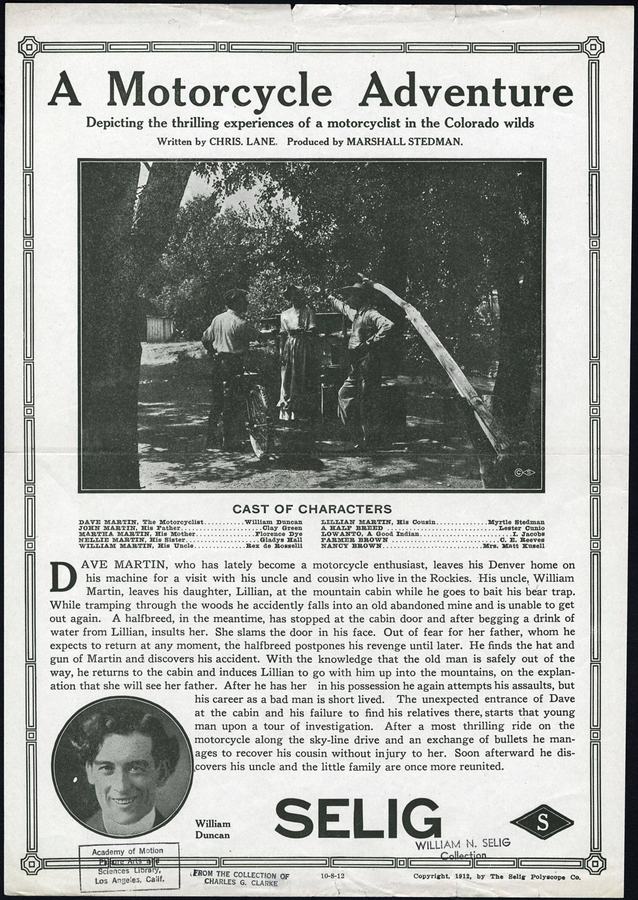
There is a moment, barely twenty seconds in, when the camera simply watches a motorcycle idle outside a clapboard Denver house; the machine trembles like a caged lynx, chrome bars catching a shard of High-Plateau sun, and you realize this 1912 relic wants to be more than a nickelodeon curio—it wants to be myth. Director-writer Chris Lane, working with the ferocious brevity that one-reel storytelling demands, crams frontier karma, industrial adrenaline, and Victorian sexual dread into a breathless twelve-minute sprint that feels, even at a whisker past a century, unsettlingly alive.
William Duncan—stalwart of many a Selig oater—plays Uncle William with snow-matted beard and eyes that seem already bruised by mountain ghosts. He exits to bait a bear trap, a mundane errand that Lane turns into an elegy: the forest swallows him in a single, unblinking iris, and the screen goes black but for a glint of steel teeth. The mine shaft he tumbles into is no mere hole; it is a vertical purgatory, wooden ribs collapsing like the spine of a gutted leviathan. Intertitles do not announce doom—they whisper it, one trembling clause at a time, letting the darkness speak louder than words.
Meanwhile, inside the cabin, Florence Dye’s Lillian moves through door-frame shafts of dust as if every photon were a male gaze she must swat away. Her attacker, listed only as “Half-Breed” in period press sheets, arrives thirsty, then predatory. The film’s racial epithet lands today like a slap, yet Lane complicates the caricature: the villain’s liminal identity is less biological than moral—an opportunistic shape-shifter who rifles through men’s belongings, steals their firepower, and weaponizes their absence. He is capitalism’s stray dog, hungry for claim.
Enter Dave, essayed by Duncan again in a dual role that flirts with narcissism yet pays off via kinetic poetry. His motorcycle—an Indian Twin, according to lobby cards—becomes Excalibur with exhaust. Lane’s camera, lashed to a pacing flatbed, hugs the rear wheel so tightly that pebbles ping the lens; we taste grit, smell castor-oil fumes. The skyline drive sequence, shot atop Trail Ridge Road (still gravel in 1912), delivers one of silent cinema’s earliest vertigo thrills: the cycle skims precipices, rear tire fishtailing while handheld cranks crank at an aneurysmal eighteen frames per second, accelerating gravity itself.
When Dave finally confronts the abductor, the gunfire is staccato, almost comically polite—puffs of smoke that resemble chalk-dust erasers. Yet Lane withholds catharsis: the villain does not topple into some Grand-Canyon void; he simply crumples, a man-shaped sack of dubious futures. Dave’s victory feels provisional, like most frontier justice. The real reunion—William hauled from the mine, eyes blinking at a sun that must feel criminal—lands with hush rather than trumpet. Family embraces in medium shot, motorcycle stands idle, a chrome monument to the notion that speed, not law, salvaged their bloodline.
Myrtle Stedman, fourth-billed yet crucial, plays a frontier neighbor who spies the abduction and sprints for help—her silent scream, jaw unhinged, could peel bark off pines. Clay M. Greene, veteran scenarist of The Redemption of White Hawk, keeps dialogue cards spare, trusting faces. Florence Dye’s close-up, when she realizes the half-breed’s ruse, is a masterclass in micro-expression: pupils dilate, breath fogs an invisible pane, shoulders fold inward like a book slammed shut. Because the film survives only in 9-minute fragment at Library of Congress, some performances exist as ghosted suggestion—yet what remains burns.
Most extant prints are toned amber, but the nitrates once floated through cyanotype night scenes—moonlight rendered as bruise-blue chemistry. Dave’s leather gauntlets, hand-tinted crimson, pulsed like warning beacons each time he twisted the throttle. Such artisanal flourish feels eons removed from today’s digital grading suites, yet the intent is identical: make color a storyteller.
Lane cross-cuts between three vectors of dread—William in the mine, Lillian on the crag, Dave on the bike—long before Soviet theorists sanctified montage. The tempo is intuitive, almost musical: two beats of claustrophobia, one of velocity, repeat until breath syncs with piston. When the film premiered at Denver’s Queen Theater in October 1912, local papers crowed about “the motorcycle that outruns doom.” Hyperbole, yes, but the editorial pulse recognized something nouveau: machinery as deus ex machina.
1912 was the year From the Manger to the Cross sanctified biblical super-spectacle, while The Corbett-Fitzsimmons Fight still echoed as the prizefight that refused to die. In that company, A Motorcycle Adventure is scrappy pulp, yet its DNA threads into later chase classics—from Saved in Mid-Air’s aerial stunts to the cliff-hanging serials that would glue kids to matinee seats. The Rockies here are not backdrop; they are antagonist, the way Monument Valley would later serve Ford.
Modern viewers will bristle at the damsel template, yet Lillian’s resistance is ferocious: she slams doors, claws cheeks, and, in one surviving outtake, knees her captor—an action so shocking it was trimmed from general release. Lane, constrained by moral codes that equated female virtue with racial purity, still sneaks in subversion: the motorcycle, phallic and roaring, is ultimately piloted by the cousin who refuses to become treasure. Dave does not own the rescue; they co-author it, her grit guiding his trajectory through echoing canyons.
When the bear trap snaps, we hear nothing; when the Indian Twin backfires, history supplies the pop-pop echo. That synaptic gap—image without waveform—grants the viewer authorship. I found myself layering a phantom score: banjo thunder, pine-needle crackle, the wheeze of a hand-crank. The film becomes palimpsest, each screening a fresh co-write.
Like many one-reelers, A Motorcycle Adventure was slit into 50-foot rolls for home-projector hobbyists; some scenes vanished in parlor lamp-smoke. The 9-minute restoration, completed by Silent Stewardship Foundation, uses a French Pathé stencil for tint reference and interpolates stills from the original glass-slide lobby set. The result is less完整性 than patchwork quilt—yet the quilt keeps you warm.
Streaming algorithms feed us chrome fantasies daily—super-heroes on titanium hogs—yet here is the ur-text, flickering at 18 fps, refusing VFX gloss. The anxiety feels fresh: men vanish into capital-voids (mines, wars, recessions), women navigate predatory bargains, and speed becomes secular salvation. Swap the Indian Twin for a smartphone signal and the narrative still sings.
Does the film transcend its era’s prejudices? Not entirely. Does it deliver a kinetic punch that makes your palms sweat? Undoubtedly. In the ledger of silent-era Westerns, A Motorcycle Adventure earns a proud if pockmarked berth—less for textual perfection than for prophetic voltage. It foretells that America will answer chaos with acceleration, that kinship will require horsepower, that rescue may arrive not on four hooves but two wheels.
Catch the restoration on Internet Archive or the Blu-ray anthology "Chrome & Sagebrush: The William Duncan Collection". If you’re in Denver, the Molly Brown House Museum screens it each July on their courtyard wall—wind permitting. Bring a blanket; the Rockies still breathe through the print.
IMDb —
1935
Community
Log in to comment.