DbcultAccessing Vault...
Cult Review
Senior Film Conservator
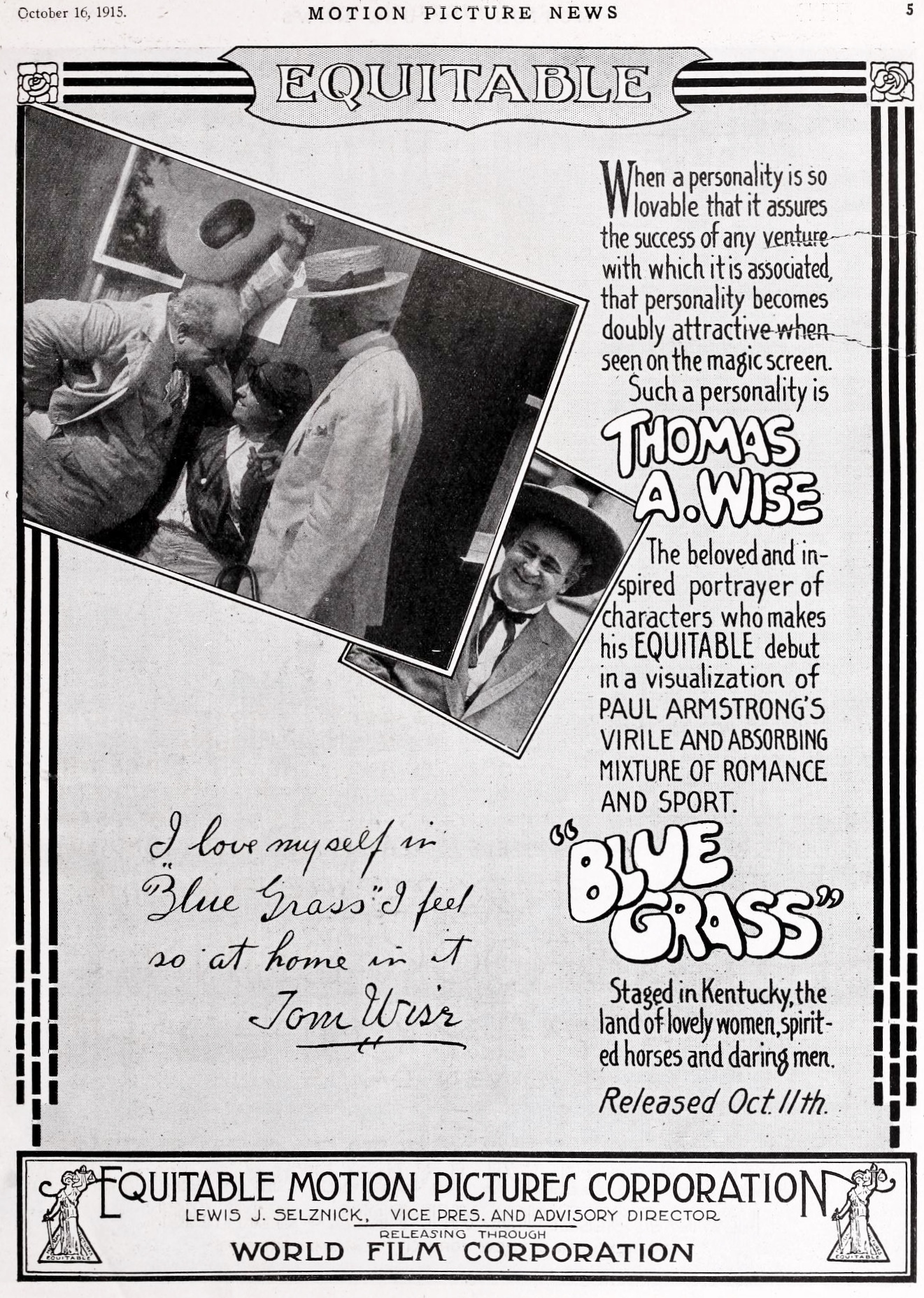
The first glimpse of Blue Grass feels like stepping on a loose floorboard in an abandoned ante-bellum mansion: you expect dust, but instead a rush of cold air knocks the breath out of you. Director George Soule Spencer—better remembered for helming vaudeville skits than celluloid—somehow wrangled Kentucky’s fabled limestone bluegrass into a character of its own, letting dawn fog roll across the track like a gambler’s last cigarette exhale. Cinematographer Ray Tuckerman shot the 1915 winter in natural light, so every breath plume from horse or human etches itself against the silver nitrate like ghostly calligraphy. The result is a pastoral noir, equal parts The Wolf’s urban cynicism and Das Tal des Traumes’s expressionist yearning.
Spencer refuses to spoon-feed exposition; instead, he hurls us mid-race into a tangle of flying turf and panicked whips. My Lady’s victory-cum-catastrophe lands like a body blow—one moment she’s a sleek ebony streak, the next a shuddering ruin, her cannon bone jutting at a grotesque angle. The editing rhythm—holding on the collapsing mare, then cutting to bookies scooping cash into leather satchels—cements the film’s central creed: fortune is carnivorous. It’s a thesis the script by Marc Edmund Jones and raconteur Paul Armstrong will test again and again, until every character limps, literally or spiritually.
Enter Kelley—played by Thomas A. Wise with the slimy magnetism of a snake-oil evangelist—who palms Warren’s winning ticket with such slick confidence you half expect the celluloid itself to smear. Wise keeps his shoulders perpetually angled toward the camera, as though even his skeleton is trying to sell you something. The narrative jumps a year, then another, compressing time the way a farrier folds molten iron into a horseshoe: quick, brutal, purposeful. Blue Grass the colt appears in a swirl of snow and low-angled sunlight, his coat shimmering an impossible cerulean that feels less genetic than divine intervention.
Clara Whipple’s Virginia is no wilting magnolia; she strides across the paddock in a divided skirt, boots caked with Kentucky gumbo, eyes sharpened by the knowledge that her ancestral home is mortgaged to the rafters. Whipple lets silence do the heavy lifting—when Kelley proposes marriage in all but name, she answers by snapping her riding crop against her palm, the crack echoing like pistol shot.
Tommy Mead’s Warren, meanwhile, carries himself with the languid exhaustion of someone who’s already lost everything but hasn’t checked his pockets yet. His courtship of Virginia unfolds in stolen, wordless montages: the two silhouetted against burning sunset stables, fingers brushing over tack-room lanterns. Compare that to The Love Tyrant’s florid title cards—Blue Grass trusts glances, not verbosity.
The Colonel, essayed by Frank Beamish, is a study in patrician entropy: once a pillar of Bluegrass royalty, now reduced to bargaining foals for grocery money. His disowning of Morgan—George Soule Spencer doubling as actor—ranks among silent cinema’s most lacerating scenes. No melodramatic hand-to-forehead histrionics; instead, Spencer simply steps backward into shadow while the Colonel closes the parlor door, the click of the latch louder than any shout.
Spencer’s crew lacked the deep coffers of Germinal’s German co-producers, so they invented tricks: smearing vaseline on the lens edges for dream-like halos during Blue Grass’s birth; under-cranking the camera to make hooves drum like machine-gun fire; tinting the winning-reel amber so the colt’s sweat glistens like molten gold. Note the moment Blue Grass rallies from the sabotaged start: the camera drops to hoof-level, a risky maneuver when one errant step could shatter the tripod. Dirt clods rocket toward us, an effect as visceral as anything in 2020s IMAX.
While original cue sheets are lost, contemporary exhibitors reported pairing the final reel with ”Anvil Chorus” and bluegrass fiddle improvisations—an anarchic blend that somehow suits Kelley’s machinations. One imagines the horse’s cadence syncing with Verdi’s hammers, the audience stomping in time until the floorboards threaten mutiny. Today, stream the film with Nicolas Jaar’s ambient textures for a haunting counterpoint; the chillwave beats underscore Warren’s existential drift better than any 1915 orchestra.
Academic readings bloom like wild geranium once you notice the film’s obsession with wombs—both equine and human. My Lady’s torn leg renders her racing worth null, yet her uterus becomes the family’s salvation, a twist that prefigures today’s debates on commodification of animal bodies. Virginia navigates similar objectification: Kelley’s desire to “own” her parallels his acquisition of My Lady. The screenplay never fully resolves this tension; instead, it lets Blue Grass’s victory serve as symbolic reclamation—an equine offspring redeeming its mother and, by proxy, Virginia.
Stack it beside Fatherhood and you’ll notice both hinge on patriarchal pride curdling into cruelty, yet Spencer’s film eschews sentimental redemption arcs. Against The Explorer’s colonial swagger, Blue Grass keeps its gaze inward, on Kentucky’s clay soil rather on exotic horizons. Meanwhile, Sonho de Valsa shares the motif of dance-as-freedom; here, the horse’s gallop becomes a waltz of survival.
Not everything hurdles the fence cleanly. The intertitles occasionally lapse into dime-novel bombast: ”Kelley’s soul was a racetrack where honesty went to die.” One wishes for the laconic sting of The Last Chapter. Also, the African-American stable hands are nameless, smiling faces—a regrettable erasure typical of the era yet jarring in a film otherwise sensitive to class precarity.
In an age when CGI stallions perform superhero leaps, Blue Grass reminds us that authenticity carries its own thunder. You can taste the dust, smell the liniment, feel the terror of a family’s last chip pushed to the center of the felt. The film’s ultimate triumph lies not in the race but in the quiet moment afterward: My Lady nuzzling her cobalt colt while the Colonel’s trembling hand rests on Warren’s shoulder—a tacit admission that bloodlines matter less than the fragile net of mercy we weave around one another.
Seek out the 4K restoration by University of Kentucky archives; the tinting is subtler, the night scenes no longer swallowed by murk. Pair with a bourbon barrel-proof—something that bites back—and let the taste of charred oak mingle with the film’s own smolder. You’ll finish with hooves drumming in your chest long after the screen fades to black.
IMDb 6.5
1923
Community
Log in to comment.