DbcultAccessing Vault...
2.5/10
Senior Film Conservator
A definitive 2.5/10 rating for a film that redefined the boundaries of cult cinema. A Texas Steer remains a cornerstone of transgressive art.
Ah, the silent era! A time when narratives unfolded through expressive pantomime, dramatic intertitles, and the sheer force of an actor's presence. And then there's A Texas Steer, a film from 1915 that, even over a century later, manages to resonate with its timeless comedic premise and surprisingly sharp social commentary. It's a delightful plunge into a world where a cattle baron from the wide-open plains of Texas finds himself utterly out of his depth in the refined, often hypocritical, milieu of Washington D.C. If you’ve ever felt like a fish out of water, or simply appreciate a good chuckle at the expense of societal pretense, this cinematic antique offers a rich, engaging experience.
At the heart of this charming escapade is Maverick Brander, portrayed with robust conviction by the legendary Tyrone Power Sr. Power, a formidable theatrical presence before his cinematic career, imbues Brander with an authenticity that is both endearing and hilariously out of place. Brander is not a man of subtle gestures or diplomatic niceties; he is a product of the land, straightforward and unburdened by the convoluted social codes of the capital. His initial reluctance to enter the political arena is palpable. He's a man content with his cattle, his ranch, and the honest toil of his life. Yet, the relentless prodding of his wife and daughter, both captivated by the allure of Washington’s perceived grandeur and social cachet, eventually sways him. This internal conflict, the battle between his inherent nature and the external pressures of familial ambition, forms the bedrock of the film’s central character arc.
Tyrone Power Sr.'s performance is a masterclass in silent film acting. Without a single spoken word, he conveys Brander's bewilderment, his frustration, and his unwavering integrity through his expressions, his posture, and his very gait. You can almost hear his exasperated sighs, his booming laughter, and his incredulous retorts. His physical comedy, though perhaps broad by today’s standards, is perfectly pitched for the era, drawing genuine mirth from his character’s predicaments. It’s a performance that grounds the entire narrative, making Brander not just a caricature, but a relatable figure whose journey we invest in.
No less pivotal to the narrative are the women who propel Brander into his political odyssey: his wife, portrayed by Mrs. Tyrone Power (likely a stage name, but adding a delightful meta-layer to the casting), and his daughter, played by Grace Darmond. These aren't malicious manipulators, but rather women blinded by the promise of social ascent. Their Washington dreams are less about policy and more about prestige, less about governance and more about glittering soirées. Mrs. Tyrone Power, as Brander’s wife, embodies a certain societal yearning, a desire to rub shoulders with the 'right' people, to elevate her family’s standing beyond the dusty plains of Texas. Her performance, though supporting, is key to establishing the catalyst for Brander's predicament, offering a glimpse into the domestic motivations that drive larger-than-life characters.
Grace Darmond, as the daughter, brings a youthful exuberance to the proceedings. Her character likely mirrors her mother’s aspirations, perhaps with a touch more naivety, eager to embrace the perceived glamour of the capital. The dynamic between the three Branders—the grounded patriarch, the socially ambitious matriarch, and the impressionable daughter—creates a compelling family unit whose interactions drive much of the film's humor and pathos. Their collective arrival in Washington D.C. is less a grand entrance and more a cultural invasion, setting the stage for a delightful clash of values and manners.
Washington D.C. in A Texas Steer is depicted not as the bastion of democracy, but as a meticulously constructed facade of snobbery and artifice. From the moment the Brander family steps off the train, they are met with a barrage of ridicule and condescension. Their genuine warmth, their lack of pretension, and their distinctly Texan customs are viewed as uncouth, unrefined, and utterly unacceptable. This portrayal of the capital as a bastion of elitism, where social standing trumps genuine character, is where the film truly shines as a satirical piece.
The film cleverly uses this cultural chasm to generate its humor. Brander’s attempts to navigate the labyrinthine social etiquette of D.C. are fraught with comical misunderstandings. His direct approach to problems, so effective on the ranch, is met with bewildered stares and hushed whispers in drawing rooms. This 'fish out of water' trope is executed with considerable charm, reminding one of other silent comedies that played on similar themes of societal incongruity, perhaps even sharing a spiritual kinship with the boisterous energy of a film like Tillie's Tomato Surprise, though with a distinct political flavor. The film’s Washington is a character in itself—a formidable, almost sentient entity of judgment and superficiality that Brander must either conquer or be consumed by.
Just as Brander begins to grapple, however clumsily, with his new environment, a new challenge emerges: an investigative committee from Texas. This plot development elevates the stakes considerably. No longer is Brander merely battling social awkwardness; he is now facing a direct challenge to his integrity and his representation of his constituents. The committee's arrival introduces a layer of dramatic tension, forcing Brander to confront the very reasons he came to Washington and whether he has remained true to the values of the people who elected him.
This particular turn in the plot, though simple, speaks volumes about the enduring concerns of political accountability. Even in 1915, the idea of a politician losing touch with his roots or succumbing to the temptations of power was a potent theme. The film, through this committee, subtly questions the nature of representation and the potential for a politician to be swayed by the very system he is meant to serve. It's a testament to the writers, Charles Hale Hoyt and Giles Warren, that they could weave such relevant social commentary into what is primarily a comedic narrative. One might draw a parallel here to the moral quandaries explored in other adaptations of stage plays from the era, such as The Walls of Jericho, which also delved into societal expectations and personal integrity, albeit with a more dramatic thrust.
Giles Warren's direction, typical of the era, focuses on clear storytelling and effective use of intertitles to convey dialogue and exposition. The pacing is deliberate, allowing the audience to absorb the visual gags and the emotional beats of the characters. While early cinema might lack the sophisticated camera movements and editing techniques of later decades, there's an undeniable charm in its straightforward approach. Each scene is carefully composed to highlight the character's reactions and the humorous situations they find themselves in. The visual language of the film, relying heavily on exaggerated expressions and physical comedy, is a testament to the actors' ability to communicate without sound. The film doesn't rush its jokes; it lets them simmer, allowing the audience to fully appreciate the absurdity of Brander’s predicament and the reactions of those around him.
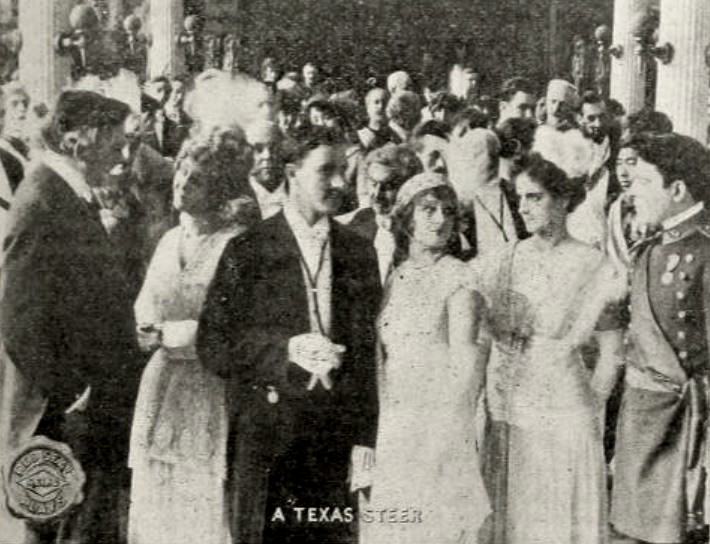
The use of sets and costumes also plays a significant role in establishing the contrasting worlds of Texas and Washington. The opulence of D.C. drawing rooms, the formal attire of its inhabitants, stands in stark contrast to the more rugged, practical aesthetic associated with Brander’s origins. This visual distinction reinforces the central theme of cultural collision, making the film's commentary on snobbery and authenticity all the more potent. It’s a gentle reminder that sometimes the simplest visual cues can speak volumes, a lesson that even contemporary filmmakers might do well to remember.
Beyond the laughs, A Texas Steer delves into themes that remain remarkably pertinent. The central conflict between authenticity and artifice, between genuine character and superficial appearances, is a timeless one. Brander represents the unvarnished truth, a man whose word is his bond and whose actions are transparent. The Washington elite, conversely, embody a world where appearances are everything, where social maneuvering often takes precedence over substance. The film asks us to consider what true integrity looks like, especially when faced with the pressures of societal expectation and political expediency.
This narrative thread, while comedic, carries a significant weight. It’s a critique of the performative nature of public life and the often-absurd standards society imposes. We see Brander struggling not with complex political issues, but with the very act of existing within a system that values polish over principle. It’s a theme that echoes in various forms across cinematic history, from the dramatic explorations of moral decay in films like Anna Karenina (though with vastly different tones) to the societal pressures depicted in Young Romance. But here, it's infused with a distinctly American flavor, pitting the rugged individualism of the West against the perceived sophistication of the East.
Adapted from Charles Hale Hoyt's popular stage play, A Texas Steer translates its theatrical origins to the screen with considerable success. The film’s ability to entertain while simultaneously offering a gentle critique of societal norms is its lasting strength. It’s a reminder that silent films were not merely precursors to talkies but a vibrant, fully formed art form capable of nuanced storytelling and profound character development. Tyrone Power Sr.'s portrayal of Maverick Brander is an iconic performance, cementing his status as a formidable actor of his generation.
For modern audiences, watching A Texas Steer offers more than just historical curiosity. It provides a window into the comedic sensibilities of the early 20th century, a chance to appreciate the craft of silent acting, and a timely reminder that the clash between authenticity and pretense is an eternal human comedy. It’s a film that, despite its age, still possesses a genuine warmth and a sharp wit, making it a valuable piece of cinematic heritage and a thoroughly enjoyable viewing experience. It invites us to laugh not just at Brander's predicaments, but perhaps a little at ourselves and the often-absurd conventions we uphold.
The 'fish out of water' narrative remains one of comedy's most reliable engines, and A Texas Steer is a foundational example of its effective deployment. Maverick Brander's journey is not just a geographical shift from Texas to D.C.; it's a profound cultural displacement. His very essence, rooted in the pragmatic, no-nonsense world of cattle ranching, clashes violently with the performative, often circuitous, nature of political and social life in the capital. This inherent conflict creates a fertile ground for humor, as Brander's honest, direct reactions are consistently misunderstood or deemed inappropriate by the sophisticated set. We see him grappling with customs that seem utterly nonsensical, his common sense often at odds with established decorum.
The brilliance lies in how the film doesn't just ridicule Brander, but often subtly critiques the very society that finds him ridiculous. The D.C. snobs, with their affected manners and superficial concerns, often appear far more foolish than the straightforward Texan. This inversion of expectations, where the supposed 'outsider' often emerges as the more sensible or morally upright character, is a hallmark of great comedic writing. It's a sentiment that resonates with the underdog narratives we still cherish today, celebrating the individual who dares to remain true to themselves amidst pressures to conform. This enduring appeal is what elevates A Texas Steer beyond a mere historical artifact into a genuinely engaging piece of entertainment.
What makes A Texas Steer particularly fascinating is its accidental role as a cultural document. It offers a snapshot of early 20th-century American identity, specifically the perceived differences and tensions between the burgeoning industrial East and the still-romanticized, rugged West. The film plays on stereotypes, certainly, but it also explores the very real cultural divides that existed within the nation. The Texan identity, with its emphasis on self-reliance, honesty, and a certain disdain for pretense, is contrasted sharply with the more formal, class-conscious identity of Washingtonian society. This isn't just a story about one man; it's a commentary on the evolving American character, a nation still grappling with its diverse regional identities and how they coalesce (or clash) in the national capital.
The film, in its own charming way, becomes a dialogue about what it means to be 'American'—is it the sophisticated diplomacy of the capital, or the unvarnished truth of the frontier? Is it about adhering to rigid social codes, or about speaking one's mind? These questions, though presented through a comedic lens, possess a certain gravitas, making the film more than just a series of gags. It’s a testament to the power of early cinema to not only entertain but also to reflect and comment on the societal currents of its time. The subtle nuances in the performances, particularly from Tyrone Power Sr., Frances Bayless, Walter Roberts, and Grace Darmond, paint a vivid picture of these contrasting worlds. Even minor characters like Frank Weed and John Charles contribute to the rich tapestry of this cultural clash, each embodying a facet of the societal expectations or the reactions to the Branders' arrival. It’s a collective effort that brings the social fabric of 1915 Washington to life, albeit through a satirical filter.
IMDb —
1924
Community
Log in to comment.