DbcultAccessing Vault...
Cult Review
Senior Film Conservator

Jacob Spraggins—once breaker-boy, now breaker-of-markets—haunts the elevated platforms of a city he rechristens New Arabia, a realm where philanthropy is merely predation wearing perfume. The film opens on a close-up of his gloved hand releasing a gold coin into a blind newspaperman’s tin; the coin lands tails-up, an augury that every charitable act will flip to its obverse: calculation.
The narrative engine runs on contrapuntal disguises. Celia Spraggins, silk-heiress by birth, starch-parlor-maid by choice, trades her pearl choker for a cotton collar and learns that the most radical rebellion a Gilded-Age heiress can stage is to volunteer for invisible labor. Her whistle—three descending notes like a tired lullaby—threads through the film’s sound-design of clanging trolleys and hissing steam pipes, becoming the aural fingerprint of authenticity.
Thomas McLeod, delivery cart virtuoso, carries crates of butter and disdain in equal measure; when the old magnate attempts to purchase his forgiveness, Thomas pockets the ten-thousand-dollar wad without breaking stride, only to fling the bills—one by one—like confetti into the East River at dusk. The gesture is filmed in reverse chronophotography: each note levitates back toward his palm, then escapes again, a loop of absolution refused.
Annette McCorkle, the romantic housemaid with a PhD in gossip, serves as both chorus and catalyst. She stage-manages Celia’s descent into service, whispering, "To be loved for oneself, one must first be unrecognizable to oneself." The line, delivered over a ironing-board lacquered with sweat, distills the film’s thesis: identity is a costume you can’t take off unless someone else tears the seams.

The climactic recognition scene unfolds inside a moonlit dairy stable—an arena fragrant with hay and class tension—where Celia’s whistle curls upward like smoke. Spraggins, arriving too late with patriarchal rage, beholds the lovers already fused in silhouette. The cutaway to his face—half-shadowed by lantern, half-illuminated by regret—ranks among silent cinema’s most economical moral collapses.
Yet the epilogue, set one vinegar-soured year later, rescues the tale from redemptive cliché. Having siphoned every cent destined for orphanages and fresh-air funds into a trust for his unborn grandchild, Spraggins raises condiment prices city-wide, a micro-tax on the poor that guarantees baby Jakey’s fortune. The intertitle burns white-on-black: "Charity begins at home—and ends in the pantry." The camera lingers on a deli counter where immigrant mothers count pennies for pickles; their silent stare indicts not just the caliph-on-the-subway but the audience complicit in his earlier applause.
Director Hazlan Drovart, working with O. Henry’s anecdotal scaffolding, constructs a visual rhyming system: every act of giving is paired with an off-screen taking. When Spraggins funds a children’s ward, the next shot reveals nurses laid off from a rival clinic; when he endows a college, tuition elsewhere rises. The montage anticipates Eisenstein’s dialectics but tempers them with a bittersweet shrug—the politics of a storyteller who trusts irony more than revolution.
Photographer J. Frank Glendon’s chiaroscuro turns New York into a proto-noir labyrinth. Sodium streetlamps spill amber pools onto rain-slick asphalt; Celia’s white apron catches the light like a sail in distress. The negative space around characters pulses with the possibility that somewhere, just outside the frame, a tenement burns while a gala toasts its benefactor.
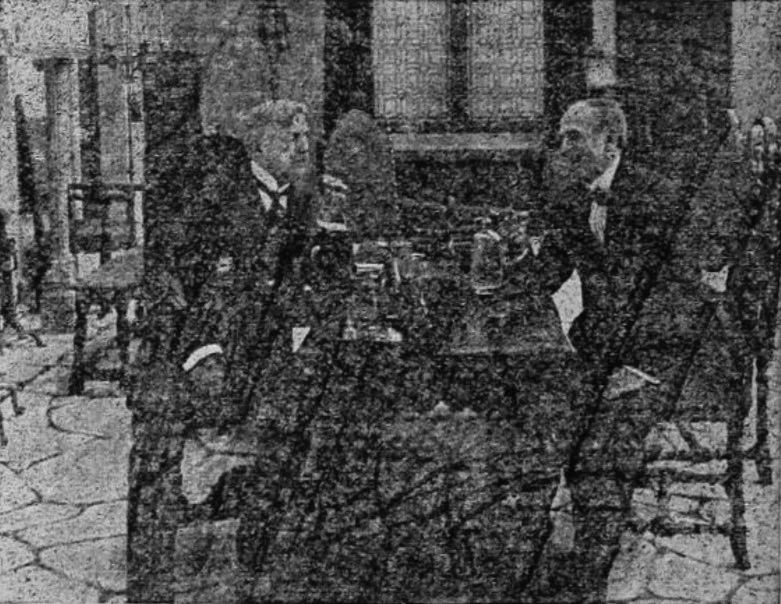
Performances calibrate to the intimate scale of deceit. Hattie Delaro’s Celia never overplays the servant masquerade; instead, she lets fatigue seep through the performance-within-a-performance—raw knuckles, swollen feet, a yawn she can’t quite stifle when Thomas recites socialist pamphlets. Horace Vinton’s Spraggins ages in real time: shoulders incrementally stooped, eyes dulled from predatory gleam to bankrupt bewilderment.
Comparative lensing enriches the experience. Where A Black Sheep treats reformation as melodramatic thunderclap, A Night in New Arabia views it as slow corrosion. The Chimes externalizes guilt through phantasmal bells; here, guilt is the echo of Celia’s whistle in Spraggins’s marble hallway, haunting him at 3 a.m. when the elevators stop.
Archival residue heightens the poignancy. The film survives only in a 35 mm nitrate print at the Cinémathèque de Paris, its lavender intertitles faded to bruise-blue. Yet the vinegar-price finale feels eerily contemporary in an era where billionaires rocket to space while workers ration insulin. The silent era reminds us that the distance between charity and cruelty is three pennies—the exact uptick that funds a dynasty.
Verdict: A forgotten lantern flickering in the capitalist catacomb—see it before the last reel combusts.
For viewers hunting pre-code moral ambiguity, pair this with Trapped by the London Sharks or the proto-feminist escapades of The Girl from Outback. Each refracts the question: can money launder guilt without staining the next generation? A Night in New Arabia answers with a whistle that lingers longer than any coin.

IMDb —
1913
Community
Log in to comment.