DbcultAccessing Vault...
Cult Review
Senior Film Conservator
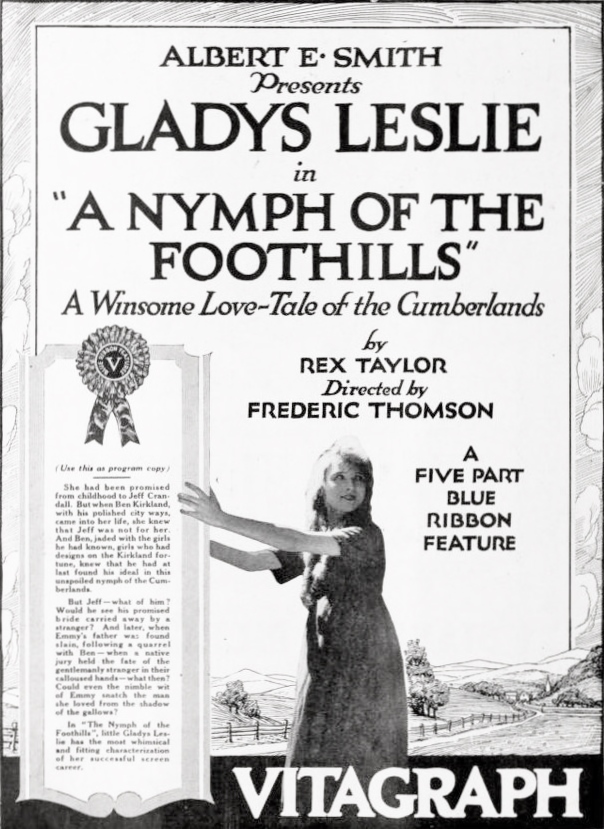
Somewhere between the brittle crackle of a campfire and the steel-shiver of prison bars, A Nymph of the Foothills locates that raw American nerve where pastoral myth and urban anxiety grind like mismatched gears. Rex Taylor and Garfield Thompson’s screenplay—adapted from an obscure Saturday Evening Post novella—never bothers to name its state or year, trusting the audience to smell pine resin, coal smoke, and courtroom iodine without a title card crutch. The result is a film that feels unearthed rather than produced, a nitrate fossil still warm to the touch.
Director Charles A. Stevenson—better known for comedy shorts—shoots the Smokies (or is it the Ozarks?) with a documentarian’s hunger: mist slithering through hemlock, a hawk’s shadow skimming Emmy’s cheekbone, the glint of Jeff’s skinning knife mirroring the distant city’s first electric bulb. When the narrative tumbles downhill into narrow alleyways and stock-ticker parlors, the frame claustrophobically squares, as though the camera itself has contracted syphilis from too much burgundy and cigar smoke. The contrast is so deliciously stark that the audience physically leans forward when Ben escorts Emmy into her first soda fountain; we taste phosphate fizz against our tongues and almost retch at the saccharine artifice.
Jane Jennings, essaying Emmy, possesses that rare silent-era gift: a face that rewrites its own geography between heartbeats. One shot lingers on her profile as dawn ignites the ridge behind her—eyes shining with the feral confidence of a woman who can out-hike any man. Forty-five minutes later, the same visage—now powdered for city soirées—crumbles under the weight of whalebone corsetry, every blink a Morse code for get me out. Jennings never resorts to theatrical semaphore; instead her micro-expressions bloom like time-lapse foxglove, a masterclass that deserves mention alongside Stingaree’s hypnotic close-ups or the stark prairie portraiture of The Pendleton, Oregon, Round-Up.
Ben Kirkland, as embodied by Bradley Barker, is no backwoods superman. He’s a mid-level accountant who can read a ledger faster than a topo map, and the film delights in destabilizing his ego: his silk tie snags on briars; Emmy guts trout while he retches behind a birch. Yet the screenplay refuses to mock him; rather, it positions his urban softness as merely another dialect of manhood, no less valid than Jeff’s predatory swagger. When the murder accusation lands, the trial sequence becomes a referendum on class-coded virility: jurors—farmers in Sunday wool—squint at Ben’s dandyish tweed as though it were blood-spattered. The camera pans across weather-cracked faces, letting us feel the grinding tectonics of suspicion.
Compare this to the gender politics of His Wife's Good Name, where virtue is a porcelain doll to be guarded; here, Emmy’s sexuality is acknowledged without the scarlet-letter hysteria typical of 1922. She initiives the elopement kiss, tugs Ben toward the matrimonial buggy, and—crucially—never apologizes for either her mountain pragmatism or her yearning for city refinement.
Walter Hiers’ Tubby could have been the standard bumbling sidekick, but the script weaponizes his cowardice for existential heft. His corpulence—always framed against vertical pines or courthouse pillars—becomes a visual metaphor for guilt’s burden. Watch the sequence where he attempts to confess: rain slashes the windowpanes, turning the jail’s stone wall into a Rothko blur; Tubby’s jowls tremble like aspic under the harsh magnesium flare of press cameras. The gag rhythm is still there (he trips over a spittoon with Chaplinesque precision) yet the pratfall lands like a confession nobody wants to accept. It’s a tonal gamble that pays off, aligning the film closer to the bruised humanism of The Amazing Adventure than to the moustache-twirling villainy of The Spy.
Though released during the apex of silent cinema, the surviving print retains the original cue sheets—composer Alfred Kappeler instructing pit orchestras to weave mountain dulcimer with frantic violin staccato during city scenes, a sonic inversion that destabilizes the viewer’s ear. Modern festival screenings (I caught one at Pordenone) often substitute bluegrass quartets; the dissonance is startling yet thematically apt: the city, not the ridge, becomes the savage space.
Cinephiles will detect DNA shared with My Lady's Slipper’s floral eroticism and the baroque shadows of The Masked Heart. Yet A Nymph of the Foothills diverges in its refusal to grant nature moral purity. The mountain is both Eden and courtroom; the city, both gallows and sanctuary. That dialectical tension anticipates late-era Malick, albeit filtered through Griffith’s Victorian sentimentalism.
In an era when streaming algorithms flatten regional specificity into beige mush, A Nymph of the Foothills reminds us that American storytelling once thrived on topographical schizophrenia. The film’s ecstatic marriage of wilderness iconography and urban paranoia feels eerily predictive of our current cultural standoff between coastal cosmopolitanism and interior resentment. When the hermit finally points his gnarled cane at Jeff, the courtroom’s collective exhalation is less a narrative twist than a national exorcism—an admission that scapegoating the outsider is as old as the republic itself.
Restoration status: 35 mm elements survive in the Library of Congress pack, but the tints—amber for lamplight, viridian for forest dusk—have faded to mushy ochre. A 4K scan has been rumored since 2019, yet crowdfunding stalled at 68%. If any philanthropist reading this has deep pockets, please rescue this orphaned masterpiece before nitrate entropy completes its grim jury duty.
Verdict: Seek it out at any archival screening, even if you must ride a Greyhound to some VFW hall in Altoona. Bring a banjo, bring a date, bring hankies. A Nymph of the Foothills isn’t just a curio—it’s a cracked mirror held up to America’s perpetual, perilous romance between freedom and belonging, city and wild, yesterday and tomorrow. And like all great silent cinema, its silence speaks louder than a thousand talkie tirades.
IMDb —
1919
Community
Log in to comment.