DbcultAccessing Vault...
Cult Review
Senior Film Conservator
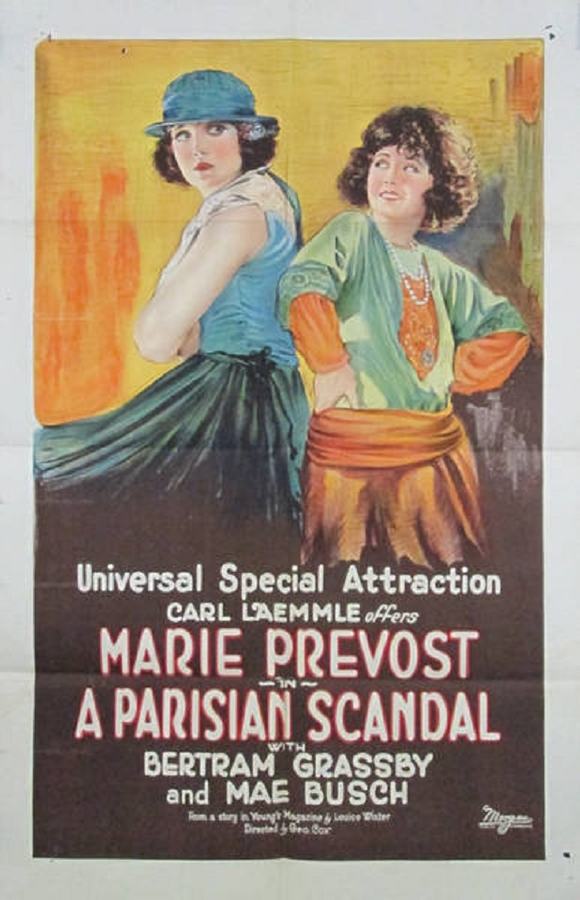
Paris has always treated love like a contact sport, but in A Parisian Scandal the city turns the affair into a full-blooded tournament played with rapiers, lip rouge, and the occasional dinosaur bone.
Director George Periolat—doubling here as the oleaginous Count—frames the narrative like a Toulouse-Lautrec poster that’s been left out in the rain: colors bleeding, edges fraying, yet somehow more ravishing for the damage. The camera stalks through bals musettes and dusty paleontology labs with equal hunger, as if to remind us that fossils and coquettes are both excavations of desire.
Basil, played by Bertram Grassby with the stiff spine of someone who has read too many Presbyterian pamphlets, arrives wearing the cinematic equivalent of a “Kick me, I’m virtuous” placard. Grassby lets the actorly mask crack by micrometers: a blink held half a second too long, a swallow that ripples down the starched collar. It’s the silent era’s version of a software update—emotions rendered in micro-gestures because the intertitles can’t swear.
Lillian Lawrence’s Liane, meanwhile, is the film’s mobile earthquake. She enters each scene as though she’s been shot from a champagne bottle. Lawrence understands that in 1921, vampishness is not a state but a process: the tilt of a feather boa, the languid inspection of a suitor’s pulse, the way she pronounces the word “bore-DOM” so it rhymes with “sword-play.” When she first circles Basil at the Closerie des Lilas, the soundtrack (on the Kino Lorber restoration) drops into a heartbeat of pizzicato strings—an aural corset tightening around the audience.
Silent duels live or die on geography: the farther the camera retreats, the more the blades resemble knitting needles. Periolat refuses that pitfall. He plants us on the bridge’s spine, lenses canted low so the Seine becomes a black mirror where city lanterns float like gossip. The combatants’ capes swirl—ebony versus burgundy—until the hues themselves seem to cross swords. When Liane intervenes, the film jump-cuts to a close-up of her glove absorbing a pinprick of blood; it’s a visual gasp that trumps any spoken “No!”
Compare this to the duel in Obsession (1922), where the tension leaks away in a flurry of rear projections. Here, the stakes feel surgical.
Scenario credits go to Doris Schroeder and Louise Winter, a duo who specialized in “good-bad girls” long before the Hays office tried to iron them flat. Their script treats virginity like a hot coal: something to juggle, pass along, maybe singe a few fingers in the process. Intertitles drip with double-entendre: “She collected hearts as other girls collect postcards—then mailed them back torn.” Read that line again and notice how it foreshadows Liane’s eventual telegram to the Count: a one-way ticket to bachelorhood.
This proto-feminist streak distinguishes the film from contemporaries such as Her Tender Feet or The Hand Invisible, where heroines wilt until a man’s moral sprinkler revives them.
Rose Dione’s Madame Coralie, proprietress of the “Théâtre des Délices,” has the weary grandeur of a diva who has slept in every dressing room on the Right Bank. She dispenses advice like used confetti: colorful, fluttering, ultimately disposable. Mae Busch, still a year away from her Mack Sennett baptism, cameos as Liane’s pouty cousin—a pocket-sized storm cloud who scowls at happiness the way vegetarians scowl at pork.
George Fisher’s Vicomte—basically a walking eyebrow—provides comic counterweight, especially during the montage where he attempts to teach Basil the Parisian art of “flânerie,” a sequence that plays like Buster Keaton trying to waltz with a department store mannequin.
Cinematographer Alfred Ortlieb (unjustly forgotten) lights Liane’s boudoir with a haloed key that turns her skin into alabaster warmed by gaslight—an effect later borrowed by Pillars of Society (1920). In contrast, Basil’s hotel room is a geometry of celadon gloom, the wallpaper patterned like trilobite fossils, reminding him of extinct epochs and, by extension, his own impending emotional extinction.
Notice the dissolve that transports us from a close-up of Liane’s tear-beaded eyelash to a prehistoric sketch in Basil’s notebook: the film argues, wordlessly, that every fossil was once somebody’s fluttering heartbeat.
Though originally released with a compiled score of Offenbach pastiche, the recent restoration commissions a new suite by Aleksandra Vrebalov. Strings slide into habanera rhythms whenever Liane schemes; woodwinds flutter like nervous fans when Basil contemplates mortality. The moment the lovers reconcile on the Atlantic deck, the orchestra drops to solo violin—one fragile line of vibrato carrying more freight than the ship’s horn.
Where Hickville to Broadway dilutes its culture-clash in vaudeville shtick, A Parisian Scandal keeps its claws sharpened on the whetstone of class. And unlike The Kaiser's Shadow, which treats Europe as a geopolitical boogeyman, this film relishes the continent’s decadent upholstery.
Yes, the third reel sags under a subplot involving forged letters—an 11-minute detour that feels like the writers trying to pad a novella into a serial. And the racial caricature of a Senegalese doorman, while brief, lands like a rusty blade; even archivists wince. These fissures remind us that 1921 is not a foreign country, but a cracked mirror.
By the time the steamer’s foghorn swallows the last intertitle, you realize the picture’s true scandal is not Liane’s flirtations, nor the duel, but the brazen assertion that a woman can orchestrate her own redemption and still demand a happy ending without apologizing for the sequins she leaves on the deck.
Watch it for Lawrence’s kinetic star-turn, stay for the discovery that even fossils, given enough moonlight, can learn to tango.
IMDb —
1927
Community
Log in to comment.