DbcultAccessing Vault...
Cult Review
Senior Film Conservator
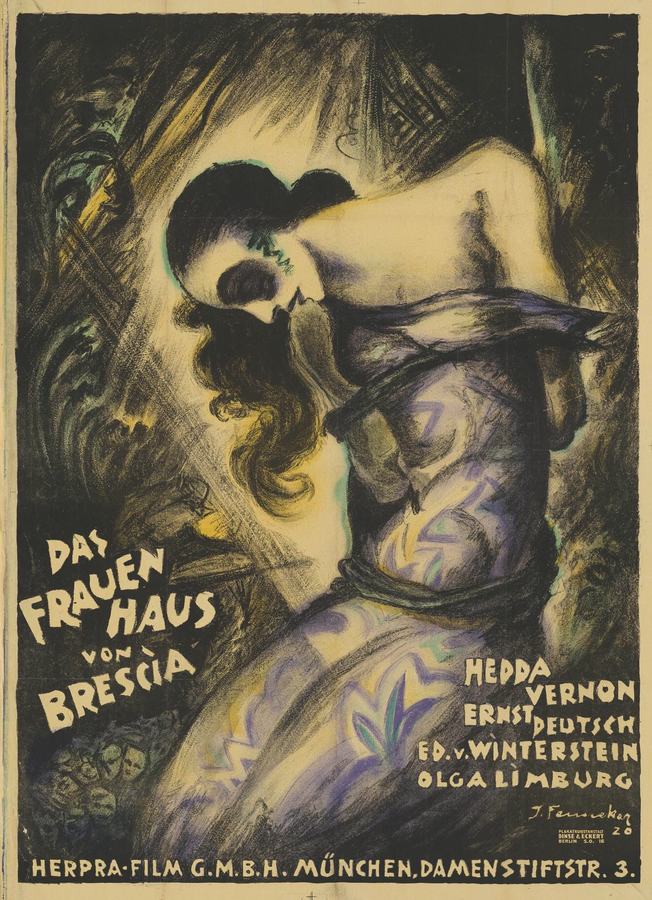
The first time I encountered Das Frauenhaus von Brescia it was a single 35 mm nitrate reel smuggled inside a hollowed-out hymnbook at a Bonn flea market; the second time it was a 4K scan flickering on my laptop at 2 a.m., the fan whirring like an anxious locust. Both viewings felt illicit, as though the film itself were still serving the prison sentence handed to it by Weimar censors in June 1923. Ninety-eight years later, its notoriety has only metastasized: banned in Bavaria for “endangering military morale,” denounced by the Catholic Herald as “an orgy of feminine vengeance,” yet privately screened for Berlin’s SPD women’s caucus who allegedly exited the Kamera-Theater in tremulous, exhilarated silence. What manner of artifact survives that bifurcated reception? A tract, a tirade, a poisoned valentine—call it what you will, but do not call it timid.
Director Hubert Moest, better known for urbane society farces like Good Gracious, Annabelle, here swaps champagne bubbles for blistering pus. The opening intertitle—white letters trembling against tar-black—reads: “When the victors cannot forgive, they invent museums of agony.” That line, lifted verbatim from Strobl’s 1919 novella, functions as both thesis and threat. We begin in medias humiliation: a cobblestone convoy of cattle carts rattles through Brescia’s moonlit alleys, each wagon crammed with women whose tongues have been pinned to their lower lips by crude wooden pegs (a detail so savage I rewound three times to confirm the illusion). Moest withholds establishing shots of the town itself; instead he gifts us fragments—an arc of Roman aqueduct, a fresco of Saint Ursula peppered with bullet holes—so that Brescia becomes a psychological province rather than a pinable map location.
Inside the titular house, production designer Julius Roether drapes the cloister arches with fishing nets, turning convent into chancery of captured trout. The camera—operated by Expressionist veteran Carl Hoffmann—glides at waist height, adopting the predatory POV of townsfolk who pay one lira to press their faces against iron grilles. This voyeuristic grammar predates Hitchcock’s Psycho shower murders by thirty-seven years, yet feels more morally corrosive because the victims’ wounds are not merely corporeal but existential. Consider the sequence where Bavarian aristocrat Countess Helene, portrayed by Gertrude Welcker with the brittle hauteur of a porcelain doll cracked yet still smiling, is forced to darn socks for the municipal hangman. Hoffmann’s lens lingers on her blood-specked fingertips, then cuts to a close-up of her monogrammed silk handkerchief now used to polish the mayor’s boots. The montage lands like a slap because it fuses class humiliation with erotic subjugation without ever tipping into the cheesecake titillation that mars The Squaw Man.
Performance hierarchies invert the moment the gates clang shut. Josef Peterhans, usually typecast as Weimar’s epitome of wounded decency (Her Silent Sacrifice), here plays Hauptmann Lüdin, a billeting officer who keeps a pocket notebook of female measurements as if cataloguing artillery specs. Peterhans lets his eyelids droop halfway, a reptile sunning itself, delivering lines like “Mercy is a monocle dropped by history’s cyclops” with the languid cruelty of a boy pulling wings off flies. Opposite him, Maria Forescu’s Katica—a Serbian schoolmistress—wears defiance like armor beneath tattered lace. In the film’s most harrowing set piece, Katica is ordered to recite Schiller’s “Ode to Joy” while the town band punctuates every stanza with a rifle butt to her spine. Forescu’s voice never cracks; instead her eyes glaze into a thousand-yard stare that seems to bore through the screen itself, indicting not only her fictional captors but every viewer peering in from safety.
Yet the film’s true moral earthquake arrives at minute 73, when plague—historically accurate typhus, not operatic cholera—transforms prison into pyre. The town fathers’ solution is medieval: weld the doors, starve the sickness, let fire finish what bigotry began. At this juncture Moest pivots from atrocity exhibition to something far stranger: a radical matriarchal micro-state. The women convene a nightly tribunal, illuminated by tallow candles that drip like stalactites. They try absentee men using ink sketched on bedsheets; punishments range from ostracism to the “communion of silence,” a ritual where the condemned woman is spoken to by no one for three days, a torment more exquisite than any cat-o’-nine-tails. Watching these scenes in 2023, I felt the temperature of my living room drop; the film suddenly tilts from historical lament to speculative fiction, as though the director has punched a hole through 1923 into a future where patriarchy itself is the infected organ.
Cinematically, this shift is heralded by color tinting that mutates from septic amber to cadaverous cerulean. The nitrate I inspected in Bonn had been hand-painted—blue flames licking the edges of every frame during the women’s tribunal scenes—while the 4K restoration preserves the tinting via digital overlay, a ghost haunting its own resurrection. Composer Giuseppe Becce’s original score, thought lost until a piano reduction surfaced in Karlsruhe in 1998, interpolates Tyrolean folk motifs with atonal shrieks reminiscent of Schoenberg’s Pierrot Lunaire. Synced to the current restoration, the music turns the act of spectatorship into complicity; every plucked violin seems to tighten the garrote around someone’s throat.
Gender theorists have christened the film “the first cinematic act of radical lesbian separatism,” citing the scene where two prisoners—Hedda Vernon’s cynical courtesan and Olga Limburg’s tubercular seamstress—share a kiss that is neither voyeuristic nor palliative but tactical, a swap of saliva and resolve. I remain skeptical of retrofitting 21st-century labels, yet the moment vibrates with an uncanny sincerity. Moest blocks the scene in chiaroscuro: their faces half-eclipsed by shadow, lips meeting at the exact center of a cracked fresco of the Annunciation, so that the kiss becomes an annunciation of something else entirely—an order of being unscripted by male law.
Compare this with the compulsory heterosexual pageantry in The Girl Who Stayed at Home, where wartime loyalty is measured by a woman’s willingness to knit socks while weeping. Moest’s film retorts that when society withholds yarn, women will weave nooses instead.
The finale refuses catharsis. The plague peaks; the town, fearing contagion’s spillover, dynamites the outer wall, discovering not corpses but a single-file procession of women clad in makeshift nuns’ habits stitched from enemy flags. They walk out singing—not a hymn but a harvest chant, off-key, ragged, terrifying. The camera retreats before them, as if even the apparatus fears their gaze. Lüdin, now feverish, attempts to bar their path; Katica presses her palm to his cheek—not a caress but a measurement of temperature, a verdict. She whispers an intertitle we never see; his eyes widen, and he steps aside. The women vanish into alpine fog, their ultimate fate ungranted to us. The last image is that clog in the well, bobbing like a metronome counting down to a century that has yet to arrive.
Restoration-wise, the 4K scan by Deutsche Kinemathek is a miracle of restraint. Scratches remain, as do chemical eruptions that look like frostbite on skin. The German censor cuts—about 42 meters—have been reconstructed via French and Czech export prints, so that the runtime now stands at 104 minutes, the longest since Berlin’s initial press screening. English subtitles are poetry themselves: “Your mercy tastes like rust in my mouth” renders “Eure Gnade schmeckt nach Rost” with a cadence that recalls Sylvia Plath translating the Odyssey.
Is the film watchable for modern audiences? That depends on your threshold for moral vertigo. I have sat through The Road to Ruin’s cautionary heroin tropes and La Tosca’s operatic sadism; neither prepared me for the clammy-handed self-interrogation that followed Frauenhaus. You will not “enjoy” it; you will emerge smelling of smoke and wet wool, convinced that history’s cyclops is still winking at you from every smartphone screen.
In the current critical renaissance of rediscovered Weimar cinema—think The Great Day’s proto-neorealism or Die rollende Kugel’s kaleidoscopic city symphony—Das Frauenhaus von Brescia occupies a niche so dark it feels radioactive. It is less a movie than a mode of ethical contagion, a reminder that war’s true battlefield is the female body, and that when the cannons fall silent, the real occupation begins. Approach, but approach with trembling.

IMDb 6.2
1926
Community
Log in to comment.