DbcultAccessing Vault...
Cult Review
Senior Film Conservator
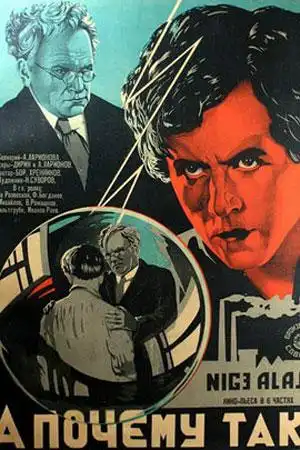
“A pochemu tak?” is one of those movies you stumble upon, probably late at night, and then can't quite shake. If you're into films that feel less like a polished product and more like a raw, almost accidental peek into something intense, then yeah, give it a shot. But if you need clear answers, big explosions, or characters you can easily root for, you'll probably spend the whole time scratching your head or just get bored. It's not for everyone.
From the first frame, you feel this weird sense of unease. It’s not really horror, but definitely unsettling. The camera often just sits there, watching, making you feel like a fly on the wall, or maybe even like you're intruding.
Fyodor Bogdanov’s character, whoever he's supposed to be, just *is*. He doesn't say much. His face carries so much weight, a kind of weary patience, even when he's just looking at a cup on a table. That quietness speaks volumes, honestly.
There's a scene, early on, where Nikolay Vildgrube and Olga Rozevskaya are just… walking. Through what looks like a half-abandoned industrial area. No dialogue for a good five minutes. You just hear their footsteps, and the distant hum of something. It's almost frustrating, but then it becomes kind of hypnotic. You start noticing the way the light hits the rust.
I kept waiting for a big reveal, a moment where everything clicks into place. But it never really does, not in the way you expect. The film kind of operates on its own logic, a sort of dream logic, I guess.
Vladimir Romashkov’s character pops up here and there, always with this slightly manic energy. He feels like he’s from a different movie, a little too loud, a little too expressive for the quiet tension everyone else is holding. It’s a jarring contrast, but it works to keep you off-balance.
One shot really stuck with me: a close-up on Nikolai Mikhailov’s hands. He’s fiddling with something small, maybe a loose thread on his shirt. The focus is so tight, you see every crease, every little shake. It’s completely unimportant to any plot, but it felt deeply human. Like, _this_ is what people do when they're lost in thought. 🤔
The pacing is a bit of a trip. Some scenes crawl, lingering on a reflection in a window or a slowly stirring spoon. Then, suddenly, there’s a quick, almost abrupt cut to something completely different. No smooth transitions, just… bam. It’s like someone was editing on instinct, not by rulebook.
You can almost feel the movie trying to convince you this moment matters. It doesn't always succeed, but the effort is there. And sometimes, it totally lands, making a mundane action feel strangely profound.
The dialogue, when it happens, is sparse and often elliptical. People talk *around* things, not directly about them. You have to really lean in and try to piece together what they're hinting at. Or maybe, there’s nothing to piece together, and that’s the point.
I remember a bit where someone is trying to light a cigarette, and it takes them _ages_. The lighter just won't catch. That tiny, frustrating struggle becomes a whole little drama in itself. It’s these small, almost mundane moments that the film really highlights.
It reminds me a little of that feeling you get watching some old European films, like the early works of Tarkovsky or maybe even some Lanthimos, but without the overt strangeness. More subtle, more internalized. It’s a mood piece, truly. 🎬
The sound design is crucial here. The background hums, the distant traffic, the creak of a floorboard. They all contribute to this feeling that you’re hearing the world breathe, not just watching a story unfold. Sometimes the silence is so loud it makes you jump.
There's a brief, almost blink-and-you-miss-it shot of a child's drawing taped to a wall. It’s out of focus, just a splash of color. It felt like a little hint of something softer, something normal, lost in all the quiet tension.
I think the film’s biggest strength is its commitment to its own peculiar rhythm. It never tries to be something it isn't. It just *is*. And that can be incredibly frustrating, or incredibly rewarding, depending on what you bring to it.
Don't go into “A pochemu tak?” expecting a traditional narrative. It's more like a series of interconnected observations, a series of existential shrugs, if that makes sense. You leave it with questions, definitely. But also with a feeling, a mood, that lingers. ✨
IMDb 6.2
1932
Community
Log in to comment.