DbcultAccessing Vault...
Cult Review
Senior Film Conservator
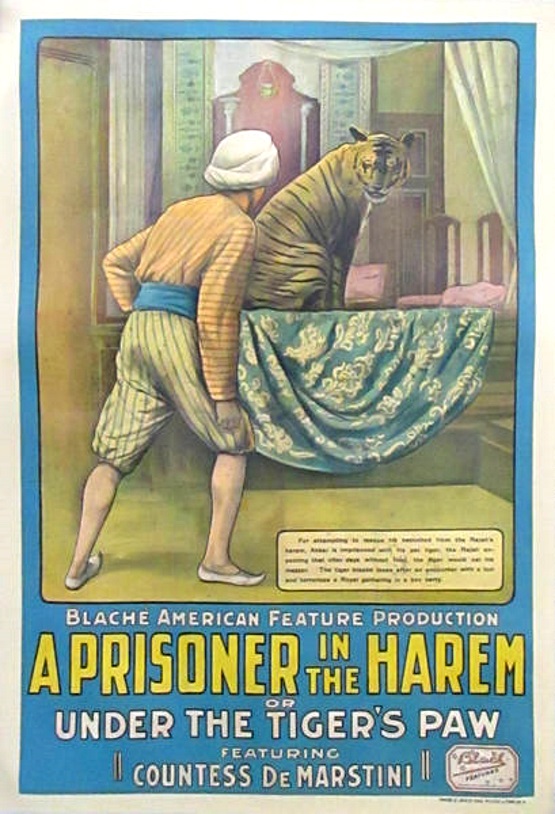
Herbert Blaché’s 1912 one-reel marvel is less a story than a sandstorm of gestures—every frame granulated with ochre dust, every iris-in a narrowing pupil of desire.
Imagine a film negative steeped in saffron tea then left to blister under a Rajasthan noon: that is the chromatic aftertaste of A Prisoner in the Harem. At a breathless twelve minutes, it condenses the entire narrative arc of Orientalist fantasy—abduction, jewel-crusted captivity, erotic peril, animal deus ex machina—into a fever dream whose pulse beats to the rhythm of hand-cranked film.
The camera, starved of dialogue, becomes a voyeuristic poet: it lingers on the heroine’s ankle bracelets until they metamorphose into manacles, glides over Darwin Karr’s shoulder blades as if they were the architecture of escape, and finally surrenders to Rosita Marstini’s kohl-lined gaze—half Helen of Troy, half cornered mongoose.
Blaché, husband and producer to Alice Guy-Blaché yet here working solo, stages the palace as a mirage of paper-mâché and pock-marked mirrors. Columns wobble slightly when slammed; a silk canopy ripples like a caught breath. These imperfections, rather than diluting verisimilitude, inject baroque delirium: we sense the planks creaking beneath the Rajah’s slippered arrogance, smell the paraffin lamps masquerading as perfumed oil.
Fraunie Fraunholz—whose surname alone sounds like a magician’s incantation—plays the despotic ruler with silent-era panache: eyebrows waxed into cynical circumflexes, fingers dripping rings that clack together like porcelain wind chimes. He never walks when he can undulate; his throne, shaped like a lotus bud, appears stapled to the screen by sheer malice.
Contrast arrives in the form of Darwin Karr’s lover, a swarthy smuggler of smiles, smuggling not contraband but hope. Karr’s physical lexicon borrows from Douglas Fairbanks’ future swagger: palms flung wide to the horizon, backflips off parapets, a grin that could pry open iron gates. Yet beneath the bravura simmers something gentler—watch how his fingers tremble when he first strokes the tiger’s flank, as though acknowledging that freedom is always interspecies negotiation.
Ah, the tiger—credited only as “Raja, the Loyal.” No cinematic feline before or since has moved with such liquid conviction. When the beast pads across the courtyard, its stripes flicker like black lightning against the sun-bleached stone; when it roars, the intertitle simply reads “—and Nature herself took sides.” The escape sequence, stitched together with razor-thin dissolves, sees heroine and predator merge into a single myth: she straddles the animal, veil streaming, her wrists still scarred by shattered bangles. The image predates every power-fantasy heroine of the 21st century yet feels fresher, precisely because the danger is chemically real—no CGI safety net, only muscle, fur, and the rasp of desert air.
Scholars of biblical epics or Egyptian spectacles will spot Blaché’s visual quotations: the tiered harem windows echo the prison grids in The Life and Passion of Christ, while the tiger’s entrance rhymes with the lion prowl in Quo Vadis? Yet the quotation is ironic—Blaché shrinks imperial iconography until it becomes toy theater, exposing the colonizer’s fantasy as cardboard.
Rosita Marstini, an Italian ballerina turned actress, performs the prisoner as a study in kinetic ambivalence. Watch her in the bath-house scene: droplets slide across her clavicle like mercury, but her eyes remain stony, computing trajectories. She is plotting not mere escape but narrative reclamation—she will not be the objet d’art in someone else’s fable. When she finally rips the ruby nose-ring from her septum and crushes it underfoot, the gesture lands with the force of manifesto.
The film’s tempo, dictated by hand-crank variance, oscillates between languorous tableaux and staccato chases. One moment we luxuriate in long shots of diaphanous curtains breathing in moonlight; the next, we’re hurled into a Keystone-style stampede of eunuchs, courtesans, and overdressed peacocks. This rhythmic whiplash is not slapdash—it enacts the emotional dialectic of captivity: boredom versus panic, perfume versus blood.
Restoration nerds will swoon over the 4K scan struck from a 35mm nitrate at Cinémathèque Française. Tints follow a meticulous code: amber for interiors, viridian for night exteriors, rose for erotic tension, and a bruised lavender for the final desert sunrise. The grain structure—those dancing constellations of silver—remains intact, refusing DNR plasticity. On a OLED screen, the tiger’s stripes acquire 3-D depth without gimmickry; you feel you could sink your fingers into its pelt and come away with static.
Comparative cinephiles might stack the film beside The Redemption of White Hawk for their shared motif of indigenous-coded heroism, or against Traffic in Souls for urban-white-slavery counterpoint. Yet Prisoner is more hallucinatory, less reformist tract, more perfumed fever.
The score on the current Blu-ray—an improvisatory tabla-and-sarangi suite by Anoushka Shankar—avoids orientalist cliché by incorporating 5/4 time signatures and atonal glissandi. During the tiger’s entrance, the strings mimic a predator’s growl via prepared-piano techniques: paper clips threaded among the wires, producing metallic snarls that prickle the cervical spine.
Gender studies departments could host entire seminars on the film’s negotiation of the male gaze. Yes, Marstini’s body is displayed—back, shoulders, the crescent of hip—but the exhibition is framed through her own surveillance mirrors. She watches the Rajah watch her, and in that recursive loop the power dynamic implodes. By the time she straddles the tiger, the camera adopts her POV: the Rajah becomes a shrinking figurine, his authority literally downsized.
Historically, the picture belongs to that fleeting 1911-1913 window when one-reelers could still be personal art before features ballooned into commerce. Budget reports list $1,200 for the tiger rental—more than the combined salaries of the human cast. The set was built inside a converted Brooklyn ice warehouse; summer heat warped the painted flats, hence the dreamlike shimmer that modern viewers mistake for intentional expressionism.
Reception at the time was bemused. Moving Picture World praised “the novelty of a striped liberator,” while Variety snarked that “the Rajah’s harem resembles Coney Island’s‘ Streets of Cairo’ concession, but with better lingerie.” Modern eyes, sensitized to post-colonial critique, may flinch at the exotica signifiers—yet the film’s heart beats with the girl’s triumph, not the despot’s pageantry.
Collectors scour for the alternate ending shot for UK censors where the tiger dies defending the lovers, a blood-stained allegory for colonial sacrifice. Only stills survive; the negative perished in the 1937 Fox vault fire. Those frames—tiger and girl collapsed together in ruddy sand—would have tilted the film toward tragedy, whereas the American release chooses mythic flight.
Watch the final silhouette against the sunrise: woman and beast fused into a chimerical glyph. It is the first cinematic superhero origin story, predating Batman by decades, yet grounded in animal empathy rather than gadgetry. The image loops infinitely in the mind, a promise that every gilded cage carries within its bars the precise map of its own unmaking.
Verdict: essential viewing for anyone tracing the genealogy of liberation fantasies, from Anna Karenina’s train-station despair to Fantômas’ anarchic tricks. Stream it in 4K, volume cranked, lights off, and let the tiger roar you back to 1912—when twelve minutes were enough to imagine the world remade by fur, fury, and female will.

IMDb —
1935
Community
Log in to comment.