DbcultAccessing Vault...
Cult Review
Senior Film Conservator
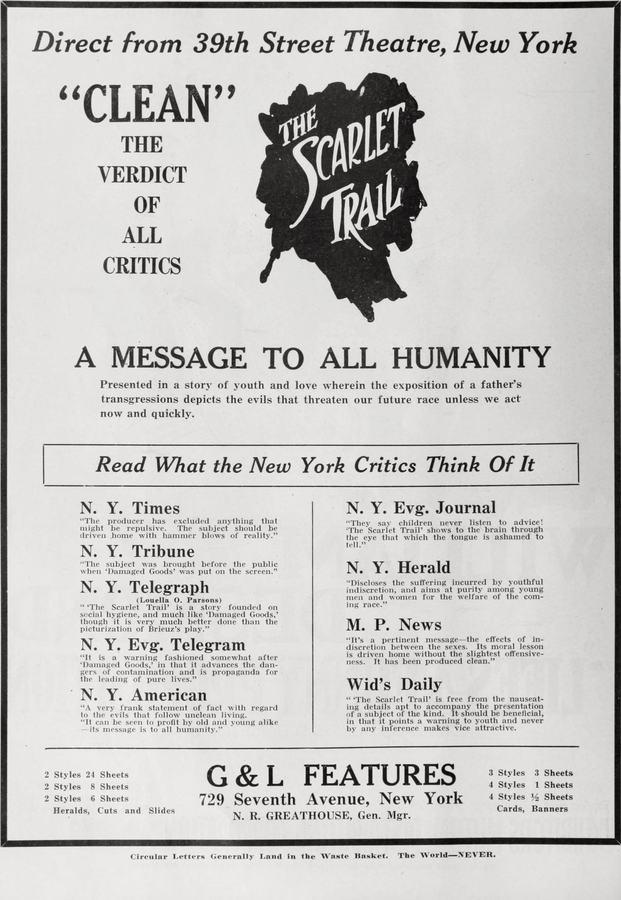
In the annals of early cinema, where flickering images often served as mere escapism or quaint amusements, a formidable and often overlooked genre emerged: the didactic film. These were not mere entertainments but potent instruments of social change, designed to educate, warn, and, at times, propagandize. Among the most striking examples of this movement is the 1918 production, 'The Scarlet Trail'. Far from the fantastical narratives or romantic dramas that populated the silver screen of its era, this film plunged headfirst into the grim realities of venereal disease, a topic then shrouded in Victorian prudery and devastating ignorance. Its very existence was an act of cinematic courage, a bold challenge to the societal conspiracy of silence that allowed these diseases to proliferate unchecked, leaving a trail of suffering and societal decay in their wake.
Directed with an unwavering focus on its public health mission, 'The Scarlet Trail' isn't just a film; it's a historical document, a window into a pivotal moment when public health officials recognized the power of moving pictures to disseminate vital information. It stands as a testament to the early understanding that effective communication could save lives, even when confronting subjects deemed too indelicate for polite conversation. The film's narrative, though constructed with the clear intent of instruction, manages to weave a compelling human drama, making its educational message resonate far more deeply than any dry lecture ever could. It eschews simplistic moralizing in favor of a more nuanced, albeit still stark, portrayal of cause and effect, illustrating the tragic ripple effects of infection through a series of interconnected lives.
The plot of 'The Scarlet Trail', penned by the collaborative efforts of Charles Larned Robinson and John S. Lawrence, is less a conventional story and more a series of vignettes designed to illuminate the various facets of venereal disease: its transmission, its symptoms, and crucially, its prevention and cure. The film does not shy away from depicting the grim consequences, presenting them with a directness that must have been shocking to contemporary audiences. It follows multiple character arcs, each designed to highlight a different aspect of the disease’s impact. We see individuals whose lives are irrevocably altered by infection, their hopes and futures dimmed by a condition they often little understood. The narrative skillfully navigates the delicate balance between fear-mongering and genuine education, striving to instill caution without succumbing to sensationalism. This approach marks a significant departure from many of its contemporaries, which often relied on melodrama to convey social messages.
The film's didactic core is its strength, yet it never sacrifices the human element. The suffering portrayed onscreen is palpable, designed to evoke empathy and understanding rather than mere judgment. This distinguishes it from certain other early films tackling social ills, such as Cocaine Traffic; or, the Drug Terror, which, while equally driven by a reformist agenda, often leaned into more overt sensationalism to shock audiences into submission. 'The Scarlet Trail', by contrast, seeks to inform and empower, providing pathways to prevention and treatment rather than simply showcasing the devastation. It's a pragmatic approach, recognizing that knowledge is the most potent weapon against an unseen enemy. The writers' ability to distill complex medical and social issues into an accessible, compelling cinematic form is commendable, making the film a powerful tool for public enlightenment at a time when such information was desperately needed and rarely discussed openly.
The ensemble cast, featuring John Costello, Beth Ivins, Margaret Blanc, and Vincent Coleman, delivers performances that are, by the standards of early silent cinema, remarkably understated and effective. Their portrayals are imbued with a gravitas that elevates the material beyond mere instructional footage. John Costello, often cast in roles demanding a certain earnestness, brings a compelling sincerity to his character, likely embodying the everyman who must navigate the treacherous landscape of public health misinformation. His performance grounds the film in a relatable reality, making the abstract dangers of disease feel acutely personal. Beth Ivins, with her nuanced expressions, conveys the profound emotional and physical toll of the affliction, her silent suffering speaking volumes about the societal stigma attached to venereal disease. Her character's journey from ignorance to understanding, and ultimately to seeking treatment, is a central pillar of the film's educational message.
Margaret Blanc and Vincent Coleman, though perhaps in supporting roles, contribute significantly to the film's tapestry of human experience. Blanc likely portrays a figure who either falls victim to the disease or represents a societal attitude towards it, her presence adding another dimension to the film’s social commentary. Coleman, on the other hand, might embody the medical professional or a figure of authority, whose role is to guide and inform, providing the beacon of hope and scientific progress within the narrative. The collective strength of these performances lies in their ability to humanize a disease often discussed only in hushed tones or clinical terms. They transform statistics into personal tragedies and triumphs, fostering a sense of urgency and empathy that was crucial for the film's propagandistic aims. Their silent acting, relying heavily on gesture and facial expression, communicates the profound shame, fear, and eventual relief associated with the subject matter, making the educational content profoundly impactful.
The cinematic language of 'The Scarlet Trail' is a fascinating blend of documentary realism and dramatic narrative. While it lacks the avant-garde experimentation of some European contemporaries like Il discepolo, its strength lies in its clarity and directness. The film employs intertitles not just for dialogue but also for direct informational delivery, a technique common in educational films of the period. These intertitles serve as explicit calls to action, providing statistics, medical facts, and practical advice, seamlessly integrating the educational mandate with the unfolding drama. The visual storytelling, while perhaps not groundbreaking in its technical innovation, is effective in its stark portrayal of physical deterioration and social isolation. Close-ups are likely used to emphasize emotional distress or physical symptoms, drawing the audience into the intimate suffering of the characters. The pacing is deliberate, allowing the audience to absorb the gravity of the situations presented, ensuring that the message is not lost in hurried sequences.
Historically, 'The Scarlet Trail' emerged during a period of significant public health reform, particularly spurred by the exigencies of World War I. The mobilization of large numbers of young men for military service brought to light the alarming prevalence of venereal diseases, which posed a serious threat to military readiness and public health. Governments, including that of the United States, began to invest heavily in public health campaigns, and cinema was quickly identified as a powerful medium for reaching a mass audience. This film, therefore, is not merely an isolated artistic endeavor but a direct response to a pressing national and global health crisis. It sits alongside other contemporaneous social guidance films, like The Tongues of Men, which also explored societal issues, though perhaps with less direct didacticism. Its importance cannot be overstated in understanding the evolution of both public health communication and the role of cinema in society.
The enduring legacy of 'The Scarlet Trail' is multifaceted. Firstly, it stands as a pivotal example of early public health propaganda, demonstrating the effectiveness of film as a medium for mass education. It helped to break down the barriers of silence surrounding venereal disease, paving the way for more open discussions and more effective public health interventions. Secondly, it offers valuable insights into the social attitudes and medical knowledge of the early 20th century. The film reflects both the limitations of the era's medical understanding and the progressive efforts to combat disease through public awareness. While some of its portrayals might seem dated by today's standards, its core message about the importance of education and prevention remains timeless. The film's influence can be seen in subsequent public service announcements and educational campaigns, establishing a template for how to address sensitive health topics through visual media.
From a purely cinematic perspective, 'The Scarlet Trail' may not be celebrated for its artistic innovations in the same vein as a D.W. Griffith epic or a European art film. Its primary goal was not aesthetic pleasure but practical utility. However, within the context of its purpose, it is remarkably effective. It demonstrates that even a film with a clear, didactic agenda can possess dramatic power and emotional resonance. The performances, though constrained by the conventions of silent cinema and the film's educational framework, are commendable for their ability to convey complex emotions and situations without relying on dialogue. The film's structure, moving between individual stories and broader informational segments, creates a compelling rhythm that keeps the audience engaged while simultaneously informing them.
In an era where information about sexual health was scarce and often deliberately suppressed, 'The Scarlet Trail' was nothing short of revolutionary. It forced audiences to confront uncomfortable truths, dispelling myths and providing scientifically accurate information. Its impact on public discourse and health policy, though difficult to quantify precisely, was undoubtedly significant. It belongs to a category of films that prioritized societal well-being over commercial success, a noble endeavor that deserves recognition. While films like The Spendthrift focused on moralistic tales of personal finance, 'The Scarlet Trail' tackled a far more immediate and pervasive threat to life and community, making its social commentary profoundly more urgent. Its continued study provides invaluable lessons not only about early cinema but also about the enduring challenges of public health communication and the powerful role film can play in shaping societal understanding.
Revisiting 'The Scarlet Trail' today offers a poignant reminder of how far public health education has come, and yet, how some fundamental challenges persist. The film's unflinching portrayal of disease transmission and its devastating effects served as a vital wake-up call in 1918. It underscored the critical need for comprehensive sex education, accessible medical care, and the dismantling of social stigmas that prevent individuals from seeking help. While the specific diseases and their treatments have evolved dramatically, the underlying principles that 'The Scarlet Trail' championed – awareness, prevention, and compassionate care – remain as relevant as ever. It's a powerful argument for the continuous investment in public health campaigns and the innovative use of media to inform and protect communities.
In a modern context, where new health crises emerge and misinformation can spread rapidly, the lessons from 'The Scarlet Trail' resonate with renewed urgency. It demonstrates that effective public health communication requires not just scientific accuracy but also a deep understanding of human psychology, social dynamics, and the power of narrative. The film, in its own primitive yet potent way, achieved this synthesis, transforming a dry medical topic into a compelling human drama that demanded attention and action. It reminds us that cinema, in its purest form, can be a mirror reflecting societal ills and a window offering pathways to a healthier, more informed future. Its place in film history, therefore, should not be confined to a niche category of 'propaganda films' but recognized as a pioneering effort in utilizing the nascent art form for profound social good.
Ultimately, 'The Scarlet Trail' is more than just a historical curiosity; it is a profound testament to the power of film as a medium for social change. It courageously tackled a taboo subject, educated a generation, and laid groundwork for future public health initiatives. Its legacy is not found in cinematic awards or box office receipts, but in the countless lives it may have touched and the dialogue it undoubtedly sparked. It is a film that demands to be seen not for its artistic flourishes, but for its audacious purpose and its enduring message of vigilance, knowledge, and compassion in the face of widespread public health challenges. It stands as a vital piece of cinematic heritage, reminding us of a time when the silver screen was enlisted in the most serious of battles: the fight for public health and enlightenment.

IMDb 7.4
1930
Community
Log in to comment.