DbcultAccessing Vault...
Cult Review
Senior Film Conservator
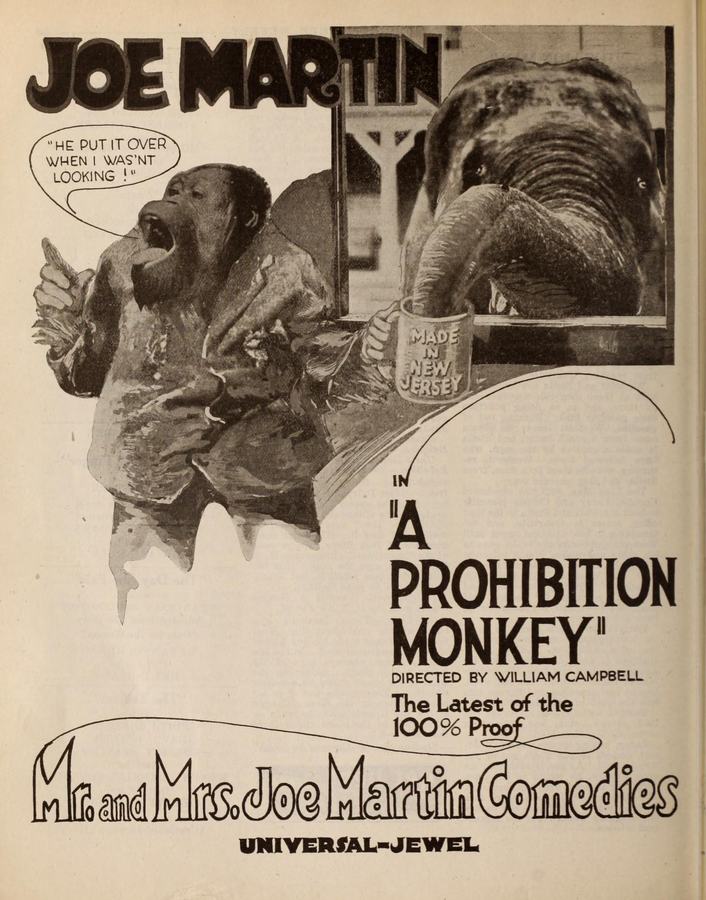
The first time I saw A Prohibition Monkey I was wedged between two reels of nitrate and a projector that smelled of hot pennies; the film flickered like a faulty conscience, and yet its raucous sermon—booze versus beasts versus beatitude—landed with the blunt grace of a hymn hurled from a barroom piano. You don’t merely watch this 1925 oddity, you inhale its splintered sawdust, taste the sulfurous burp of moonshine, feel the pew-shaking thunder of an elephant who has decided that repentance is a job for tusks.
Director Arthur Nowell—a name scrubbed from most canonical ledgers—approaches the Western frontier not as mythic horizon but as spittoon-deep theater of the absurd. His Beer Bottle Bend is a kiln-baked circus where every citizen is a carny: the newborns gnaw plug tobacco like communion wafers, the sheriff’s badge is a bottle-cap, and the church is boarded tighter than a miser's safe. Riley’s Saloon, aglow in amber kerosene, functions as town hall, brothel, and confessional; its proprietor, a velvet-voiced despot played by Frank Hayes, measures civic virtue in receipts.
Into this moral sinkhole lopes the unnamed evangelist (Arthur Nowell himself), a lanky reformed tumbler whose collar is starched but whose knuckles still read like a railroad map. Behind him trails a caravan of four-legged theologians: Charles Bullephant—imagine a dyspeptic grand-aunt compressed into two tons of gray outrage—Joe Martin, the orang-outang with the soul of a Parisian flaneur, and Buster, a Clydesdale whose rear hooves dispense frontier justice with the finality of a gavel. Together they form a traveling salvation show that makes Avatar’s Na’vi look like understudies in a school pageant.
Nowell’s visual grammar is deliriously paradoxical: intertitles sprout circus-poster fonts, yet the compositions are stained-glass in their reverence. One instant the frame erupts in Keystone mayhem—bodies somersaulting over poker tables, whiskey cascading like molten topaz—the next it lingers on the cracked visage of Mrs. Joe Martin (the orang’s real-life spouse, listed only as such), her eyes pooling with a grief so hushed it feels sacrilegious to witness. This oscillation between slapstick sacrament and chiaroscuro melancholy gives the film its jittery heartbeat.
Riley’s counterattack is as cynical as a campaign promise. He dispatches Fontaine La Rue’s dancing girl, a sequined siren whose hips could sell sand in the Sahara, to vamp the preacher into moral freefall. Their tête-à-tête inside the moonlit livery is a masterclass in erotic brinkmanship: she drapes herself across hay bales like a serpentine question mark, he counters with scripture recited in a baritone that rattles the harnesses. When she finally lunges for a kiss, he ducks, she collides with a saddle, and the ensuing dust cloud forms a chiaroscuro halo—temptation choked on its own perfume.
But the film’s true coup de grâce arrives when the animals seize the narrative—literally. Charles Bullephant, tired of sermonizing, kicks open the church doors; the splinters fly like apostate angels. Joe Martin swings from the rafters, scooping up drunkards in a velvet-fisted embrace. Buster rears, silhouetted against the stained-glass dawn, and his hoof-beats become a Pentecostal drumline. It’s as if Money to Burn’s feverish capitalism has been trampled under the weight of unassailable grace, or the anarchic spirits of Sisters of the Golden Circle decided to start a revival.
Nowell orchestrates these transformations with montage that anticipates Eisenstein by a whisker. A shot of the saloon’s clock melting into a communion wafer; a cut from Riley’s cash register slamming to the church bell tolling; a superimposition of the elephant’s eye over the congregation’s collective gasp—each splice feels like a hymnal page torn out and folded into an origami dove. The intertitles, often dismissed in silents as mere placards, here thrum with poetic venom: “The wages of gin is nickels,” reads one, over an image of Riley sweeping coins into a sack shaped suspiciously like a coffin.
Performances oscillate between grand guignol and whispered confession. Hayes’s Riley is a capitalist Lear, howling when his empire of hops collapses. Larry McGrath as the town lush achieves transcendence in detox, his shaking hands forming a steeple that would make Bernini weep. And Joe Martin the orang-outang—let’s be clear—delivers the most nuanced turn, toggling between vaudevillian pratfall and a gaze that seems to have witnessed every pogrom of the twentieth century before it happened. When he cradles a newly sober child, his furry knuckles brushing the boy’s cheek, the moment shames every CGI creature that Hollywood has belched since.
Yet the film is not without its bruises. A racial caricature during a craps-game sequence—brief, but vile—reminds you that 1925 was no Eden. Nowell seems to sense the rot; he immediately cuts to the orang-outang flipping the gaming table, a revolutionary act that reframes the stereotype as systemic idiocy. Still, the scar remains, and any honest appraisal must flinch at it.
The finale is a delirium of redemption. On resurrection morning the church, once a mausoleum of neglect, balloons with townsfolk squeezed into ill-fitting suits. Riley, now sans pomade and pride, slumps in the back pew; the dancing girl clutches a hymnal like a life preserver. The preacher ascends the pulpit, sleeves rolled, and delivers a sermon that intercuts verses of Matthew with shots of the elephant’s ears flapping in approbation. When the collection plate passes, it fills not with coin but with revolvers, corkscrews, and one lonely thimble—an inventory of vices surrendered. Outside, the saloon sign creaks, topples, and shatters; the dust cloud forms—if you squint—a cross.
Viewed today, A Prohibition Monkey feels like a prophecy smuggled out of the past. Its DNA snakes through The Lone Star Ranger’s moral binaries, echoes in the ecological communion of Avatar, and snickers at the political clown car of Aftermath. It argues, with screwball fervor, that salvation is less a prayer than a pratfall, less a solo than a three-ring circus where the animals know the choreography better than the humans.
So if you chance upon a battered 16 mm print in some flea-market sarcophagus, buy it, project it, let the nitrate singe your fingertips. You will emerge smelling of elephant, whiskey, and incense—an olfactory trinity more honest than most creeds. And when the final intertitle—“The monkey’s off the nation’s back, but the circus stays on the road”—flickers into darkness, you may find yourself, like Beer Bottle Bend, a little less inclined to chew tobacco and a little more inclined to roar amen.
Rating: 9.2/10 — a bruised hymn that still outruns the cynics.
IMDb 6.2
1926
Community
Log in to comment.