DbcultAccessing Vault...
5.8/10
Senior Film Conservator
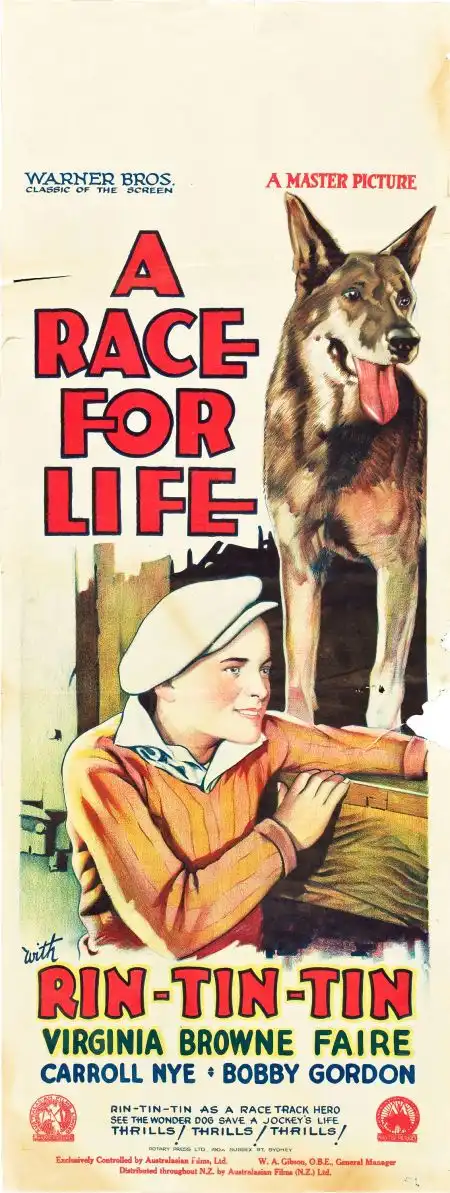
A definitive 5.8/10 rating for a film that redefined the boundaries of cult cinema. A Race for Life remains a cornerstone of transgressive art.
If you have about an hour to kill and you don’t mind the flickering grain of 1928, A Race for Life is perfectly fine. You’ll like it if you have a soft spot for Rin Tin Tin or if you’re the kind of person who finds the logic of 1920s melodramas funny. You’ll probably hate it if you need your sports movies to have, you know, realistic stakes or if silent film mugging drives you crazy.
Let’s be honest: nobody was buying a ticket in 1928 to see Robert Gordon. They were there for the dog. Rin Tin Tin (Rinty) is doing a lot of heavy lifting here. There’s a scene early on where Danny is deciding to run away, and the dog is watching him with this intensity that feels almost human. It’s actually a bit distracting because the dog seems to understand the stakes of the scene better than Gordon does. Gordon has this habit of looking slightly past the camera, like he’s trying to remember his next mark, while Rinty is just on.
The plot is thin, even for a programmer like this. Danny wants to be a jockey. He ends up at the track. There are some bad guys who want to fix the race. It’s the same skeleton you see in something like Out to Win, but with more fur. The pacing in the middle is a bit of a slog. There are these long stretches of Danny hanging around the stables where not much happens. The lighting in the stable interiors is surprisingly moody, though—lots of deep shadows that make the place look way more dangerous than a horse barn should be.
The racing footage itself is where the movie finally wakes up. The cameras are mounted low, and you get a real sense of the dirt kicking up. It’s not quite as polished as the action in Dynamite Dan, but it has this raw, shaky quality that works. There’s one shot where the horses are coming around the final turn and the camera almost feels like it’s going to get trampled. It’s one of the few moments where the movie stops feeling like a stage play and starts feeling like a film.
Jim Mason plays the villain, and he is doing the absolute most with his eyebrows. He has this way of leaning into the frame that feels like he’s trying to physically push the hero out of the movie. It’s a bit much. Virginia Brown Faire is there as the love interest, I guess, but she doesn’t have much to do except look concerned in a very 1920s way—lots of hand-to-cheek poses and wide eyes. Her chemistry with Gordon is basically non-existent. They feel like two people waiting for the same bus.
There’s a weird edit near the climax where we jump from a wide shot of the crowd to a tight closeup of Rinty barking, and the lighting change is so jarring it looks like they filmed the dog’s reaction in a completely different building three days later. The dog is supposed to be cheering Danny on, or maybe warning him? It’s never quite clear, but the dog looks very committed to the bit.
I noticed the costumes in the crowd scenes are all over the place. You have people in the background who look like they actually belong at a 1928 race track, and then you have a few extras who look like they just wandered in from a different movie set entirely. One guy in the back of the betting scene is wearing a hat that is at least three sizes too big, and I spent about four minutes just watching him try to keep it from falling over his eyes instead of listening to the intertitles.
Is it a masterpiece? No. It’s a B-movie from a time before they called them B-movies. It’s a bit like Pretty Smooth in that it relies on a very specific kind of charm to get past the fact that the script is basically a series of coincidences. But if you just want to watch a very talented dog out-act a bunch of humans while some horses run fast, it hits the spot. The ending is exactly what you think it is, and it happens about five minutes faster than it probably should, but that’s silent cinema for you. It doesn’t overstay its welcome.
One last thing: the way they filmed the dog jumping over obstacles is still impressive. No CGI, no safety nets, just a dog that was probably smarter than the director. Every time Rinty is on screen, the energy of the film shifts. When he’s not, you’re mostly just waiting for him to come back.

IMDb 6.3
1930
Community
Log in to comment.