DbcultAccessing Vault...
Cult Review
Senior Film Conservator
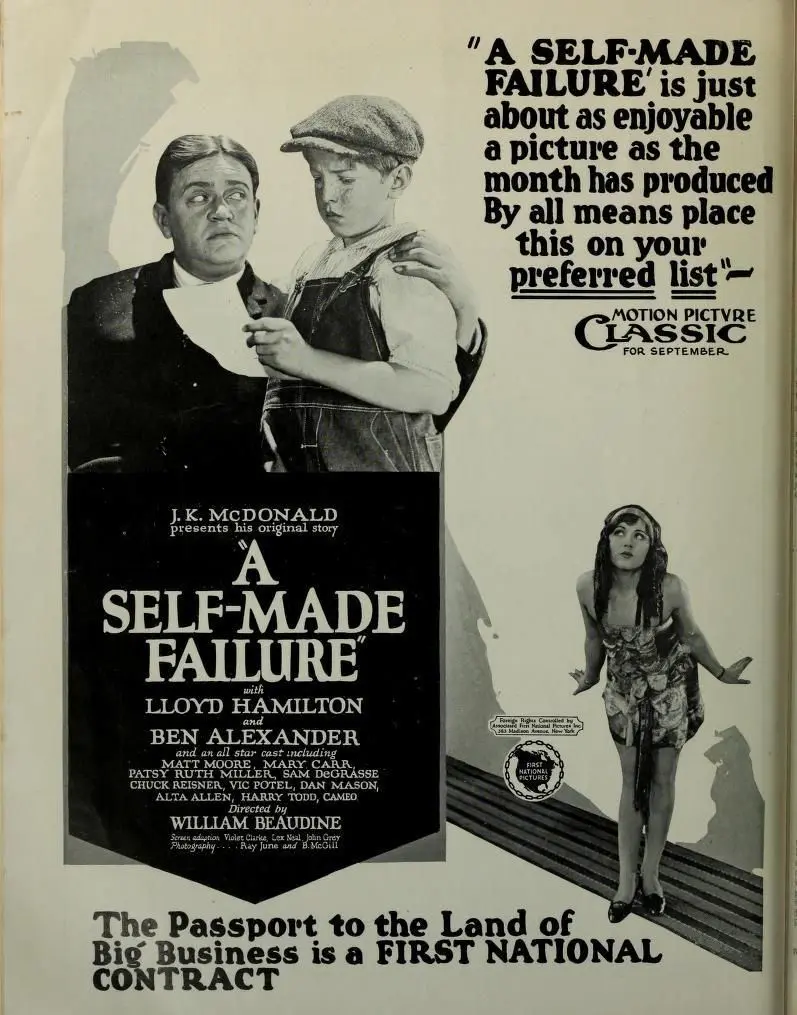
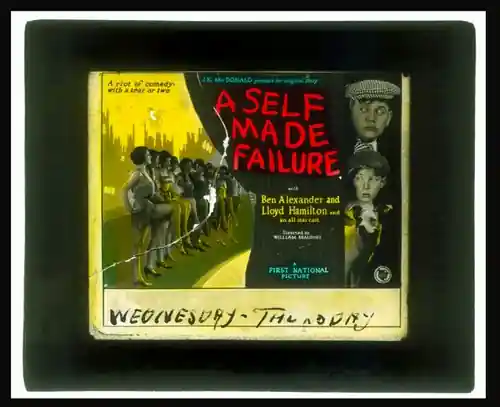
The silent era of the 1920s often oscillated between the grandiloquent epics of Griffith and the intimate, often biting social commentaries disguised as low-brow comedies. A Self-Made Failure falls squarely into the latter category, yet it possesses a peculiar, haunting depth that distinguishes it from the assembly-line shorts of its contemporaries. Lloyd Hamilton, an actor whose physical comedy was always underpinned by a sense of profound, almost cosmic isolation, finds his most resonant role here as Breezy. The film eschews the typical 'rags-to-riches' trajectory in favor of a more cynical, albeit humorous, exploration of the 'fake it until you make it' ethos that defined the American decade. Unlike the protagonist in A Gentleman from Mississippi, who navigates the corridors of power with a certain innate nobility, Breezy is a man of the shadows, a creature of the periphery thrust into the blinding white light of a high-society health resort.
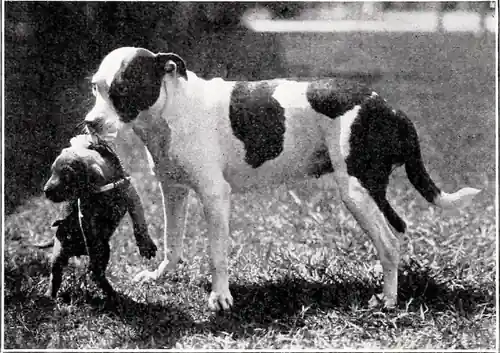
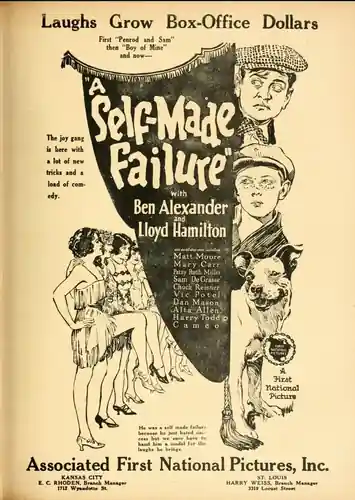
The opening sequences are surprisingly somber for a film marketed as a comedy. The death of Sonny’s father is handled with a starkness that recalls the grittier elements of The Whistle. It establishes a stakes-driven narrative where the comedy isn't just for laughs, but a survival mechanism. When Breezy inherits the guardianship of Sonny (played with a refreshing lack of sentimentality by Ben Alexander), the film transforms into a road movie that predates the genre's formalization. The inclusion of Cameo the dog isn't merely for canine appeal; the animal acts as a silent witness to the absurdity of human social structures, often exhibiting more common sense than the 'civilized' denizens of Sulphur Springs.
Once the trio arrives at the health resort, the cinematography takes on a different hue. The resort itself is a character—a sprawling, antiseptic labyrinth designed to extract wealth from the infirm and the bored. Cyrus, the owner, is portrayed with a menacing oily charm by Sam De Grasse. His immediate misidentification of Breezy as a medical advisor is the pivot upon which the entire plot turns. This central conceit allows the writers—a formidable team including Tamar Lane and Lex Neal—to sharpen their scalpels. The 'medical advice' Breezy dispenses is a brilliant parody of the wellness fads of the era, suggesting that the difference between a hobo and a high-priced consultant is merely a matter of costume and confidence.
The tension in the film arises from the dual layers of deception. While Breezy is an accidental fraud, Cyrus is a deliberate one. This mirrors the thematic undercurrents found in The Little Fool, where innocence is exploited by those who claim to be its protectors. The resort’s 'healing waters' become a metaphor for the murky ethics of the characters. As Breezy stumbles through his duties, the film utilizes the physical space of the resort for some of the most inventive slapstick of Hamilton’s career. His use of his lanky frame to navigate the restrictive, formal environments of the spa creates a visual dissonance that highlights the absurdity of the upper-class setting.
Patsy Ruth Miller and Matt Moore provide the necessary romantic and dramatic ballast to the film’s more manic moments. Miller, in particular, possesses an expressive range that elevates her character beyond the typical damsel-in-distress trope. Her interactions with Breezy are colored by a subtle realization that this 'doctor' is something far more interesting—and perhaps more honest—than the elite circles she usually inhabits. The supporting cast, featuring stalwarts like Dan Mason and Dot Farley, creates a rich, lived-in world. Each character seems to be hiding a secret, contributing to a sense of pervasive paranoia that keeps the audience off-balance.
One cannot discuss A Self-Made Failure without acknowledging the technical prowess of the direction. While William Beaudine is often remembered for his prolificacy, his work here shows a keen eye for pacing. The transition from the outdoor, pastoral scenes of the first act to the claustrophobic, high-stakes environment of the resort is handled with a fluidity that was rare for 1924. The editing, particularly during the climactic sequences where Cyrus’s true nature is revealed, utilizes cross-cutting to build a genuine sense of peril. It lacks the melodrama of The Alaskan, opting instead for a tension that is grounded in the personal stakes of the characters.
At its core, the film is a critique of the 'self-made' mythos. The title itself is a paradox. Can one truly make oneself a failure, or is failure an external condition imposed by a rigid social hierarchy? Breezy is 'self-made' in the sense that he has crafted an identity that allows him to navigate a world that has no place for him. His 'failure' is only a failure in the eyes of those who value capital over character. This film shares a spiritual kinship with Her Five-Foot Highness in its exploration of how individuals must perform specific roles to achieve agency within a restrictive society.
The screenplay by Tamar Lane and her collaborators is remarkably tight. There is very little 'fat' in the narrative. Every gag serves the character development, and every plot twist reinforces the central theme of mistaken identity. The dialogue titles are witty and often bitingly sarcastic, providing a linguistic sharp-edgedness to the visual comedy. It’s a film that demands a second viewing to fully appreciate the intricacies of the social maneuvering on display. While some might compare it to the lighter fare of Her First Kiss, there is a darkness here—a 'sulphurous' quality, if you will—that lingers long after the final frame.
Lloyd Hamilton’s transition from shorts to features was not always seamless, but A Self-Made Failure stands as the pinnacle of his long-form work. He manages to sustain the 'Breezy' persona across several reels without it becoming tiresome—a feat that many of his peers struggled with. The film’s ability to balance the pathos of the orphan Sonny with the high-stakes intrigue of the resort is a testament to the sophisticated storytelling of the mid-20s. It avoids the overt sentimentality of Golden Dreams, preferring a more grounded, almost documentary-like observation of human foibles.
In the broader context of silent cinema, this film serves as a bridge between the pure slapstick of the early teens and the more complex narrative comedies of the late 20s. It lacks the polish of a Keaton feature but compensates with a raw, unpredictable energy. The set design of Sulphur Springs, with its ornate fountains and sterile corridors, provides a visual metaphor for the 'whitewashing' of corruption. When the truth finally comes to light, it isn't just a victory for Breezy; it’s a vindication of the marginalized. The film suggests that the only true failure is the loss of one's humanity in the pursuit of status.
Revisiting A Self-Made Failure today, one is struck by how little has changed in the realm of institutionalized fraud. The 'resort' could easily be a modern corporate boardroom or a questionable tech startup. The film’s cynicism is tempered by the genuine bond between Breezy, Sonny, and Cameo—a bond that is forged in the fire of necessity rather than the convenience of social standing. It is a more complex work than In Bad or The Halfbreed, offering a nuanced look at the performance of identity.
For those interested in the evolution of the comedic anti-hero, Lloyd Hamilton’s performance is essential viewing. He doesn't seek the audience's pity; he demands their respect through his sheer tenacity. The film’s conclusion, which I will not spoil, offers a satisfying resolution that feels earned rather than manufactured. It is a rare example of a silent comedy that manages to be both hilariously funny and deeply uncomfortable. A Self-Made Failure is not just a relic of a bygone era; it is a timeless exploration of the masks we wear and the truths we hide behind them. It remains a high-water mark for the 1924 cinematic landscape, a year that was pivotal for the maturation of the medium.
IMDb 5.8
1925
Community
Log in to comment.