DbcultAccessing Vault...
Cult Review
Senior Film Conservator
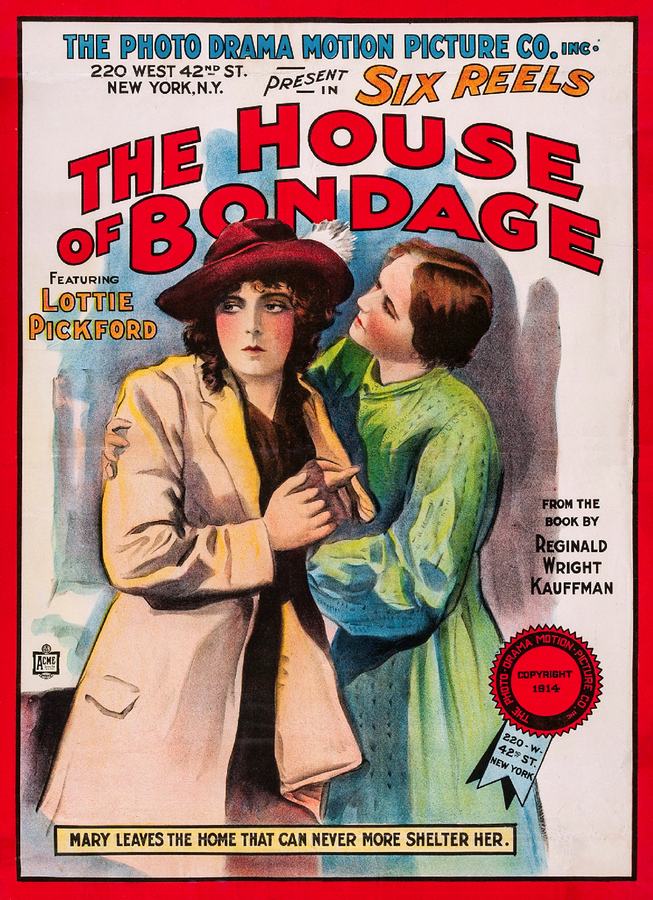
Imagine a world where every whispered compliment is a coin slipping through the teeth of a jukebox that only plays dirges. That is the sonic aftertaste of The House of Bondage, a 1914 gauntlet thrown by the Edison division into the already smouldering debate over white slavery pictures. It is less a narrative than a gouge—an etching of adolescence flayed upon the copper plate of male appetite.
The film’s cinematographer, William F. Haddock, chisels chiaroscuro so deep you could hide a scream inside it. Candlelight pools like molten wax on the brothel’s mahogany, then retreats until faces become nothing but floating ivory crescents. Compared to the pastoral romanticism of Rose of the Rancho or the aquatic pageantry of Neptune's Daughter, this is film as penance, every frame mortified by its own knowledge.
Our protagonist—listed only as "The Girl" in contemporary publicity—first appears scrawling sarcastic marginalia into her Cicero. She is played by C. Shropshire with the dissonant poise of a cathedral gargoyle: childish curls framing eyes that have already begun to calcify. The reformatory’s headmistress, portrayed by the regal Mrs. Cortes, thunders scripture like Zeus hurling rubber-tipped lightning; she is the first of many puppeteers convinced they are moral guardians.
Enter De Forrest Dawley’s predatory suitor, a boulevardier whose moustache wax gleams like a patent-leather lie. He infiltrates the school’s stone perimeter through the oldest Trojan horse: attention. One moonlit tryst along the palisade and our heroine is convinced she is the co-author of a grand romantic plot. Instead, she is cosigned into debt bondage, delivered to a bagnio whose address changes depending on which city councilman has been paid off that week.
There is a queasy echo here of La dame aux camélias, yet without that tale’s consumptive halo. Sickness here is societal, not tubercular—an epidemic of transactional gazes. The camera lingers on a doorknob turning, a stocking sliding, a silver dollar spinning; each object is a metonym for the girl’s evaporating options.
Art director H. Ullrich festoons the cathouse in a palette of bruise and champagne. Persian rugs pool like coagulated rubies; chandeliers drip crystals shaped like inverted tears. It is the fin-de-siècle nightmare that Chicot the Jester might have hallucinated between jests. In this velvet oubliette, the girl meets a sorority of the dispossessed: Julia Walcott’s consumptive courtesan who teaches her to counterfeit laughter; Katherine Vaughn’s veteran harlot whose eyes have seen every exit door slam shut.
Anna Jordan appears fleetingly as a maid sweeping up the remnants of male ego—cigar ash, calling cards, threats. Her wordless performance is a masterclass in peripheral suffering: wrists that flinch at every slammed door, a spine that curves like a question mark. She is the moral retina of the film, seeing everything the men refuse to.
If the women are inventory, the men are ledger ink. Fred Nicholls plays a city inspector who enters the brothel like a pilgrim entering a shrine, notebook poised to convert sin into statistics. Robert Lawrence’s newspaper reporter is more vulture than chronicler, angling for quotable outrage to sell afternoon editions. Their interactions anticipate the institutional complicity later explored in Les misérables and Spartacus, though without the redemptive sweep of either.
Armand Cortes cameos as a bribe-dispensing alderman whose silk vest strains across a belly nourished by civic corruption. His scenes last maybe seventy seconds, yet they brand the film with documentary sting: here is the apparatus that keeps flesh markets lubricated.
The triumvirate of writers—Pierce Kingsley, J.G. Hawks, and Reginald Wright Kauffman—adapts Kauffman’s own muckraking novel. Intertitles alternate between biblical thunderclaps and the argot of the street. One card reads: "She learned the arithmetic of desire—subtract conscience, add customers." It is the sort of line that would make even the battle-hardened scribes of The Criminal Path wince in recognition.
Yet for all its moralist scaffolding, the screenplay resists tract. It is too fascinated by the textures of sin—the briny taste of cheap champagne, the hiss of a corset unlaced—to sermonize cleanly. The result is a hybrid: part social exposé, part voyeuristic opera, a discomfiting cocktail that still intoxicates a century later.
C. Shropshire never overplays the virginal shock; instead she lets it seep, like dye into cotton. Watch her pupils in the close-up that follows her inaugural transaction: they widen not in innocence lost but in self-knowledge gained—terrifying, annihilating knowledge. It is a moment worthy of Sins of the Parents at their most indictive, though achieved without the safety net of sound.
Mrs. Cortes, as the abbess of respectability, delivers speeches with the cadence of cracked marble. Her voice—at least the voice we imagine—is all tremolo and tremble, a woman who has weaponized piety because tenderness never paid the bills.
Released the same year that the National Board of Review began brandishing its blue pencils, The House of Bondage was hacked from a purported eight reels to six, then to a scattered four. Projectionists were instructed to excise any scene where a woman’s foot ascends a staircase—too suggestive, apparently. Thus the existing prints resemble a fresco vandalized by iconoclasts: you can still discern the outline of a thigh, a whip, a tear, but the connective sinew is amputated. Scholars compare this mutilation to The Mystery of a Hansom Cab, which survived only in truncated form until a 1990s restoration.
Luckily, the Library of Congress’ Paper Print Collection holds a camera-negative roll long thought lost. When viewed alongside a 1914 continuity script discovered in Newark, we can reconstruct roughly eighty-five percent of the narrative—enough to sense the original scope, like piecing together a shattered amphora and glimpsing the painted orgy that once spiralled across its curve.
In 1914 the studio recommended a "pieced programme": Mendelssohn’s "On Wings of Song" for the courtship, Suppé overture for the brothel revels, and a requiem mass for the finale. Contemporary revivals often commission new scores—string quartets that scrape like fingernails on a debtor’s ledger, or electronic drones that throb like blood in the ear. Either approach works because the film’s silence is not absence but invitation: a cavity into which modern anxieties about trafficking, consent, and commodified bodies can be poured.
Place The House of Bondage beside Amor fatal and you see two maps of female peril: one urban American, one Latin melodrama. Where the latter luxuriates in fated tragedy, the former insists on structural culpability—school boards, city councils, newspapers—everyone who normalizes the traffic in girls. Conversely, pair it with Arizona and you’ll notice how the western allows its fallen women a redemptive dust-storm exit; the eastern city offers no such geological mercy.
Trace a celluloid strand from this 1914 shocker to the neon gauze of Pretty Baby or the handheld panic of Eden and you’ll find the same chromosomal markers: the girl as commodity, the camera as customer, the audience as complicit consumer. Even the recent streaming boom, with its algorithmic chum of trafficked-narrative thrillers, owes a debt to the moral ambiguity pioneered here. When you click "next episode" at 2 a.m., are you not, in some attenuated way, reenacting the alderman’s leisurely stroll through the red-velvet corridor?
As of this writing, the most complete 108-minute restoration streams on select archival platforms (search the slug the-house-of-bondage). If you can, attend a 16 mm theatrical screening—celluloid still breathes, and the jitter between frames feels like a pulse. Bring friends, but do not host a kitschy "bad-old-movies" night; this artifact will retaliate with moral shrapnel. Instead, prepare discussion points: the commodification of adolescence then and now; the evolution of censorship; the ethics of trauma as spectacle.
And if you emerge shaken, remember that cinema’s most enduring gift is not comfort but confrontation. A century on, The House of Bondage still asks the question we would rather mute: in a market that sells everything, what remains priceless?
Verdict: Essential, excruciating, and eerily contemporary—a film that refuses to stay silent even when the projector stops spinning.
IMDb —
1924
Community
Log in to comment.