DbcultAccessing Vault...
Cult Review
Senior Film Conservator
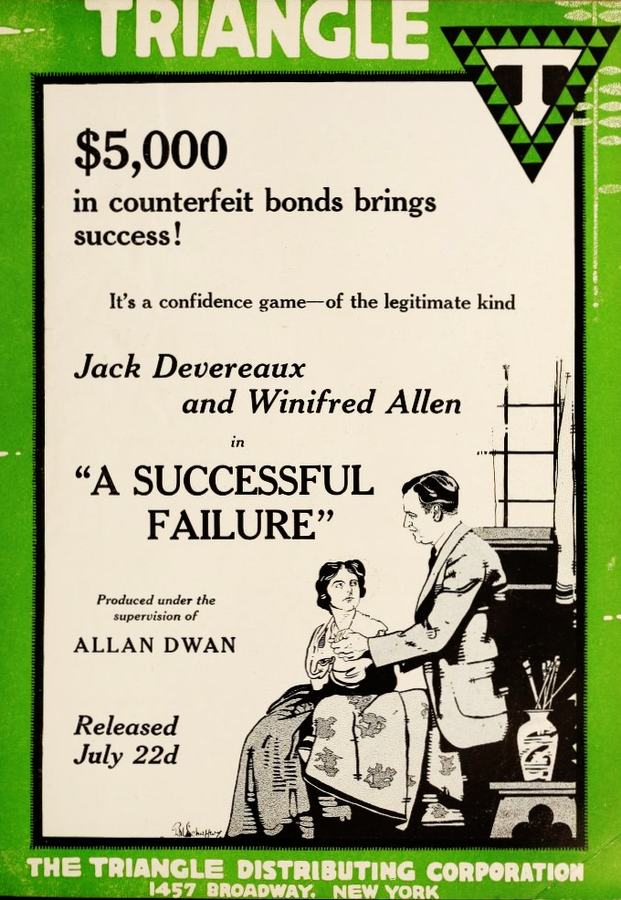
There are films that etch themselves into the very fabric of cinematic history not through bombast or overt spectacle, but through a quiet, persistent exploration of the human condition. 'A Successful Failure' stands as a testament to this principle, a nuanced tapestry woven from the threads of ambition, societal judgment, and the profound, often ironic, dance between triumph and despair. In an era when the moving image was still finding its voice, this particular feature dared to grapple with a paradox inherent in its very title, offering audiences a narrative that was both deeply personal and universally resonant. It's a journey into the heart of a dream, its public demolition, and its ultimate, unexpected resurrection, all filtered through the compelling performances of its leading players.
At the core of this compelling drama is Winifred Allen's portrayal of Elara Vance, an inventor whose intellect burns with an intensity that threatens to consume her. Allen imbues Elara with a fascinating blend of fierce determination and an almost childlike vulnerability, making her character immediately sympathetic despite her unconventional pursuits. We witness her in the solitude of her laboratory, surrounded by intricate contraptions and the flickering gaslight, a solitary figure battling not just the laws of physics but the profound skepticism of her age. Her 'Aetheric Resonator' is more than just a machine; it is an extension of her very soul, a tangible manifestation of her unwavering belief in progress and human ingenuity. The early scenes, though wordless, speak volumes through Allen's expressive physicality, conveying the relentless grind of invention, the flashes of insight, and the quiet sacrifices made in pursuit of a grand idea. It is a performance that resonates with the quiet strength found in other portrayals of marginalized brilliance, perhaps echoing the misunderstood genius seen in certain interpretations of Peer Gynt, though Elara's struggle is rooted in scientific innovation rather than epic self-discovery.
The film excels in illustrating the profound isolation that often accompanies pioneering thought. Elara's world is one of gears, wires, and abstract equations, a universe largely incomprehensible to those around her. This isolation is further compounded by the dismissive attitude of the scientific establishment, epitomized by George Senaut's Dr. Alistair Finch. Senaut, with a masterful command of subtle gestures and stern visages, crafts a character who is not overtly malicious but rather stubbornly entrenched in conventional wisdom. His skepticism is born less of malice and more of a rigid adherence to established paradigms, a common antagonist in narratives of innovation. He represents the immovable object against Elara's irresistible force, a dynamic that drives much of the film's early tension. This clash of ideologies, the bold visionary against the staid gatekeeper, provides a powerful commentary on the often-arduous path of groundbreaking discovery.
Amidst this intellectual battleground, Jack Devereaux's Arthur Sterling emerges as the film's moral compass and, crucially, its empathetic anchor. Sterling, a journalist by trade, possesses a keen sense of observation and an innate understanding of the human spirit that transcends mere reportage. He sees beyond Elara's eccentricities to the passion and integrity that fuel her work. Devereaux portrays Sterling not as a romantic lead in the conventional sense, but as a steadfast supporter, a man whose belief in Elara is rooted in respect rather than infatuation. His quiet encouragement, his subtle nods of understanding, and his unwavering presence are vital to Elara's fragile spirit. It's a portrayal reminiscent of the unsung heroes who stand by the misunderstood, offering a glimmer of hope when all seems lost. His role is pivotal in bridging the chasm between Elara's isolated genius and the broader public, acting as both an advocate and a chronicler of her extraordinary journey. One might draw parallels to the steadfast loyalty found in certain characters within melodramas like Mother o' Mine, where quiet devotion often underpins the grander narratives.
The narrative's turning point, Elara's public demonstration of the Resonator, is a masterclass in building tension and delivering crushing disappointment. The scene is meticulously crafted, from the expectant faces of the onlookers to the intricate details of the device itself. When the machine fails to deliver on its promise, instead emitting only a strange hum and ethereal light, the collective sigh of disillusionment is palpable. The film brilliantly uses visual storytelling to convey Elara's shattered hopes: the close-ups on her face, contorted in anguish, juxtaposed with the triumphant sneer of Dr. Finch and the sympathetic, yet helpless, gaze of Arthur Sterling. This moment of abject failure is crucial, not just for Elara's character arc, but for the very premise of the film. It is here that the audience is invited to grapple with the meaning of failure, to understand its crushing weight, and to anticipate, however subconsciously, the possibility of redemption.
What follows is a period of profound desolation. Elara's retreat from public life is depicted with a quiet dignity, emphasizing the emotional toll of her perceived defeat. The film doesn't wallow in melodrama but rather portrays a woman grappling with the bitter taste of squandered dreams and public scorn. Yet, it is precisely in this nadir that the seeds of an unexpected triumph are sown. The emergence of the mysterious plague serves as a stark, dramatic catalyst, shifting the narrative from personal tragedy to a wider societal crisis. The film's brilliance lies in its gradual unveiling of the Resonator's true, unintended purpose. The subtle visual cues – the healthier plant life, the calmer demeanor of those residing near Elara's abandoned laboratory – slowly build towards the shocking revelation. Arthur Sterling, ever the diligent investigator, pieces together the puzzle, transforming from a simple reporter into a detective of destiny. His journey of discovery, meticulously portrayed, provides the audience with a surrogate through whom to experience the unfolding miracle.
The film masterfully plays with the concept of perception versus reality. What was initially deemed a dangerous nuisance is revealed to be an accidental panacea. The very emissions that disrupted radio signals and caused peculiar plant growth were, in fact, subtly altering the environment, creating an atmospheric buffer against the virulent plague. This twist is not merely a plot device but a profound philosophical statement on the unpredictable nature of discovery and the limitations of human understanding. It forces Dr. Finch, and by extension the audience, to confront the arrogance of intellectual certainty. Senaut’s portrayal of Finch’s gradual realization and ultimate public recantation is particularly compelling, showcasing a man humbled by the very phenomenon he so vehemently dismissed. It’s a moment of intellectual reckoning, a stark reminder that true progress often emerges from unexpected quarters, sometimes even from what appears to be outright failure. One might compare this ironic reversal to the thematic core of films dealing with misunderstood genius or accidental heroism, though 'A Successful Failure' posits a more profound, almost cosmic, irony. Its exploration of unforeseen benefits from perceived flaws brings to mind the complex layers of intent and outcome seen in films like Dvoynaya zhizn, where hidden truths slowly come to light, or the intricate web of cause and effect in Le diamant noir.
The film's final act is a study in bittersweet vindication. Elara Vance is hailed as a hero, a visionary ahead of her time. The public, once scornful, now celebrates her. Yet, Winifred Allen's nuanced performance ensures that this triumph is not unblemished joy. There is a profound melancholy in her eyes, a lingering weariness that speaks volumes about the personal cost of her journey. The initial humiliation, the years of ridicule, and the grim irony that her true genius was only recognized through a tragic happenstance have left an indelible mark. Her success is undeniable, but it is a success born from failure, a triumph tinged with the memory of profound despair. This complex emotional landscape elevates 'A Successful Failure' beyond a simple rags-to-riches narrative, transforming it into a poignant exploration of the human spirit's resilience and the often-paradoxical nature of achievement.
The direction, though subtle, plays a crucial role in conveying this emotional complexity. The use of light and shadow, characteristic of the silent era, is particularly effective in mirroring Elara's internal state. Early scenes in her laboratory are often bathed in a solitary, almost mystical glow, symbolizing her isolated brilliance. The period of her public failure is marked by stark, unforgiving shadows, emphasizing her despair. And in her final, celebrated moments, while bathed in light, there remains a shadow in her eyes, a testament to the film's refusal to offer an overly simplistic happy ending. This visual sophistication, combined with the powerful performances, allows the film to communicate profound emotional truths without the aid of spoken dialogue. It's a testament to the power of silent cinema to convey deep meaning through purely visual and performative means, a quality shared by other contemplative dramas of the period, perhaps even the stark realism found in Shame, though with a different thematic focus.
'A Successful Failure' remains a compelling artifact, not just as a piece of cinematic history, but as a timeless narrative. Its themes of intellectual courage, the resistance to new ideas, and the unpredictable nature of progress resonate as strongly today as they did upon its release. It challenges us to reconsider our definitions of success and failure, to look beyond immediate outcomes, and to appreciate the often-circuitous path of human endeavor. The film subtly critiques societal judgment, reminding us that what we perceive as a blunder might, in the grand scheme of things, be the very catalyst for unforeseen good. Its message is one of profound hope, albeit a hope tempered by the understanding that innovation often comes at a personal cost. The film's ability to tackle such complex ideas with grace and emotional depth, particularly within the constraints of silent film, is truly remarkable.
Moreover, the film's exploration of public perception and rehabilitation of character offers interesting parallels to other narratives of social ostracism and eventual acceptance. One might consider the journey of protagonists in films like The Little Shepherd of Bargain Row or The Girl by the Roadside, where societal scorn is eventually overcome, though 'A Successful Failure' adds a unique scientific dimension to this redemption arc. The film's enduring power lies in its ability to provoke thought and stir emotion without resorting to overt didacticism. It allows the audience to draw their own conclusions about the true meaning of success, inviting introspection rather than dictating a moral. This nuanced approach ensures its continued relevance, solidifying its place as a quiet masterpiece of its era, a film that, much like its protagonist's invention, initially appears to be one thing, only to reveal a far more profound and impactful truth upon deeper examination. The subtle shifts in public opinion and the slow dawning of understanding are depicted with a realism that transcends its silent medium, making it a powerful commentary on the fickle nature of fame and the enduring value of genuine contribution, regardless of initial reception. It's a cinematic experience that stays with you, prompting reflection long after the final intertitle fades.
IMDb 5.9
1919
Community
Log in to comment.