DbcultAccessing Vault...
Cult Review
Senior Film Conservator
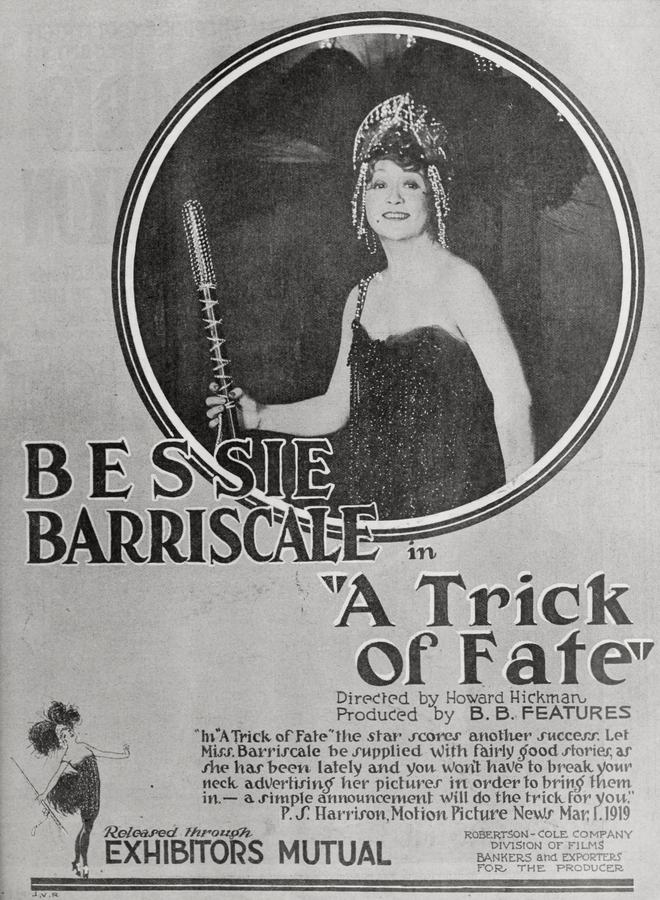
There's an undeniable allure to the silent era, a cinematic period where heightened emotion and visual storytelling reigned supreme, often distilling complex human predicaments into stark, compelling narratives. Among these forgotten gems, A Trick of Fate, a 1919 melodrama penned by Fred Myton and Maie B. Havey, emerges as a fascinating artifact, a testament to the era's penchant for intricate plots, mistaken identities, and the relentless pursuit of honor. It’s a film that, even a century later, speaks to the timeless human fascination with disguise, redemption, and the capricious hand of destiny.
Our journey begins in the fading grandeur of the American South, a setting often romanticized yet here imbued with a palpable sense of decline. Mary Lee, portrayed with a captivating earnestness by Bessie Barriscale, embodies the last vestiges of a once-proud aristocratic lineage. Her world, steeped in tradition and the quiet dignity of her ancestors, is irrevocably shattered by the death of her father. This tragedy, however, is not merely personal grief; it carries with it the crushing burden of a $5,000 debt, a sum seemingly insurmountable in her straitened circumstances. What truly ignites Mary's resolve, propelling her from the familiar comforts of her Southern home, is not just the financial obligation, but the stinging insult hurled by the banker upon her family's honor. This slight, a wound to the very core of her being, transforms a quiet dancing instructor into a woman driven by a singular, unwavering purpose: to reclaim her family's good name, no matter the personal cost. It’s a powerful opening premise, one that immediately establishes the high stakes and the profound emotional landscape Mary is forced to navigate. Her odyssey to New York is not just a geographical shift but a symbolic severance from her past, a plunge into the unknown in a desperate bid for self-redemption and ancestral vindication.
Meanwhile, the narrative skillfully pivots to the vibrant, often shadowy, theatrical underworld of Paris. Here, Raoul Garson, an American theatrical manager, a character whose moral compass often veers into opportunistic territory, discovers Anna Gerard. Anna, a dancing sensation whose allure is as undeniable as her striking resemblance to Mary Lee, becomes Garson's latest acquisition for a Broadway spectacle. This uncanny physical similarity is the linchpin upon which the entire edifice of deceit will be constructed. However, Anna’s professional ascent is complicated by the possessive and volatile affections of Pierre La Rouge, her Apache lover. La Rouge, a figure embodying the darker, more untamed passions of the Parisian demi-monde, vehemently opposes Anna’s transatlantic ambitions. His objection sets the stage for the tragic events to follow, hinting at the destructive power of jealousy and unchecked desire.
When Anna, performing under the exotic moniker "Zura," abruptly abandons her Broadway commitment, Garson finds himself in a precarious position. The stakes are high; contracts are broken, and financial ruin looms. It is at this critical juncture that fate, or perhaps a particularly convenient narrative contrivance, intervenes. Garson stumbles upon Mary Lee, adrift and desperate in the labyrinthine streets of New York. The resemblance is not merely coincidental; it is a stroke of narrative genius, allowing for the intricate web of deception to be spun. Seeing an opportunity to salvage his venture, Garson offers Mary $5,000 – precisely the sum she needs to satisfy her family's debt – in exchange for her assuming Anna's identity as "Zura." The agreement is sealed with a vow of absolute secrecy, binding Mary to a perilous masquerade that will test her resolve and moral fortitude. This moment is pivotal, trapping Mary in a situation where her honorable intentions are twisted into a foundation for elaborate lies. It reminds one of the moral ambiguities explored in films like The House of Lies, where characters are forced to navigate a treacherous landscape of truth and falsehood, often with devastating consequences.
The narrative takes a decidedly darker turn with the brutal murder of Anna Gerard at the hands of the enraged Pierre La Rouge. This act of violence is not merely a plot device; it underscores the dangerous undercurrents of passion and possessiveness that characterized certain melodramas of the era. Garson, ever the pragmatic opportunist, seizes upon this tragedy to solidify Mary's assumed identity. He meticulously stages the scene to create the illusion that it was Mary Lee who perished, effectively erasing her past and cementing her new persona as the resurrected "Zura." This act of macabre manipulation adds a chilling layer to the story, transforming Mary from a willing participant in a deception to a coerced inhabitant of a ghost's life.
The arrival of Richard Crane, Mary's fiancé, returning from a demanding engineering project in South America, injects a profound emotional complexity into the unfolding drama. Richard, a man of integrity and deep affection, is confronted with the woman he loves, yet she denies her true self, maintaining the elaborate ruse. This refusal to admit her identity, born out of the desperate need to protect her secret and the precarious position she finds herself in, creates a heartbreaking chasm between them. The emotional tension here is palpable, a testament to the silent film's ability to convey profound psychological conflict through gesture and expression. One might draw parallels to the agonizing choices faced by protagonists in films like On Dangerous Paths, where personal sacrifice and hidden truths often lead to profound emotional estrangement.
The elaborate charade, however, cannot endure indefinitely. Anna's own fiancé, John Wentworth, a man presumably of keen observation and deep attachment, eventually pierces through the veil of deceit. His realization of the ruse marks the beginning of the end for Mary's carefully constructed deception. Wentworth, driven by a desire for justice or perhaps merely a refusal to accept the elaborate lie, informs the police. This brings the full weight of the law crashing down upon the precarious situation. In a poignant and deeply selfless act, Richard confesses to Anna's murder, choosing to protect Mary from the legal repercussions, even at the cost of his own freedom. This moment elevates Richard beyond a mere romantic interest; he becomes a tragic hero, willing to sacrifice everything for the woman he loves, regardless of the tangled web of lies she has become enmeshed in. Such acts of sacrificial love were a common, powerful trope in silent melodramas, designed to elicit maximum empathy and emotional resonance from the audience.
The climax of A Trick of Fate is a masterclass in silent film theatrics, marrying psychological suspense with visual spectacle. Mary, driven by a desperate need for justice and to exonerate Richard, returns to Paris. Here, she confronts Pierre La Rouge, not as herself, nor even fully as Anna Gerard, but as a spectral manifestation – Anna's ghost. Her performance, a haunting dance before the tormented La Rouge, is designed to exploit his guilt and superstition. It's a bold, almost supernatural gambit, reminiscent of the dramatic flair seen in contemporary films that explored psychological manipulation or spiritualism, though A Trick of Fate grounds it firmly in human cunning. The sheer audacity of this performance, the way it plays on La Rouge’s fractured psyche, is a testament to the creative ingenuity of silent screenwriters. His eventual confession, wrung from him by the sheer terror of what he perceives to be a supernatural visitation, provides the necessary catharsis, unraveling the final threads of deceit and bringing the truth to light.
With justice finally served and the intricate web of lies untangled, Mary and Richard are free. Their journey culminates not in a return to their former lives, but in a new beginning, far from the societal constraints and tragic entanglements of their past. They find happiness in the vibrant, unburdened landscapes of South America, a symbolic fresh start, a land of opportunity and renewal. This ending, while perhaps a touch idealistic, aligns perfectly with the romantic sensibilities of the era, offering a triumphant resolution after a harrowing ordeal. It speaks to the enduring power of love to overcome adversity and the promise of a future forged anew.
Bessie Barriscale, a prominent figure in early cinema, carries the substantial weight of this narrative on her shoulders, embodying both Mary Lee and Anna Gerard. This dual role, a staple of melodramatic storytelling, demands a nuanced performance capable of conveying distinct personalities within a single physical form. While silent film acting often relied on exaggerated gestures and facial expressions to communicate emotion without dialogue, the challenge of portraying two characters who are physically identical yet temperamentally distinct would have been immense. Barriscale, by all accounts, was adept at conveying inner turmoil and dramatic intensity, making her an ideal choice for such a demanding role. Her ability to switch between Mary's Southern gentility and Anna's more bohemian, perhaps even wilder, stage persona would have been crucial to the film's success. The audience, without the benefit of verbal cues, would have had to rely entirely on her physical portrayal and subtle shifts in demeanor to differentiate between the two women and understand the psychological strain of Mary's impersonation. This kind of performance, where the actor must convey layers of identity and deception, is a hallmark of truly engaging silent cinema, much like the compelling central performances in The Siren's Song (1919) or Fires of Youth, where the protagonist's internal struggle is paramount.
A Trick of Fate stands out not just for its dramatic plot but for its structural ingenuity. The way it weaves together disparate elements – Southern honor, Parisian theatricality, mistaken identity, murder, and romantic sacrifice – into a cohesive, fast-paced narrative is truly commendable. Fred Myton and Maie B. Havey's screenplay demonstrates a keen understanding of cinematic pacing, ensuring that each revelation and twist propels the story forward with increasing urgency. The film's exploration of identity is particularly poignant. Mary's transformation into "Zura" is not merely a costume change; it's a profound psychological journey. She loses herself in the role, struggling to reconcile her true self with the persona she has adopted, a theme that resonates deeply even today. This internal conflict, conveyed through the powerful visual language of silent film, elevates the story beyond simple melodrama into a more nuanced exploration of selfhood.
The supporting cast, including Gayne Whitman as Richard Crane, Josef Swickard, and George Field, would have played crucial roles in anchoring Barriscale's performance. Whitman, as the steadfast fiancé, provides a moral center to the narrative, his unwavering love a beacon in Mary's tumultuous journey. The villains, such as Pierre La Rouge, would have been portrayed with the broad strokes characteristic of the era, yet with enough menace to make their threat palpable. The film's reliance on visual cues, such as the contrast between Mary's initial demure appearance and "Zura's" flamboyant stage presence, would have been key to conveying these shifts without dialogue.
Moreover, the film touches upon themes of class and social mobility. Mary's fall from grace and subsequent immersion in the theatrical world, a realm often viewed with suspicion by polite society, underscores the rigid social structures of the time. Her journey is one of transgression and eventual triumph, challenging the notion that one's fate is solely determined by birthright. This subtext adds another layer of richness to the narrative, making it more than just a thrilling mystery but a commentary on societal expectations and individual resilience.
For modern audiences, A Trick of Fate offers a captivating window into the storytelling techniques and cultural sensibilities of the early 20th century. It reminds us that even without synchronized sound, cinema possessed an incredible power to enthrall, to provoke, and to explore the depths of human experience. The film’s intricate plot, driven by compelling character motivations and escalating stakes, ensures that it remains engaging despite the passage of time. The melodrama, often dismissed as simplistic, is here utilized to explore complex themes of honor, sacrifice, and the elusive nature of identity.
While it shares thematic DNA with other silent films that delved into deception and mistaken identities, such as the aforementioned The House of Lies or even the more overtly criminal machinations of Burglar by Proxy, A Trick of Fate carves out its own distinct niche through its blend of Southern Gothic undertones and Parisian theatricality. Its resolution, a departure to South America, suggests a definitive break from the past, a conscious choice to forge a new destiny free from the shadow of old debts and tragic betrayals. This sense of renewal, a fresh start in an exotic land, provides a satisfyingly optimistic coda to a story fraught with peril and despair.
In an era of cinematic experimentation, A Trick of Fate represents the peak of popular narrative filmmaking, demonstrating how silent cinema could weave together romance, suspense, and social commentary into a deeply satisfying whole. It’s a film that deserves to be rediscovered, not just as a historical curiosity, but as a vibrant piece of storytelling that continues to captivate with its timeless themes and dramatic intensity. The enduring appeal of such narratives lies in their ability to tap into universal human anxieties and aspirations: the desire for belonging, the pursuit of justice, and the transformative power of love. And in Mary Lee's journey, from the faded aristocracy to a new life in South America, we witness a resilient spirit triumphing over the twists and turns of a truly remarkable fate.
IMDb —
1922
Community
Log in to comment.