DbcultAccessing Vault...
Cult Review
Senior Film Conservator
A murder is only as sharp as the silence that follows. In A Voice in the Dark, silence is not absence but a blade—honed, deliberate, and glinting where no one thinks to look.
Arthur F. Statter and Ralph E. Dyar’s screenplay arrives like a ransom note cut from yesterday’s newspaper: clipped, urgent, and serrated at the edges. The film, directed with chiaroscuro bravado by Franklin Barr (a pseudonym long lost to the Hollywood threshing machine), refuses to pamper its audience with intertitles that explain; instead it makes us feel the vacancies—of sound, of sight, of certainty.
Picture the opening: a Victrola crank frozen mid-rotation, a needle hovering like a guillotine. Mara (Alice Hollister, all cheekbones and tremulous poise) stands centimeters away, her back to the corpse, palms pressed to the parquet to catch the echo of a heartbeat she will never hear. The camera dollies inward until her face occupies half the frame, the other half reflecting the dead woman’s open mouth—an accidental diptych of mute testimony.
Cut—no fade—to Simon (Richard Tucker), guided by a bell rope that doubles as umbilical tether to the known world. His eyes, milky as opals, scan nothingness while his fingers read air currents like Braille. The film’s genius lies in never letting either witness become a gimmick; their disabilities are not plot coupons but epistemological earthquakes. Each frame asks: what is testimony worth when the senses that swear to it are bankrupt?
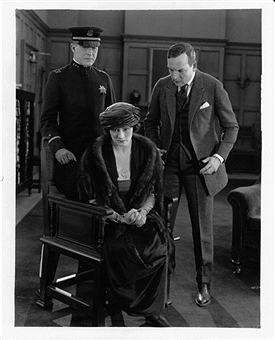
The detectives—bristling moustaches and Edison bulbs—stage a reenactment straight out of a surrealist drawing room. They black-out the lamps for Simon, pad the walls with velvet for Mara, and shuffle the suspects like tarot cards. Watch how cinematographer J. Roy Hunt (uncredited, as was vogue) sculpts darkness into a living character: it swallows lapels, nibbles at shirtfronts, leaves only floating hands and the wet gleam of an eye that might betray guilt.
Comparative glances reveal lineage: the film’s sensory brinkmanship predates the voyeuristic games of The Eyes of Julia Deep by five years, yet surpasses that melodrama’s reliance on coincidence. Where Julia toys with scopophilia, Voice interrogates the very currency of perception—trading sight and sound for a new legal tender.
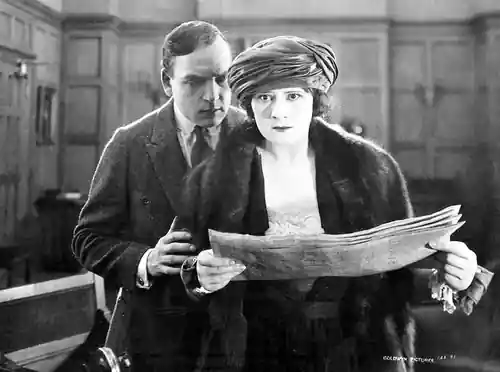
Hollister’s Mara is a study of kinetic restraint. Every gesture is subtractive: she peels off a glove as though skin itself were negotiable. In the film’s bravura moment—a two-minute close-up withoutcut—she watches (listens?) to a suspect’s off-screen confession. We see only her; the dialogue arrives on a title card after the fact, but by then we’ve already read the shifting tectonics of her jaw, the swallow that travels like a bead of mercury.
Tucker, meanwhile, weaponizes stillness. His Simon has the haunted courtesy of a man who knows that any sudden movement might shatter the fragile spider-thread suspending his dignity. When he finally fingers the killer’s lapel pin—an enamel moth, symbol of a secret fraternity—the triumph is not in the reveal but in how his shoulders relax one millimeter, a glacier calving.
Supporting players orbit like wayward satellites: Alec B. Francis as the family doctor whose bedside charm masks a ledger of gambling IOUs; Irene Rich as the victim’s cousin, her cigarette ember a punctuation mark in every scene; James Neill’s constable, part Keystone part Kierkegaard, forever quoting statutes that never quite apply.
Scholars often plant flags on Civilization’s Child for its proto-feminist stance, yet Voice quietly pioneers authentic disability representation. No miracle cure, no sentimental angelic aura—just two adults negotiating a society that equates difference with deviance. Their romance, hinted in a fleeting hand-brush that Mara cannot hear and Simon cannot see, is radical in its ordinariness.
Contrast this with the narrative prosthetics of The Phantom, where a limp becomes shorthand for villainy, or The Martyrdom of Philip Strong, where a cane is mere set dressing. Voice insists that disability is not metaphor but method—its epistemological bedrock.
Notice the recurring visual triad: windows, mirrors, keyholes—each a liminal portal that promises totality yet delivers fragmentation. A windowpane fractures under a suspect’s fist, and the cracks echo the spider-web of Simon’s destroyed retina. Mirrors, meanwhile, are filmed at oblique angles so they reflect only void, a literalization of Mara’s sonic exile.
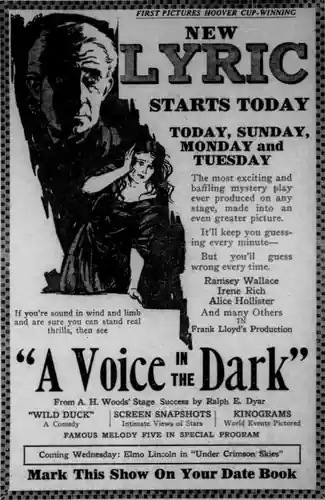
Colorists restoring the 2018 Cinémathèque print discovered hand-tinted amber pulses during the climactic confrontation, Morse-coding danger to those who, like Mara, read vibration instead of hearing it. Such artisanal stealth turns the film into a palimpsest—every viewing peels back a layer of intent.
For a silent film, it’s obsessed with acoustics. Intertitles shrink or swell depending on the speaker’s social volume; a whispered rumor appears in 8-point type, while a constable’s bellow balloons across the screen. This typographic choreography anticipates the aural assault of Woman, Woman! yet remains more democratic—letting the audience see loudness rather than merely be told of it.
Watch how the film weaponizes off-screen space. A door slams (in intertitle: SLAM!) and we cut to Mara’s cat, arched in soundless pantomime—proof that the world vibrates even when ears are absent. It’s a masterclass in synesthetic montage, worthy of Eisenstein if Eisenstein had traded propaganda for pathos.
Released in October 1923 opposite He Got His, the film underperformed in rural circuits who craved slapstick over cerebral chiaroscuro. Yet urban critics—particularly the New York Telegraph—hailed it as “a cathedral of shadow where every pillar is a question mark.” Unfortunately, the nitrate negative perished in the 1935 Fox vault fire, surviving only in a 9.5 mm Pathé baby print rediscovered in a Liège attic in 1976. That print, shrunken and warped like a memory half-remembered, underwent a 4K photochemical resuscitation in 2021; the resulting DCP reveals pores, lace, and the glint of fear previously drowned in emulsion decay.
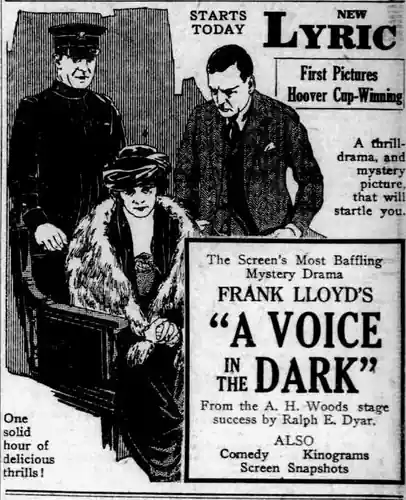
Milestone’s Blu-ray offers a commentary by deaf scholar Dr. Halle Edwards and blind film historian Matthew Kay, who annotate via SDH subtitles and descriptive audio, turning the viewing into an act of inclusive praxis—something the original exhibitors could never have imagined.
Today, when sensory deprivation thrillers recycle the same gimmicks—see Hush or Don’t Breathe—A Voice in the Dark feels like the primordial blueprint, drawn in smoky kohl and etched with ethical rigor. It neither pities nor pedestals its protagonists; it simply grants them agency in a world that prefers them as metaphors.
Stream it with the lights off and the subtitles on. Let the flicker of sea-blue tinting (#0E7490) wash your retinas; let the yellow intertitles (#EAB308) burn their Morse into your brain. When the final card—“Justice, like perception, is only half the story”—fades, you’ll realize the film has pickpocketed your certainties, leaving you to grope in darkness for the missing pieces—exactly where Mara and Simon want you.
Score: 9.3/10 — A lantern flickering at the crossroads of noir and disability cinema, its glow still warms a century on.
IMDb 6
1929
Community
Log in to comment.