DbcultAccessing Vault...
Cult Review
Senior Film Conservator
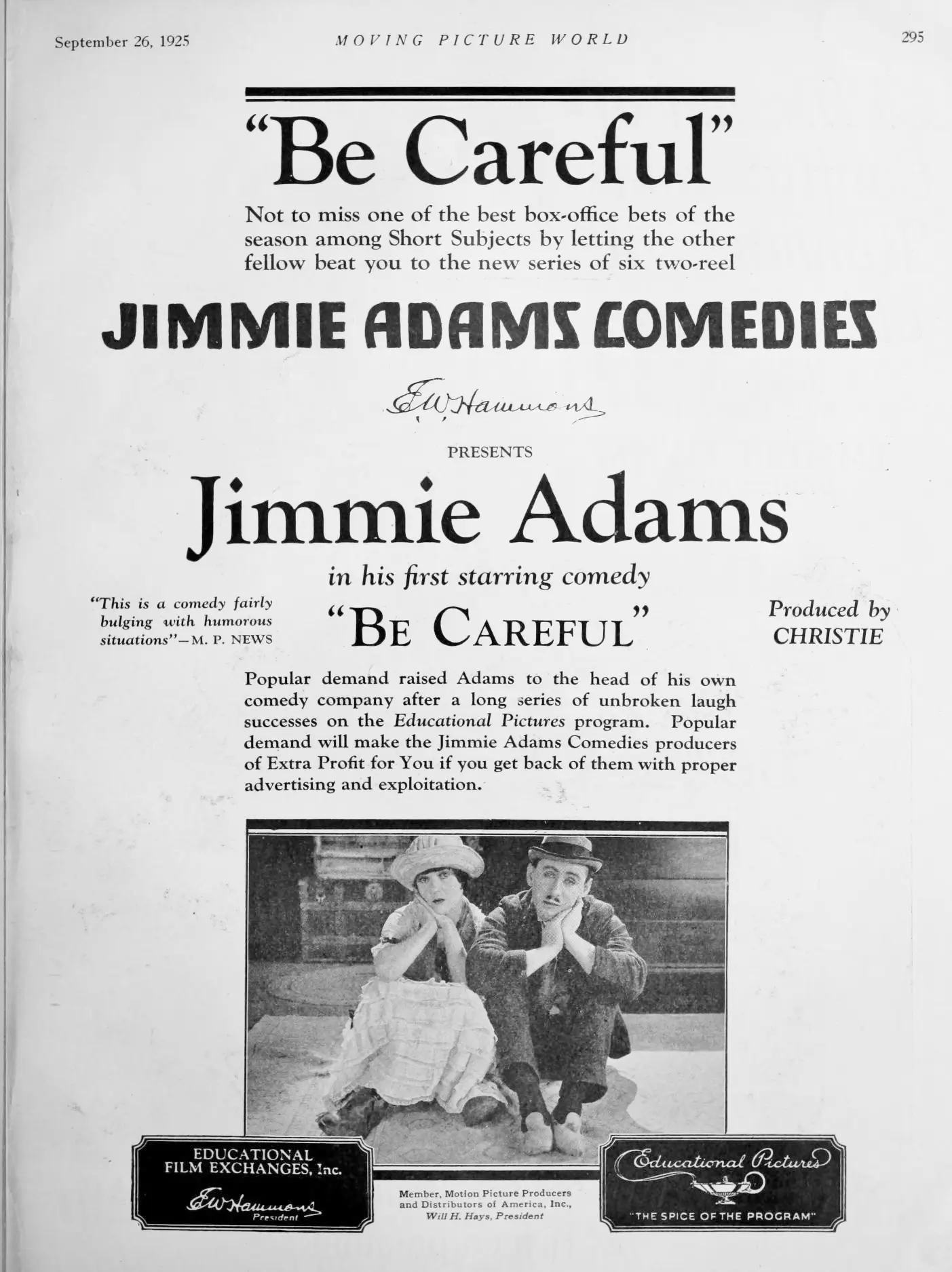
Is 'Be Careful' worth unearthing from the silent film archives today? For aficionados of early cinema and those fascinated by the foundational mechanics of slapstick, the answer is a qualified yes, though casual viewers accustomed to modern narrative pacing might find its charms more academic than entertaining. This film is best suited for those with an appreciation for historical context in comedy and the raw, physical performances of the silent era, but it is unequivocally not for audiences seeking sophisticated plotlines or contemporary comedic sensibilities.
Early in our critical journey, it’s imperative to establish a baseline for 'Be Careful'. This is a film that operates on a different wavelength than what modern audiences expect. It’s a relic, yes, but a fascinating one.
This film works because its protagonist's relentless physical comedy and the inventive set pieces showcase the burgeoning language of cinematic humor.
This film fails because the narrative often feels secondary to the gags, lacking deeper character development that might resonate beyond its immediate comedic impact.
You should watch it if you appreciate the foundational elements of screen comedy, have a keen interest in silent film history, and don't mind a lack of synchronized sound or complex emotional arcs.
'Be Careful' is, at its core, a testament to the sheer physical genius required for silent comedy. Jimmie Adams, embodying the titular 'good-natured guy' Jimmie, delivers a performance built on kinetic energy and an almost desperate commitment to his character's evolving objective. His transition from benevolent matchmaker to relentless marriage saboteur is less about emotional depth and more about the escalating inventiveness of his methods.
The film revels in a series of meticulously choreographed chase sequences and sight gags. One particularly memorable moment involves Jimmie attempting to disrupt the elopement through a series of absurd disguises and near-misses, culminating in a chaotic scramble across rooftops. This scene, while lacking the polished precision of later silent era greats like Buster Keaton, nonetheless demonstrates a nascent understanding of cinematic rhythm and comedic timing. It's rough around the edges, but the intent is clear.
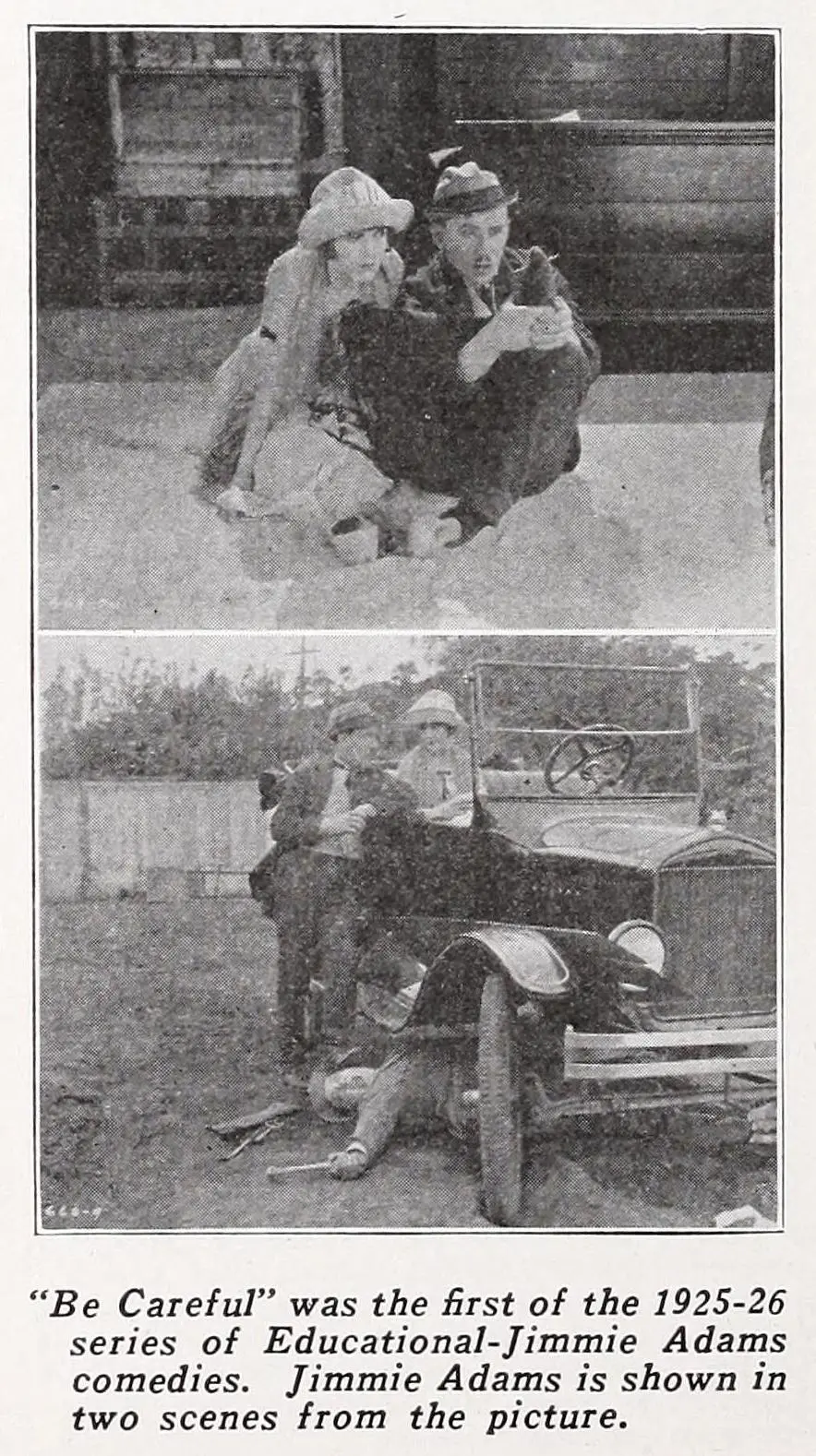
Director Sig Herzig, though not a household name today, orchestrates these moments with a straightforward effectiveness. There's a pragmatic approach to the filmmaking, focusing on clarity of action rather than visual poetry. The camera is largely static, serving as a window to the unfolding farce, allowing the performers to fill the frame with their exaggerated movements and expressions. This directness can feel primitive, yet it also possesses an undeniable charm, like watching a blueprint for future comedic masterpieces.
Jimmie Adams, as our central figure, carries the film on his shoulders. His performance is a whirlwind of frantic energy. He rarely pauses, constantly reacting, scheming, and executing. While the emotional range is limited—primarily to earnestness, frustration, and triumph—Adams’s physical commitment is unwavering. He embodies the spirit of the 'everyman' thrown into extraordinary circumstances, a common trope of the era, but executed here with a particular vigor. His expressions are broad, designed to be read from the back rows of a nickelodeon, and they largely succeed in conveying his agitated state.
Molly Malone, as the unsuspecting bride, provides the necessary emotional anchor, even if her character is largely a pawn in the male-driven plot. Her innocence is key to Jimmie's motivation, making his frantic efforts to save her from the thieving groom (played with suitable villainy by Eddie Baker) feel justified. The supporting cast, including Lincoln Plumer and William Irving, contribute to the comedic chaos, often as foils or unwitting participants in Jimmie's schemes.
The pacing of 'Be Careful' is typical for a short silent comedy of its time. It’s quick, almost breathless, moving from one gag to the next with little time for exposition or character introspection. This relentless forward momentum is both a strength and a weakness. It prevents boredom, keeping the audience engaged in the immediate action. However, it also means that any deeper thematic exploration or character development is sacrificed at the altar of pure comedic impact. It’s a sprint, not a marathon.
Compared to a film like The Vampires: The Poisoner, which revels in its slow-burn suspense, 'Be Careful' is a jolt of pure adrenaline. It doesn't aim for atmosphere or intricate plotting; its ambition is solely to elicit laughter through physical absurdity. This distinction is crucial for appreciating its place in cinematic history.
The cinematography in 'Be Careful' is functional rather than artistic. The shots are generally wide, allowing the full scope of the physical comedy to unfold without unnecessary cuts. There’s a noticeable lack of complex camera movements or innovative shot compositions, a common characteristic of films from this period. The focus is on capturing the action clearly, ensuring that every pratfall, every frantic dash, and every exaggerated expression is visible. This straightforward approach, while perhaps uninspired by today’s standards, was effective for its original audience.
Production design, similarly, serves the plot directly. Sets are practical, providing backdrops for the chases and hiding places for Jimmie’s antics. We see simple interior rooms, bustling street scenes, and the aforementioned rooftops. These locations are utilized for their utilitarian value in facilitating the gags, rather than for creating a rich, immersive world. For instance, a scene set in a cramped office provides ample opportunities for Jimmie to hide behind furniture and narrowly avoid detection, demonstrating a pragmatic use of space.
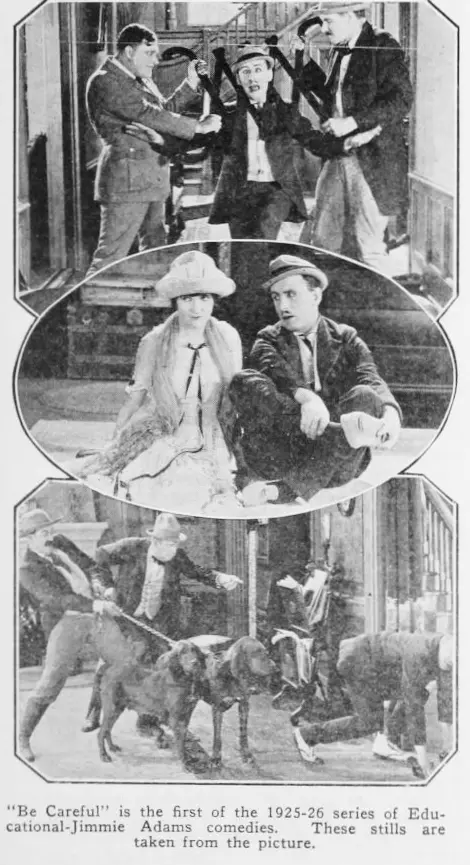
The film's aesthetic is raw, reflecting the nascent stage of the art form. There are no grand visual statements or symbolic imagery. It’s a document of early filmmaking, where the technology itself was still being explored and narratives were often simple vehicles for performance. One could compare its visual simplicity to other early works like A Poor Fish, which also prioritized clear, functional storytelling over elaborate visual flair.
The tone of 'Be Careful' is overwhelmingly lighthearted and farcical. Even with the underlying threat of a thief marrying an innocent woman, the film never veers into genuine suspense or drama. The stakes are presented purely for comedic effect, a catalyst for Jimmie’s increasingly desperate and amusing interventions. It’s a world where problems are solved not through emotional confrontation but through elaborate, often improbable, physical solutions.
Thematically, the film touches upon themes of mistaken identity and the triumph of good intentions, even if those intentions manifest as chaotic interference. Jimmie’s moral compass guides his actions, transforming him from a simple helper into a protector. It’s a peculiar experience to watch a film so dedicated to thwarting love, almost as if it's a proto-anti-rom-com, a genre decades ahead of its time. This unconventional premise is arguably one of its most surprising observations. Most films want the couple to get together; 'Be Careful' wants them apart.
There's also a subtle commentary on appearances versus reality, as the charming suitor is revealed to be a scoundrel. This isn't explored with any great depth, but it provides the necessary moral justification for Jimmie's relentless meddling. It works. But it’s flawed. The film doesn't linger on these ideas; it uses them as springboards for the next gag, maintaining its rapid-fire comedic rhythm throughout.
For those who appreciate the historical significance of silent cinema and the unadulterated physical comedy that defined its early years, 'Be Careful' offers genuine value. It’s a snapshot of a particular moment in cinematic evolution, showcasing the raw talent of performers like Jimmie Adams and the straightforward storytelling approach of its time. It’s an excellent example of how early filmmakers used ingenuity to overcome technical limitations and create entertainment.
However, if your film diet consists primarily of modern blockbusters or character-driven dramas, 'Be Careful' might feel like a quaint, albeit somewhat exhausting, curiosity. Its reliance on broad physical humor and simple narrative arcs may not translate well for all contemporary viewers. It asks for a certain level of patience and an understanding of its historical context. Don’t expect a sophisticated narrative or deep character work; expect a lot of running, jumping, and frantic expressions.
'Be Careful' is a fascinating artifact of early silent comedy, a testament to the raw energy and physical inventiveness that characterized the genre's formative years. Jimmie Adams’s performance is a whirlwind of comedic effort, and the film’s unique premise—a good Samaritan turning into an obstacle course for love—provides a genuinely interesting twist on classic tropes. It’s a film that demands a specific kind of viewership: one that cherishes the historical context of cinema and finds joy in the unadulterated, often chaotic, charm of silent slapstick.
While it won't be for everyone, particularly those unaccustomed to the rhythms of early 20th-century filmmaking, 'Be Careful' undeniably holds a place in the comedic lineage. It's not a forgotten masterpiece, but rather a robust example of foundational screen comedy, demonstrating how much could be conveyed without a single spoken word. For the right audience, it’s an entertaining glimpse into the past, a spirited romp that reminds us of comedy’s enduring power, even in its most primitive forms. Ultimately, it’s a spirited, if unrefined, gem that deserves to be seen by those eager to explore the roots of cinematic humor.
IMDb 6.4
1927
Community
Log in to comment.